Context study / TESSERA
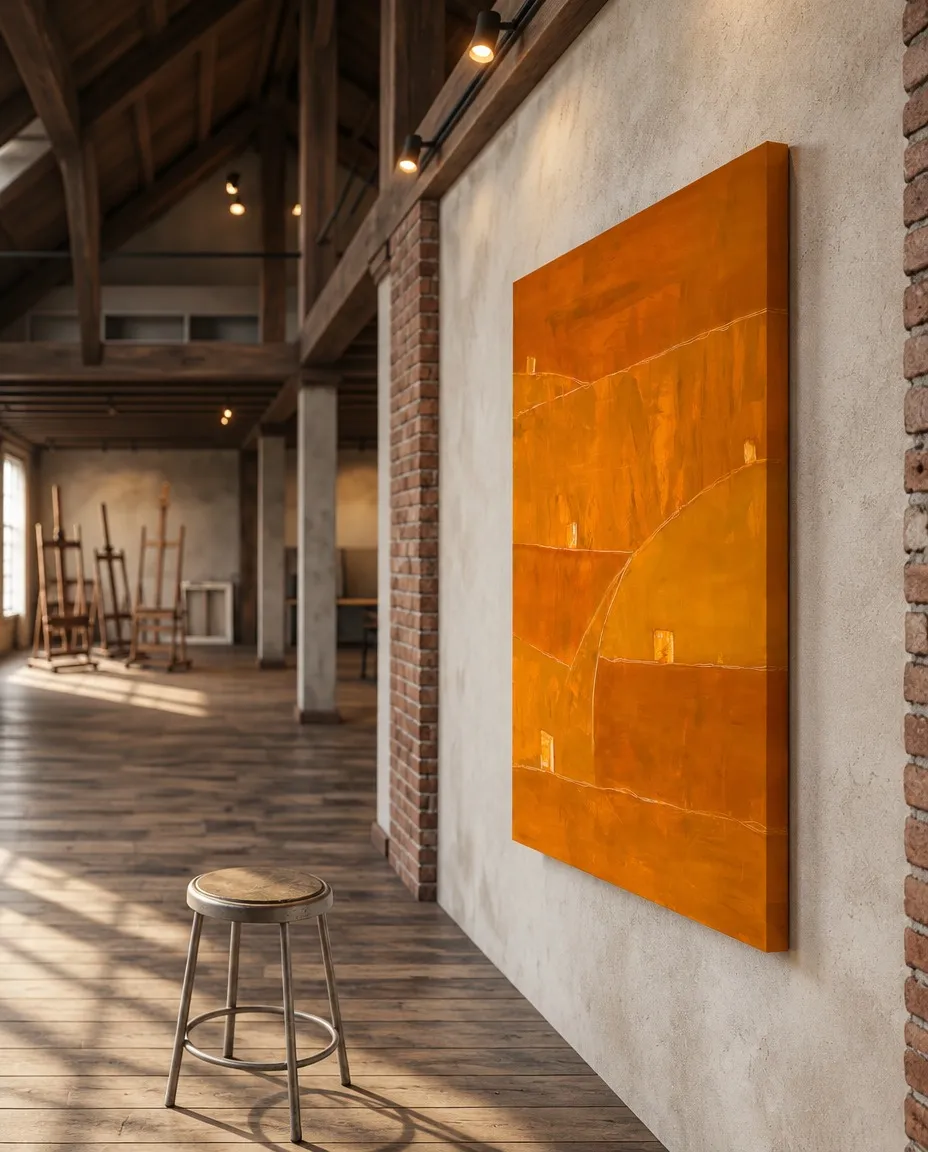
TESSERA Orange Abstract Painting - Maurizio Valch in Rustic Space
In a space where natural light glides over the rustic plaster of the walls and the wood of the suspended beams evokes the severity of an ancient refectory, TESSERA acts as a focus of silent gravitation, a threshold of color claiming the quietude of a secular chapel. The surface, dominated by a gradation of oranges and ochres that oscillate between glowing amber and the density of burnt earth, does not describe a theophany nor appeal to the heraldry of faith. There are no crosses, halos, or sacred geometries here; there is, in their place, a chromatic vibration that seems to emanate from the matter itself. By stripping the image of all recognizable iconography, the painting forces the viewer to lay down the analytical urge to decipher a dogma, opening up the possibility of experiencing that suspension of consciousness traditionally sought in temples.
When I spread these oranges and ochres on the canvas, I do not intend to build an altar or codify a spiritual revelation. I work with the matter until the color stops being a decorative layer and becomes a physical presence that alters the temperature of the space surrounding it. I am interested in that moment when mental noise—the theories about what I paint, the demands for recognition, or the urgency to justify my existence—meets the resistance of the oil and begins to dissolve. I know well that a brushstroke cannot save anyone, but by making these clear, fine incisions I seek to open an interval, a clean cut in the inertia of the day that allows us to pause. I do not paint to impress with a display of virtuosity; I paint to check if it is possible to stand before a surface and simply remain silent.
The mystery of the work does not lie in an assumed hidden dimension, but in the honesty of its visible accidents. The incisions crossing the pictorial field of TESSERA act as traces of a memory that is not added to the support, but rather compromises it, reminding us that time leaves marks that are impossible to erase. By dispensing with narrative, Valch shifts the numinous toward the material event: the relief, the glaze, the wear, and the collision of opposing forces. The small rectangular blocks floating in the orange immensity function like Saint-Exupéry's empty boxes or Arvo Pärt's silent intervals: shelters of the invisible that do not impose themselves on the observer, but preserve a space free from interpretation so that imagination and somatic attention can settle.
Sometimes I am asked about my journeys on foot, about the fatigue of walking for hours with apparently nothing happening in the external landscape. I think I paint in the same way I traveled those roads: without searching for a sanctuary at the end of the journey, simply attending to the gravity of the ground and to the inner movement whose direction I do not know. In TESSERA, the luminous rectangles are like those transient rooms where one stops to rest—minimal presences that do not seek to dominate the immensity of color, but to offer a boundary, a proximity that does not demand fusion. I do not need a doctrine to justify these blocks on the canvas; it is enough for me that they resist the pressure of the orange and remain there, like fragments of a recognition that requires no words to be real.
In the end, the placement of TESSERA on the rough plaster wall, flanked by the bare architecture of the studio and the respectful distance of the empty easels, solidifies its character as a contemplative portal. The canvas does not compete with the sobriety of the environment; it reveals it, turning the friction of light on the painting's textures into an experience of almost physical proximity. By renouncing the eloquence of words and the rigidity of inherited symbols, the painting demonstrates that true transcendence does not reside in escaping the visible world, but in the courage to sustain one's gaze before a surface that remembers. The work thus becomes a tactile shore, a seamless fabric where the observer and the observed unify in the absolute present of a tide of color.
- Original artwork
- TESSERA
- Actual dimensions
- 31.5 × 47.2 in / 80 × 120 cm
- Presentation
- Digital contextual visualization
Context references
orange abstract painting · minimalist ochre painting · rustic decor with art · original artwork maurizio valch · textured paintings living room · rustic contemporary art
About this visualization
This visualization places the artwork within an architectural context to help collectors and viewers imagine its presence in a real space. It is an interpretive reference, not an exact reproduction: the original work remains the sole authority for scale, color, surface and material presence.