Context study / TESSERA
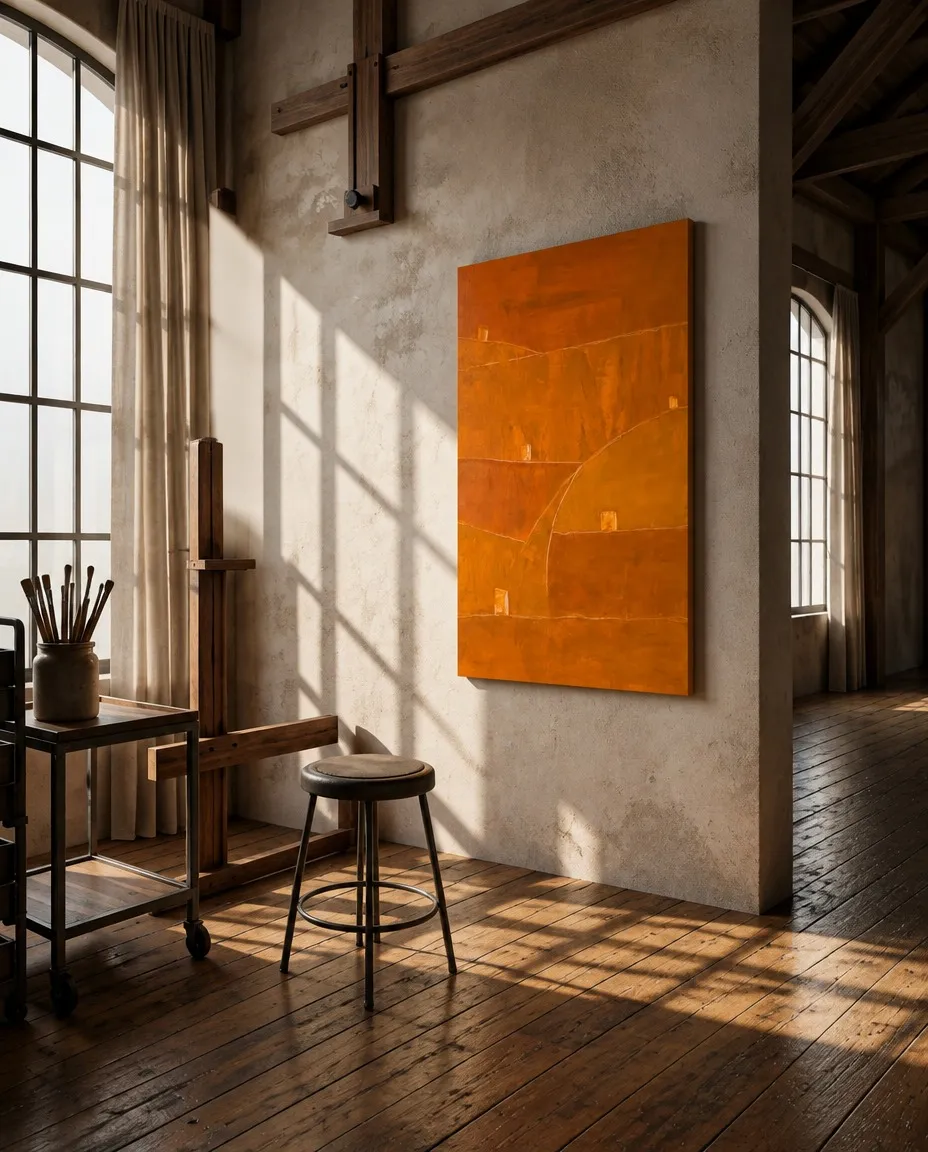
TESSERA Abstract Art by Maurizio Valch | Rustic Loft Decor
Stratum I: Deep Time
To contemplate "TESSERA" is to submit oneself to a geological radiation. Maurizio Valch's large orange canvas does not offer itself as a static surface; it vibrates with the temperature of a mild desert or a slowly cooling foundry. In this chromatic immensity, the fine sinuous lines that cross the surface do not act as mere decorative traces, but as tectonic faults, invisible sutures where matter has folded under immense pressure.
To understand this accumulation of strata, we must summon James Hutton, the Scottish geologist who conceived the concept of "deep time" and taught us to decipher the history of the Earth through sediments and rock fractures. Hutton would see in this work not an abstract representation, but a record of concentrated eons. For him, orange is not a color, but a chronology: the patient accumulation of sedimentary layers that have required an eternity to settle. The subtle lines that divide the large bands of the canvas reveal the wear, the erosion, and the slow drift of two color plates exerting silent pressure on each other.
When I face this orange, I do not simply see pigment on canvas, but a pulsing thermal wound. I felt the need to accumulate layers, to rub and superimpose color as if I were pushing sediments with my own hands so that the canvas would cease to be a two-dimensional plane and become a body with weight, a heat fossil breathing on the wall of this studio.
Stratum II: The Partition of Space
If we turn our gaze away from the geological vastness to concentrate on the minimal details, the canvas proposes a radical change of scale. Scattered across the surface, almost suspended in the drift of the orange, float small light squares: the tesserae. These discrete forms interrupt the continuity of the background and present a geometric enigma.
It is here that Srinivasa Ramanujan intervenes, the Indian genius of intuitive mathematics who asserted that every equation was a thought of the divine and who unraveled the secrets of numerical partitions. Before the painting, Ramanujan would ignore the vastness of the desert to focus on the distribution of these small forms. For him, the tesserae are not whims of the brush, but an unfolding visual equation, a partition theory where continuous space fragments into discrete units of light. Each square acts as a mathematical node, a support point that prevents the immensity of the background from collapsing onto itself, revealing an implicit order that does not need the rigidity of a grid to manifest its harmony.
I know that I was the one who placed those small luminous squares on the surface, but looking at them now I admit that their logic completely escapes me. I do not know if they are anchors holding the gravity of the orange or if they respond to an obscure order that my hand executed almost unconsciously; there is an insurmountable mystery in their distribution that I myself, as a painter, am unable to decipher.
Stratum III: The Zone of Uncertainty
At the frontier where Hutton's infinite time intersects with Ramanujan's discrete precision, the painting opens a crack of pure uncertainty. Here, the slowness of geological wear and the immediacy of the mathematical leap friction against each other, forcing us to look at the work not with the gravity of a scholar, but with the clean wonder of a child.
Are the yellow squares floating on the surface of the orange, or are they small windows allowing us to glimpse an eternal fire burning hidden behind the painting? How much does one of those fine lines actually weigh when it dares to divide two color worlds that are almost identical?
If we pressed our ear to the lower part of the canvas, where the pigment seems to become denser and darker, would we hear the distant echo of a wind-swept desert or the imperceptible hum of a mathematical vibration? And what would happen if, by the simple effect of gravity, the tesserae began to slide very slowly toward the lower edge of the frame, leaving the painting completely empty, surrendered to its own immensity?
Valch's painting refuses to give us an answer. It keeps us suspended in that clayey temperature, where order and chaos, the immense and the minuscule, meet in a balance that seems ready to break in the next second, yet remains intact forever.
- Original artwork
- TESSERA
- Actual dimensions
- 31.5 × 47.2 in / 80 × 120 cm
- Presentation
- Digital contextual visualization
Context references
modern rustic abstract painting · wall art for industrial loft · natural light orange painting · Maurizio Valch original work · art studio decor ideas
About this visualization
This visualization places the artwork within an architectural context to help collectors and viewers imagine its presence in a real space. It is an interpretive reference, not an exact reproduction: the original work remains the sole authority for scale, color, surface and material presence.