Context study / TESSERA
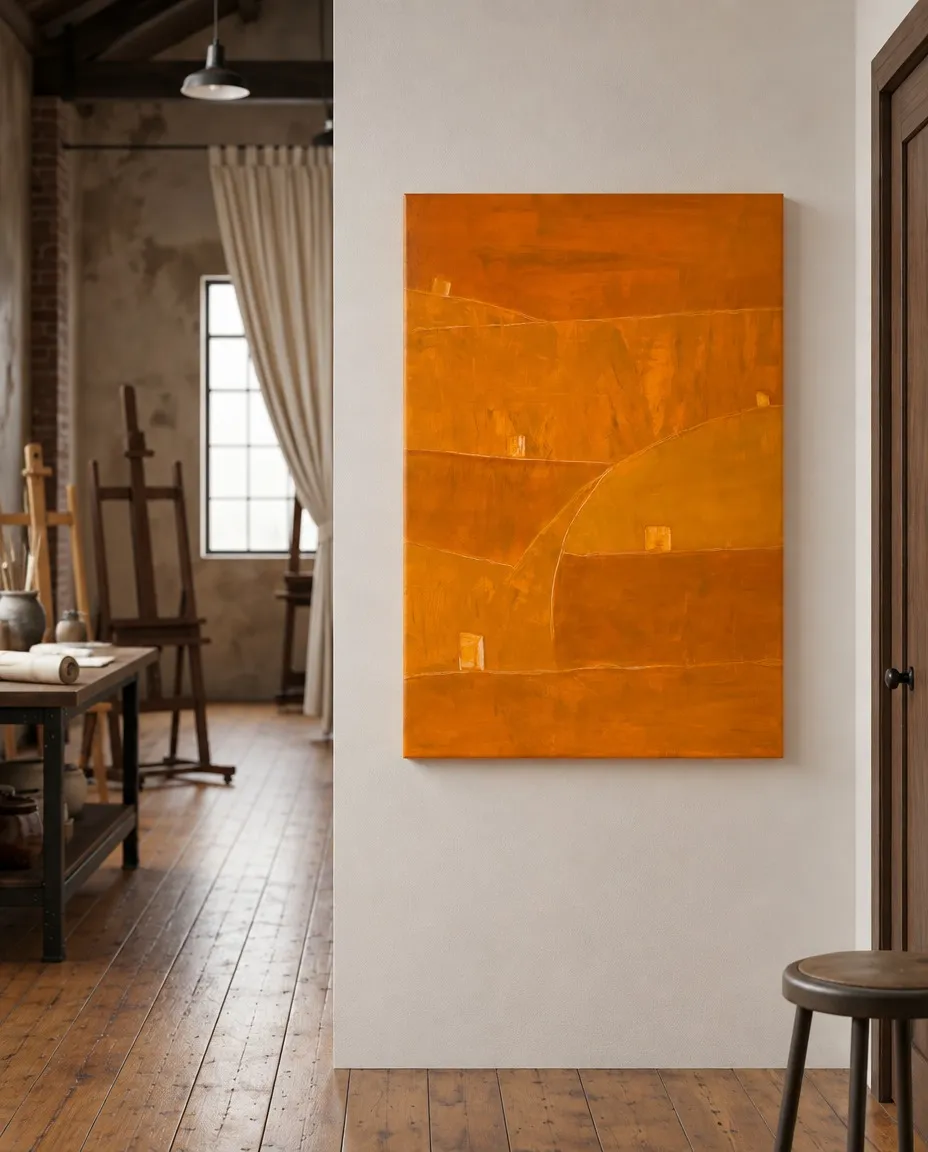
TESSERA Orange Painting by Maurizio Valch in Artist Studio
"TESSERA" imposes itself before the gaze like an immense crust of cooled fire, a vertical geography where orange, ochre, and sienna operate not as simple chromatic choices, but as sediments of an extreme and primordial temperature. The subtle tonal variations on the surface of the 80x120 cm canvas evoke geological strata that have resisted eras of pressure and wear; there is a tectonic quality in this warm vibration that immediately points to the idea of permanence. We do not find ourselves before an inert plain or a purely decorative void, but before the dense accumulation of time materialized in layers of pigment superimposed with a palette knife and brush. The scale of these color fields, distributed in horizontal bands that overlap like plates of the earth's crust, transmits a monumental stillness. It is a soil that has survived its own combustion, a block of visual memory that remains motionless before the erosion of the transitory, presenting itself to the viewer as a silent witness to the persistence of the physical world.
When facing the density of the still-wet paint, I feel a physical need to wound it, to reduce its volume to find its underlying truth. These fine, trembling white lines that cross the surface are not simple contours or compositional divisions; they are direct incisions, grooves that tear the matter to reveal its reverse, embodying a deep feeling of helplessness. The small square shapes—those tesserae or geometric niches that I have suspended almost precariously over the incised traces—are the representation of our own vulnerability. They seem to hang or wobble in the abyss of a territory too vast, desperately searching for a handhold, a minimal refuge against the scorching immensity of the canvas. For me, painting this picture has been an exercise in recording radical isolation: each small cube is a body that trembles, a solitary consciousness barely holding itself on the edge of an invisible and unstable border.
In the composition of "TESSERA", the relationship of forces between the color-saturated void and these meager geometric structures generates an almost physical gravitational tension. The dense layers of paint exert an oppressive visual weight on the fracture lines, threatening to bury the small blocks that inhabit the canvas. However, it is precisely in this state of apparent helplessness—where the geometries seem on the verge of sliding down the slope of the chromatic hills—where the transformation into wonder occurs. The viewer, adjusting their gaze, discovers that these isolated niches are not scattered at random; they function as milestones of a secret navigation, a coded human map written over the desert of pigment. Wonder arises from this revelation: the realization that, in the midst of a hostile and tectonic immensity, an attempt at order persists, a subtle testimony of habitability and shelter that challenges the inertia of the abyss.
The use of orange is not accidental; I seek a vibration that emanates from within the matter itself, a light that is not projected from the outside, but is released from the depth of the painting through subtraction. By scraping the oil, by wounding the paint through incision, I execute an act of material resistance that gives way to wonder. I do not destroy the surface, but open it up so it can breathe, revealing that the true permanence of things does not reside in the solidity of an impenetrable wall or the rigidity of an immutable structure, but in the capacity to sustain a crack. The painting is that open wound which, far from weakening, becomes a luminous threshold, a channel through which the original helplessness is transmuted into a quiet and persistent revelation of light springing from the scraped pigment itself.
Ultimately, "TESSERA" shapes itself as a cartography of consciousness where the boundaries between the geological and the intimate dissolve completely. Maurizio Valch manages to collapse the viewer's physical distance: the immensity of the canvas becomes as close, as tactile, as our own skin exposed to the elements. By unifying the persistent permanence of matter with the tremulous helplessness of its lines and the unexpected wonder of its inner light, the work stands as a sacred and silent territory. It is a space that does not demand to be deciphered through the intellect, but offers itself to be felt in its gravity and texture, reminding us that the most lasting refuge is often found at the very heart of our own fragility.
- Original artwork
- TESSERA
- Actual dimensions
- 31.5 × 47.2 in / 80 × 120 cm
- Presentation
- Digital contextual visualization
Context references
modern orange painting for living room · minimalist painting decor · Maurizio Valch original · large scale abstract art · textured orange artwork
About this visualization
This visualization places the artwork within an architectural context to help collectors and viewers imagine its presence in a real space. It is an interpretive reference, not an exact reproduction: the original work remains the sole authority for scale, color, surface and material presence.