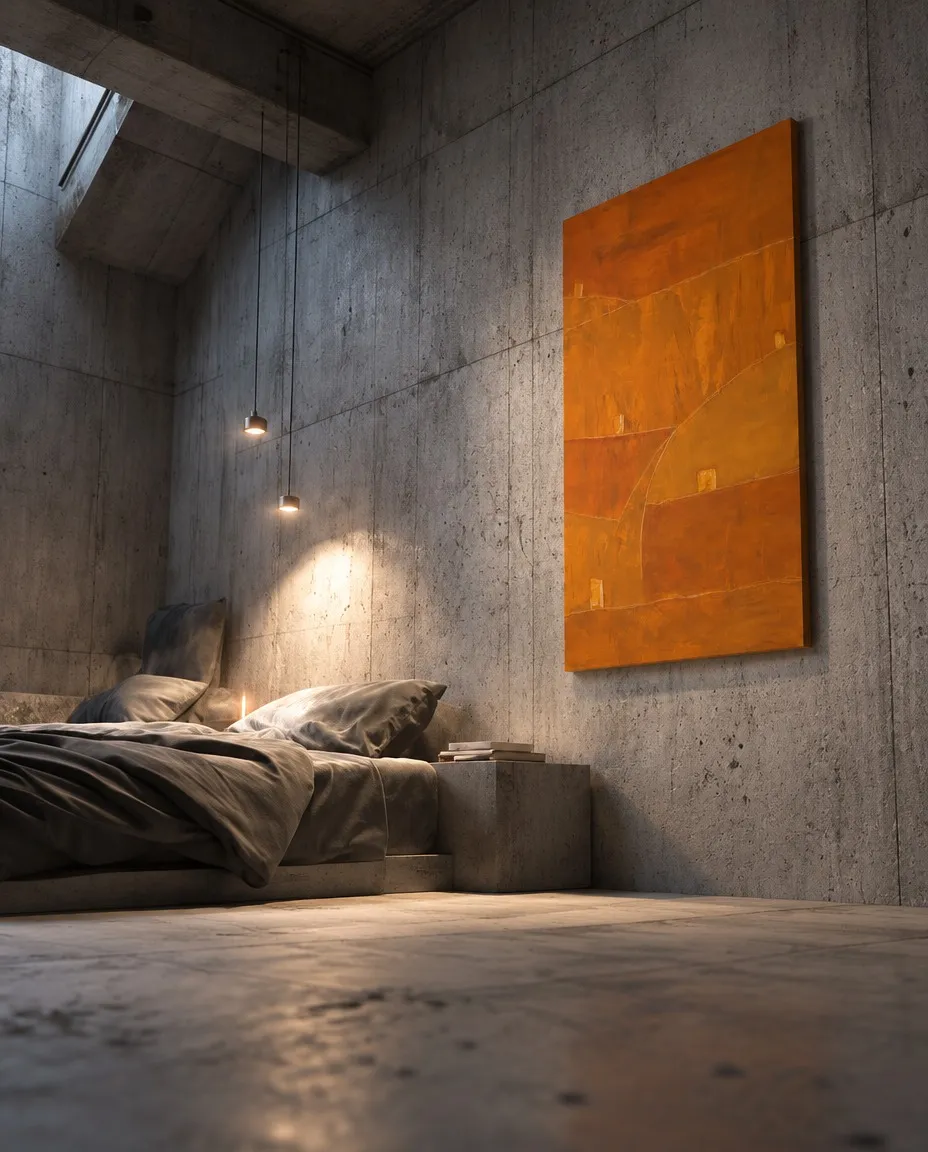
Context study / TESSERA
TESSERA Ochre Abstract Painting by Maurizio Valch | Designer Room
First Stratum: The Low Plain
At the lower edge of the canvas, where the pictorial matter seems to settle with the weight of terrestrial gravity, the ochre manifests as dense, laden with an ancient dust that claims its belonging to the ground. Here pauses Miguel de Cervantes, a spirit marked by his obsession with the wanderer, the blurred boundaries of reality, and those dusty plains where delirium and lucidity merge under the same implacable sun. For him, this lower band is not abstraction, but a transfiguration of the dry fields of La Mancha, a territory where the earth has been stripped of its green to reveal its skeleton of clay. The author contemplates the small square shapes that timidly emerge from the sandy background; he does not see them as mere geometric exercises, but as possible wayside inns, castles imagined by a feverish mind, or perhaps the narrow prisons of thought where the human soul attempts to shelter itself from the immensity of the horizon. The viewer's eyes, attempting to decipher the plain, drag slowly, feeling the friction of a brushstroke that offers resistance, as if the canvas itself were made of compacted earth.
Second Stratum: The Mid-Slope
Ascending along the first sinuous line that tears through the ochre, the rhythm of the gaze changes. The horizontality breaks, and the slope forces us into a slower, almost reverent ascent. At this point of the climb, we encounter Facundo Cabral, a wanderer, singer, and mystic of detachment who made the errant path his only homeland and silent observation his greatest prayer. Cabral does not seek to analyze the layers of pigment or decipher the composition; he prefers to sharpen his hearing before the canvas. He suggests, in a whisper, that this painting does not represent a physical landscape, but a silent score where the dividing lines are curved staves and the floating tesserae are isolated notes, detached from the noise of the world. The air here feels milder, less dusty, charged with a stillness that invites one to halt the march and contemplate space not as a goal, but as a transition. The eye, however, experiences a strange fatigue: the white lines are so subtle that they fade when attempting to fix the gaze upon them, forcing the pupils to constantly lose and find themselves again in the vibration of color.
When I spread this ochre, this orange that seems to burn without a flame, I was not looking for the warmth of a shelter, but for a dense matter that would devour forms, erasing them with its own weight. I remember that, as I traced those dividing lines segmenting the canvas, a purely physical doubt assailed me: I feared that the color was too thick, a tide of dry dust that would end up suffocating the space before the lines could open a path for it. I wanted the boundary to be not a border, but a subtle tear in the chromatic mass.
Third Stratum: The Hanging Tesserae
Upon reaching the upper-middle area of the painting, the space becomes an anomaly that defies the logic of landscape. Here float the tesserae, small cubes of pale light suspended from extremely fine whitish filaments. Confronting them, the two travelers face their visions. Cervantes distrusts the scene; he suspects it is a beautiful stage trick, a hanging fiction designed to deceive the gaze of the tired wanderer searching for a reference point in the immensity of the ochre. Cabral, on the other hand, smiles at the fragility of these suspended squares, finding in them the humble beauty of that which exists without claiming possession—empty boxes of light that hold neither treasures nor secrets, but simply the pure space of emptiness. There is no warmth of home in these structures, nor promises of refuge; they are visual detours, poetic accidents in the middle of nothingness. It is here that the simplest and most disturbing doubt arises, a question a child would ask without hesitation: what actually holds those white threads if the background of the painting is only orange-colored air? Why does the chromatic mass not drag them down in its fall toward the edge of the painting?
Fourth Stratum: The Abstract Summit
In the upper band, the painting detaches itself from any formal allusion. The ochre saturates, becoming thicker and more mysterious, like a sandstorm sky that has decided to freeze over our heads. The reading speed is reduced to a minimum; the gaze halts before a mass of color that no longer suggests paths or clear divisions, but a monolithic presence. The emotional temperature cools; the orange, stripped of its association with fire, becomes a mineral matter, heavy and silent, which seems to absorb the light of the concrete room where the canvas hangs.
Now that I look at the finished work, already detached from my hands, I discover something that escaped me during the struggle with the pigment. Those fine white lines, which I conceived as mere separation strokes, actually seem like invisible tensioners holding the entire mass of the painting so that it does not collapse off the canvas. It is a strange contradiction: what I believed to be weightless is what sustains the weight, and the density of the ochre seems to float thanks to the fragility of a thread of light that barely supports itself.
In the end, the gaze returns to the physical space of the room, but the suspicion remains adhered to the concrete wall: is it the painting that hangs from a nail on the wall, or is it the room itself that floats, suspended from the invisible white lines that traverse Maurizio Valch's canvas?
- Original artwork
- TESSERA
- Actual dimensions
- 31.5 × 47.2 in / 80 × 120 cm
- Presentation
- Digital contextual visualization
Context references
abstract painting for modern bedroom · designer ochre and orange painting · concrete minimalist art · Maurizio Valch TESSERA · brutalist interior decor
About this visualization
This visualization places the artwork within an architectural context to help collectors and viewers imagine its presence in a real space. It is an interpretive reference, not an exact reproduction: the original work remains the sole authority for scale, color, surface and material presence.