Context study / TESSERA
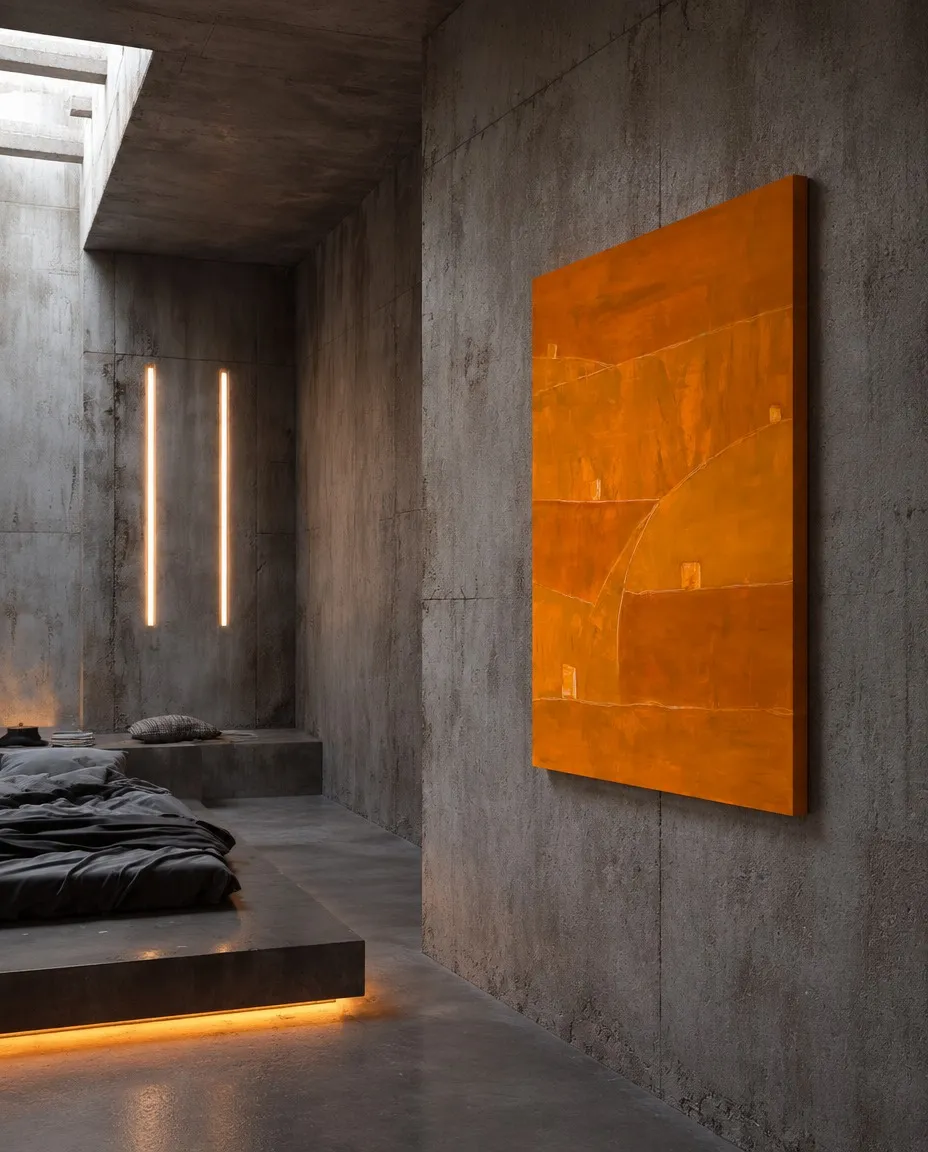
Orange Abstract Painting TESSERA by Maurizio Valch in Brutalist Space
The orange of TESSERA does not illuminate this concrete chamber: it forces it to admit that it can also contain warmth. Against the rough walls, the vertical lines of light, and the compact gloom, the canvas does not act as an escape window, but as a presence that alters the emotional temperature of the space. Its variations of amber, ochre, and burnt earth do not soften the architectural hardness; they make it more perceptible. The surface seems to keep a reserve of intensity within a space built to resist. In this opposition, protection ceases to look like a comfortable refuge. It takes on the more ambiguous form of matter capable of holding light while still showing its wounds.
I do not need a mark to secure a definitive border. I am more interested when it barely manages to sustain itself: when it crosses the color, deviates, loses continuity, and yet still modifies the entire expanse. An incised mark may be small against such an expansive orange field, but it is not thereby insignificant. It is enough that it introduces a difference so that the surface can no longer be read as an intact unity. I work close to this uncertainty: not that of being protected from all contact, but of testing whether something can receive pressure, proximity, deviation, without immediately turning into ruin.
The small light rectangles intensify this test. Suspended in different areas of the canvas, they do not form a regular constellation or establish a recognizable architecture. They seem like pieces that have arrived from another order and have not yet decided whether to integrate or resist. The title invokes the memory of the tessera: a fragment of a whole, a token of recognition, a part that only acquires meaning in front of another part. Yet, the painting does not offer the other fragment or an already resolved community. What it presents is a difficult coexistence between proximity and separation. Each block remains within the field but retains its own light; it belongs without dissolving. Belonging, the work suggests, is perhaps not the relief of completely coinciding, but the possibility of not being expelled for preserving an edge.
While painting, I distrust the idea that a surface must obey me because I constructed it. The color proposes its own limits: one area becomes more opaque than I expected, another lets through a light that should not be covered, and so I have to pay attention before deciding. The rectangles appear this way too, not as emblems that come to explain the painting, but as presences that demand distance. I could enclose them, give them a function, turn them into secure signs. But I prefer that they remain exposed. Trust does not consist in having found an immune form; it consists in letting something vulnerable occupy space without forcing it to defend itself all the time.
In this presentation, the painting is set slightly apart from the body inhabiting the space: it does not dominate the room from a ceremonial center, but neither is it reduced to mere accompaniment. Its verticality causes the incisions to be perceived less as a drawing and more as a fine network of paths on a glowing wall. The concrete architecture, with its joints, stains, and cracks, introduces a silent reply: it too is made of surfaces that have had to bear weight, time, and contact. But TESSERA does not blend into this environment. Where the concrete retains the gravity of the built, the orange retains the instability of what can still change. Between the two remains an unresolved question: what kind of shelter can be offered by a form that does not close itself off, a belonging that does not demand fusion, and a light which, precisely because it promises no salvation, remains.
- Original artwork
- TESSERA
- Actual dimensions
- 31.5 × 47.2 in / 80 × 120 cm
- Presentation
- Digital contextual visualization
Context references
Large orange abstract painting · Brutalist contemporary art · Minimalist concrete living room decor · Minimalist abstract painting · Maurizio Valch STRATA
About this visualization
This visualization places the artwork within an architectural context to help collectors and viewers imagine its presence in a real space. It is an interpretive reference, not an exact reproduction: the original work remains the sole authority for scale, color, surface and material presence.