Context study / TESSERA
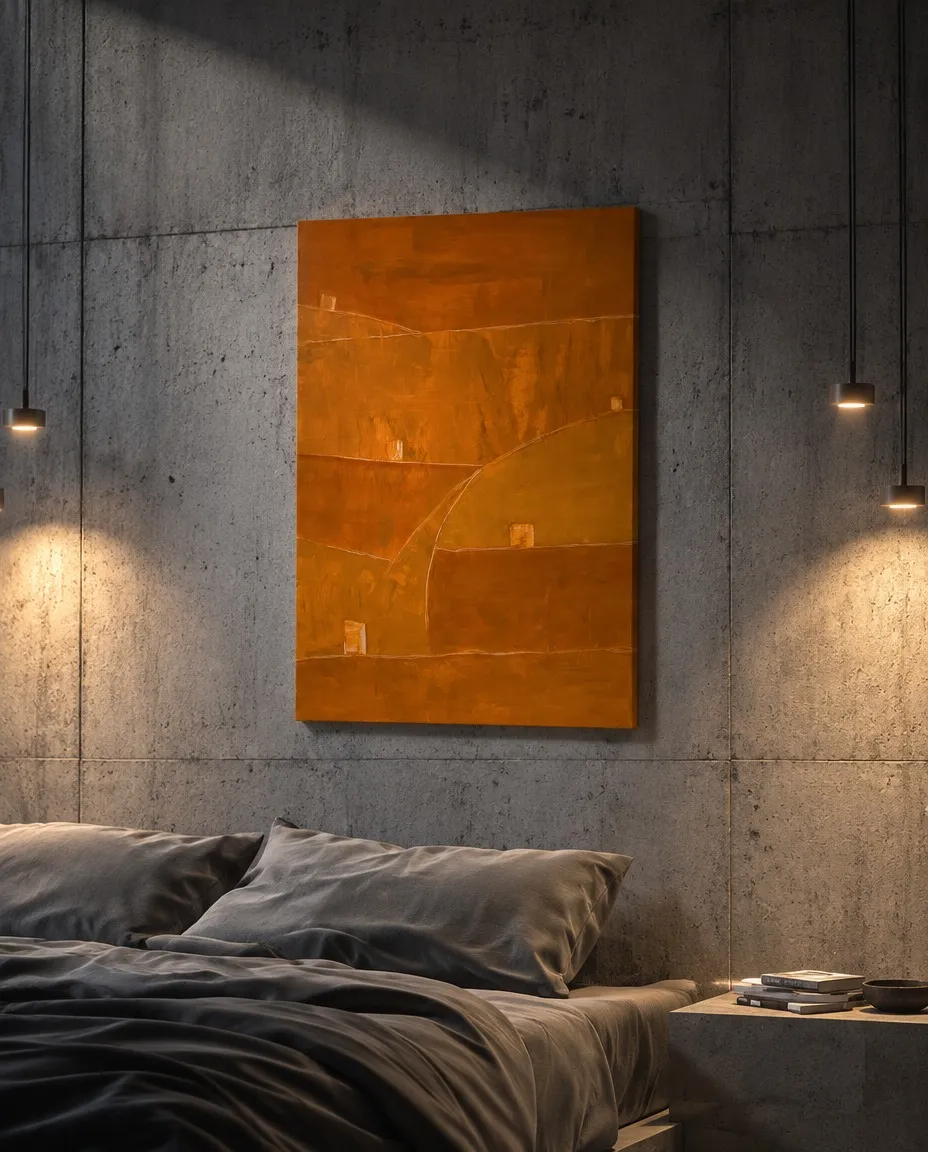
TESSERA Painting by Maurizio Valch on Bedroom Concrete Wall
TESSERA presents itself first as a vertical field of contained heat: oranges, ochres, and ambers are deposited in glazes, build-ups, and areas of varying opacity, so that the surface does not offer a uniform expanse, but rather a material that seems to have retained unequal times. There are smoother areas that receive light with dry calm, and others where the color becomes denser, more eroded, as if something had insisted upon it without quite erasing it. The light, fine, and partially incised lines do not impose themselves from above; they give the impression of having been found within the painting, freed from its layers. They cross the field, deviate, bifurcate, or approach one another without grounding themselves in a definitive structure. Among them, small luminous squares remain isolated, suspended at different heights, without explaining themselves as complete signs. The title opens up the possibility of a piece, a token, a minimal unit, a counter that credits an still-uncertain belonging. And then the improbable archaeological question begins to make itself visible: what kind of community would imagine these paths before raising a dominant form, before deciding that the territory must obey a center?
I do not work with orange as a feeling to which a precise word must correspond. I need it as a condition: light retained on a surface, ground that changes with distance, matter that is never entirely opaque nor transparent. In this color, I can let the paint accumulate, recede, grow rougher or more silent without fully abandoning its temperature. At the beginning, lines may appear to separate, to contain an area, to test a limit between one layer and another; but as I move forward, they stop obeying me as boundaries. They begin to act as directions I do not fully know, as interruptions that cut through what I believed was already resolved. I do not understand them as paths that necessarily lead somewhere. I incise them, leave them barely visible, cover or retrieve them because I need the surface to retain a tension between what is fixed and what can still deviate. When a small square is lit up in the middle of that field, I do not intend for it to name a thing: I am interested in how it alters distance, forcing the surrounding color to reorganize itself.
The friction of the work arises where a repeated mark might become a habit. One line extends because it seems logical to continue it; another approaches it because the eye seeks a relationship; a bifurcation, however, introduces a hesitation that interrupts this logic. Are these incised lines pathways that free a possibility of passage, boundaries that order the gaze, or gestures that begin to automate themselves simply by insisting? The painting does not answer, because each repetition alters the ground that seemed known. The small squares intensify this doubt: they could be pauses, minimal presences, temporary shelters, or units that refuse to be absorbed by the continuity of the lines. Their isolation is not a vacuum of content; it is a resistance to integrating too quickly. Where the eye would like to establish a rule, the surface returns a difference in density, a shift in luster, an incised line that weakens before completing its direction. The possible civilization of TESSERA is not founded on a recognizable construction, but on the uncertainty of deciding where a gesture is repeated and where it is broken.
I do not believe that every line has to lead somewhere. Sometimes the incision only preserves the physical passage of pressure on the surface; it traverses strata, changes in intensity, becomes almost imperceptible, and offers no exit. Nor do I need each isolated form to fulfill a function. A luminous square can remain there because the void surrounding it makes it necessary, not because it must represent something. I am interested in the painting resisting an overly tidy reading, in it not surrendering itself as a system of equivalences where every mark immediately finds its explanation. When I work with layers, I do not think I am building a territory to dominate it; rather, I perceive that the accumulations, cuts, and reserved areas force me to accept decisions I had not foreseen. Perhaps the territory does not wait to be organized. Perhaps it is already organizing us through its resistances, its differences in matter, the distance that opens between one incision and another.
Toward the middle of the field, a light line deviates and seems to brush against another without deciding to join it; lower down, a small square hangs suspended in a more glazed orange area, while around it the matter becomes more heavily worked and darker. This proximity without connection concentrates the painting: nothing is completely fixed, yet nothing is entirely scattered. One can imagine, without stating it as a certainty, that the first human marks on stone arose not only to possess or represent something, but to essay a relationship with distance, to verify that a border, a cleft, or a sign could modify the experience of being in a place. In TESSERA, this test remains open in the difference between the smooth and the accumulated, between the hinted direction and the form that resists following it. We are left before a surface where orientation and wandering remain inseparable.
- Original artwork
- TESSERA
- Actual dimensions
- 31.5 × 47.2 in / 80 × 120 cm
- Presentation
- Digital contextual visualization
Context references
Painting for above the bed · Industrial bedroom decor · Abstract art on concrete wall · Brutalist interior design with art · Modern bedrooms with abstract paintings
About this visualization
This visualization places the artwork within an architectural context to help collectors and viewers imagine its presence in a real space. It is an interpretive reference, not an exact reproduction: the original work remains the sole authority for scale, color, surface and material presence.