Context study / TESSERA
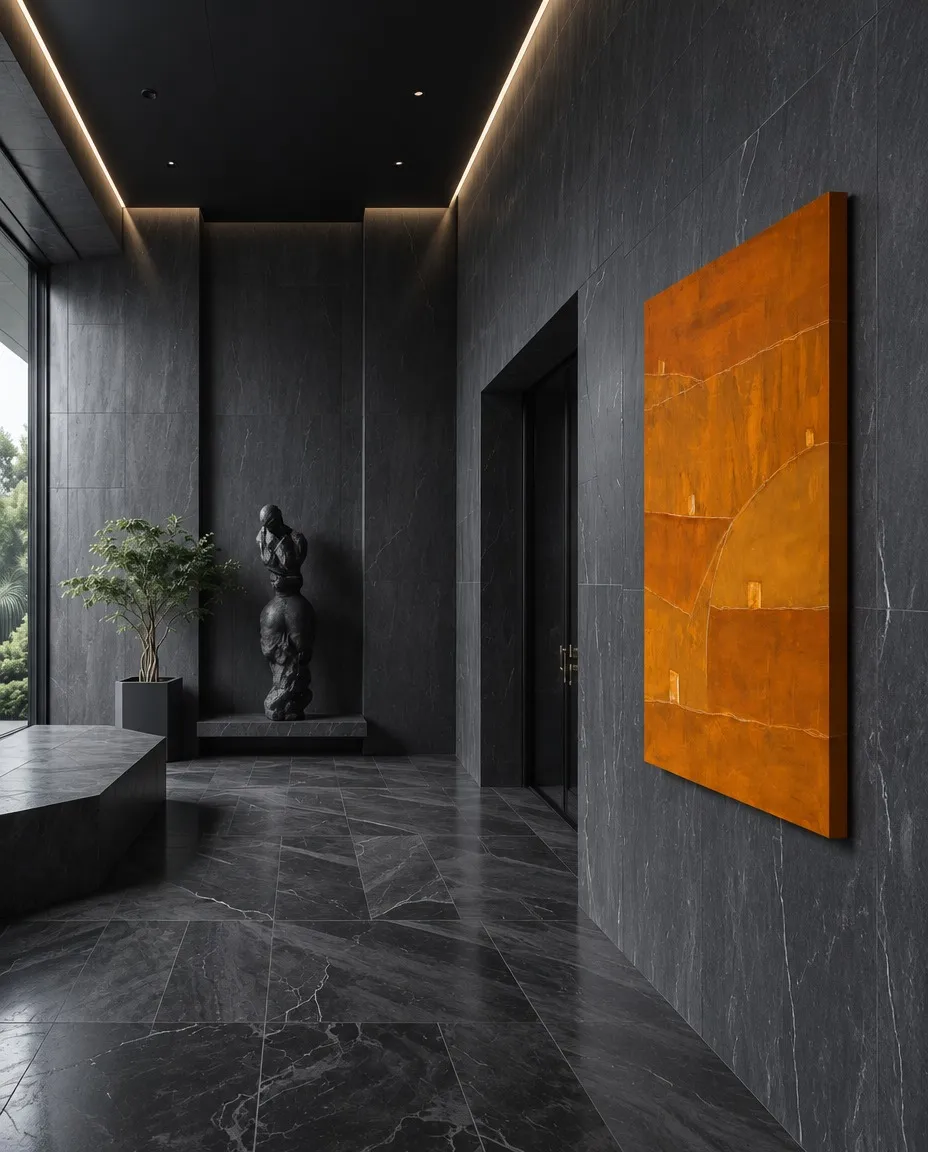
Orange Abstract Painting TESSERA in Dark Marble Hallway
Against the black marble and the rigorous twilight of this hallway, TESSERA does not seem to seek refuge: it erupts. The orange, intensified by the dark architecture, acquires an almost physical, bodily quality—warm but not gentle, akin to matter that retains heat after being subjected to pressure. The work does not tell a story; there is no recognizable figure, landscape, or scene to reconstruct a biography. Yet, its surface feels lived-in. The glazes, irregular thicknesses, and areas of deeper ochre prevent the color from functioning as a mere coating, presenting it instead as an accumulation: something has settled, something has been covered, something persists beneath without demanding to be fully revealed.
I cannot say that these lines are paths, though they sometimes appear with the obstinacy of a journey while I work. Nor do I know if the small rectangles are shelters. It would be too easy to call protection that which remains untouched. I am more interested in the possibility of something remaining visible without being entirely exposed: a minimal presence within an expanse that could absorb it. To incise the orange is to accept that continuity is not pure, that a surface can contain cuts, deviations, and zones that do not obey the general unity. The mark does not need to become a wound to have weight; it is enough that it alters the way the field breathes.
The presentation makes a decisive paradox visible. The painting hangs in a dark stone corridor of severe lines, stable planes, and dense shadows; against this, the light incised lines of TESSERA seem to refuse the discipline of the wall. They do not establish a grid or organize the space with architectural precision. They advance, interrupt themselves, and barely shift direction. In that difference, the painting ceases to be simply a chromatic focus within a sophisticated interior: it becomes a surface that maintains a quiet resistance to the order surrounding it. Its orange does not illuminate the hallway as an ornament; it disquiets it, introducing a temperature that never fully submits to the mineral sobriety of the environment.
The luminous blocks scattered across the canvas could be read as units of a larger construction, but they refuse to become docile pieces. The title refers to the tessera: a fragment, a token of recognition, a part whose identity also depends on a relationship with other parts. Valch does not use this ancient idea to promise a recoverable whole. The rectangles do not fit together or form a recognizable mosaic; they maintain distances, interruptions, and uneven positions. Autobiography thus appears without a narrative: not as a list of places, losses, or decisions, but as the persistence of a physical question about how to belong without disappearing within that to which one belongs. The painting holds this question in its proportions: each small presence matters because the immense field fails to render it indifferent.
Sometimes I think that belonging does not consist in finding a shape that completes us. Perhaps it is being able to remain alongside what we do not fully understand, without immediately turning it into a threat or a possession. In TESSERA, trust does not look like a certainty: it is a fine line that traverses the matter and continues, even when it seems lost; it is a small block that does not dominate the surface, but refuses to be erased by it. The orange contains these differences without resolving them. And perhaps that is the closest thing to a life that painting can say without narrating it: not the events that explain it, but the marks, proximities, and separations that are still looking for their place.
- Original artwork
- TESSERA
- Actual dimensions
- 31.5 × 47.2 in / 80 × 120 cm
- Presentation
- Digital contextual visualization
Context references
Decorating hallway with abstract art · Orange painting on dark wall · Black minimalist interior design · Contemporary foyer art · Large painting decor ideas
About this visualization
This visualization places the artwork within an architectural context to help collectors and viewers imagine its presence in a real space. It is an interpretive reference, not an exact reproduction: the original work remains the sole authority for scale, color, surface and material presence.