Context study / TENSUM
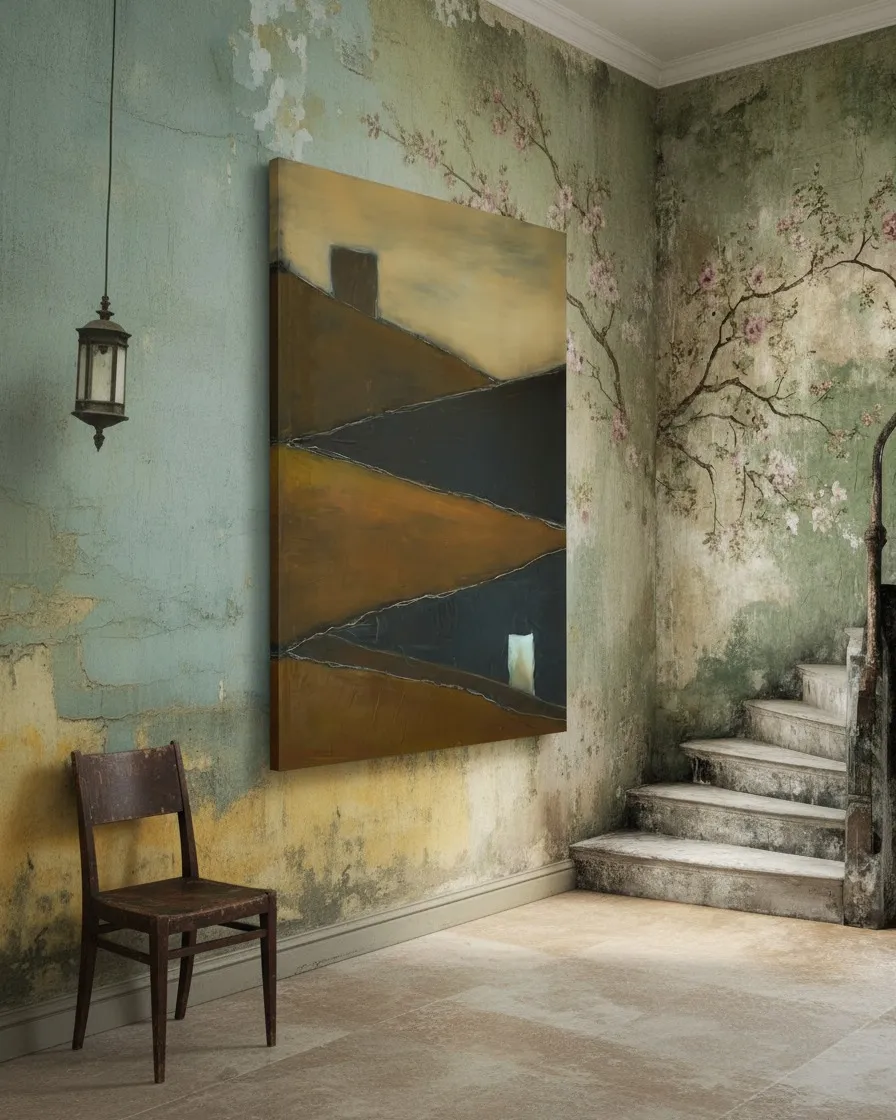
TENSUM by Maurizio Valch in Rustic Interior - Abstract Painting
The eye takes time to find a place to rest. It slips across an ochre surface that is not quite smooth, falls toward a dark band, tries to halt on its pale edge, and slides once more. Above, the air feels wider, diluted in a yellowish clarity that offers no reassurance; below, by contrast, the planes compress, closing in, pressing against one another like layers too heavy for the space they occupy. The earthy tones weigh down slowly, sedimentarily. The blacks weigh in another way: they do not seem denser, but closer, as if advancing. Nothing remains horizontal long enough to become rest.
A child might ask: why doesn't that little pale thing at the bottom fall into the black? The question is disarming because the small pale rectangle does not seem to have arrived with the rest. It stands there, vertical, almost intact, arrested in a zone that tilts and sinks. Higher up, another rectangle, dark, also remains upright, but its darkness makes it difficult to separate from what surrounds it. One absorbs; the other insists. Between them, the bands tense as if they had to sustain not an image, but the possibility of those two presences remaining standing.
Louis Kahn was an architect who thought of buildings as intense agreements between weight, light, silence, and what a space asks to become. Faced with these bands, his question would perhaps not be what they represent, but which of them carries the silence of the others. The central band, dark and oblique, seems to serve as a support; but it also seems to be served by the surrounding ochre surfaces, as if they all needed to push it so that it does not break away. If these expanses ceased to be paint, they would not build a stable room: they would raise an enclosure without a fixed floor, a room where the walls had forgotten which of them was meant to remain vertical. Kahn would seek a light that revealed mass. Here, light does not manage to reveal anything: it escapes through the edges, remaining trapped in the fine wounds that separate one plane from another.
I did not feel that the bands obeyed when they began to tilt toward each other. At first, I wanted to follow them with my gaze as if they could lead me to a stillness, but each seemed to demand a different weight. The darkness did not come to cover: it pressed. The clarity did not open: it receded. Then I understood that the direction was no longer mine, that the image was organizing itself with a tension that left me outside, watching how something found its balance without wanting to be balanced.
After that pressure, the gaze accelerates. It no longer knows if it is observing a wall from too high up, a floor that has come too close, a city deprived of buildings, or the inside of an eyelid that remembers having seen architecture. Tilt your head slightly to the left and follow a single band without tracing its ends. Then something uncomfortable appears: the band neither ascends nor descends; it shifts laterally beneath the gaze. Its tilt does not belong entirely to the painting; it settles in the neck, in the shoulders, in the small adjustment the body makes to avoid feeling crooked.
Kazimir Malevich was an artist who pushed geometry to the limit where a form stops describing the world and begins to invent another kind of reality. He might ask that the two rectangles abandon all tasks: that they be neither entrance, sign, object, nor late figure, but simple events of pure weight. The small pale one could be just a white interruption; the dark one, a reservoir of density. But this painting does not let them float. There is a worn gravity in them, an almost domestic closeness, something that recalls the dust accumulated at the edge of a surface, the shadow left beneath a piece of furniture, the stain that persists when something is removed from a room. Geometry wants to emancipate itself; the bands drag it back to friction, to visual mud, to an intimacy that admits no purity.
Between the mass Kahn would want to make habitable and the form Malevich would want to liberate, the pale edges begin to demand attention. They are thin, almost filamentous, yet they divide the painting with a stubbornness greater than the large dark zones. Are they seams? If they were, the bands would not be blocks, but pieces stitched together under tension. Are they reflections? Then they would not come from a source, but from friction: light born right where two weights fail to touch. Are they cracks? That possibility transforms the previous ones, because a crack does not join or illuminate: it announces a separation that has already occurred. Or perhaps they are simply the place where the eye defends itself from getting lost, the minimal line it invents so as not to fall entirely into the dark.
I can step away from the painting and still feel that one of those small presences has not accepted being there. The pale one, above all, keeps a distance I cannot reduce: it does not illuminate the whole, nor does it let itself be absorbed by it. I do not need it to find a function. I prefer it to remain a remnant, a kind of vertical disagreement. If anything holds together here, it is not because the parts have made peace, but because none completely imposes itself over the others.
Then the child's question returns, but it no longer asks only why the small pale form does not fall. It asks what would happen if it finally fell: if the dark band received it, if the thin edge gave way, if the entire painting lost the tilt that forces the body to adjust. Perhaps the bands do not sustain a construction, nor a wounded horizon, nor even a memory unable to keep itself straight. Perhaps they are sustaining the discomfort of the one who looks, preventing the eye from finding an innocent position.
Below, the pale rectangle is still there. It is not quite weight, nor opening, nor an error of scale. It remains on its dark edge like a question that still emits a light too small to save anything and too insistent to disappear.
- Original artwork
- TENSUM
- Actual dimensions
- 31.5 × 47.2 in / 80 × 120 cm
- Presentation
- Digital contextual visualization
Context references
abstract paintings for rustic living rooms · weathered wall decor · ochre and black abstract painting · minimalist contemporary art
About this visualization
This visualization places the artwork within an architectural context to help collectors and viewers imagine its presence in a real space. It is an interpretive reference, not an exact reproduction: the original work remains the sole authority for scale, color, surface and material presence.