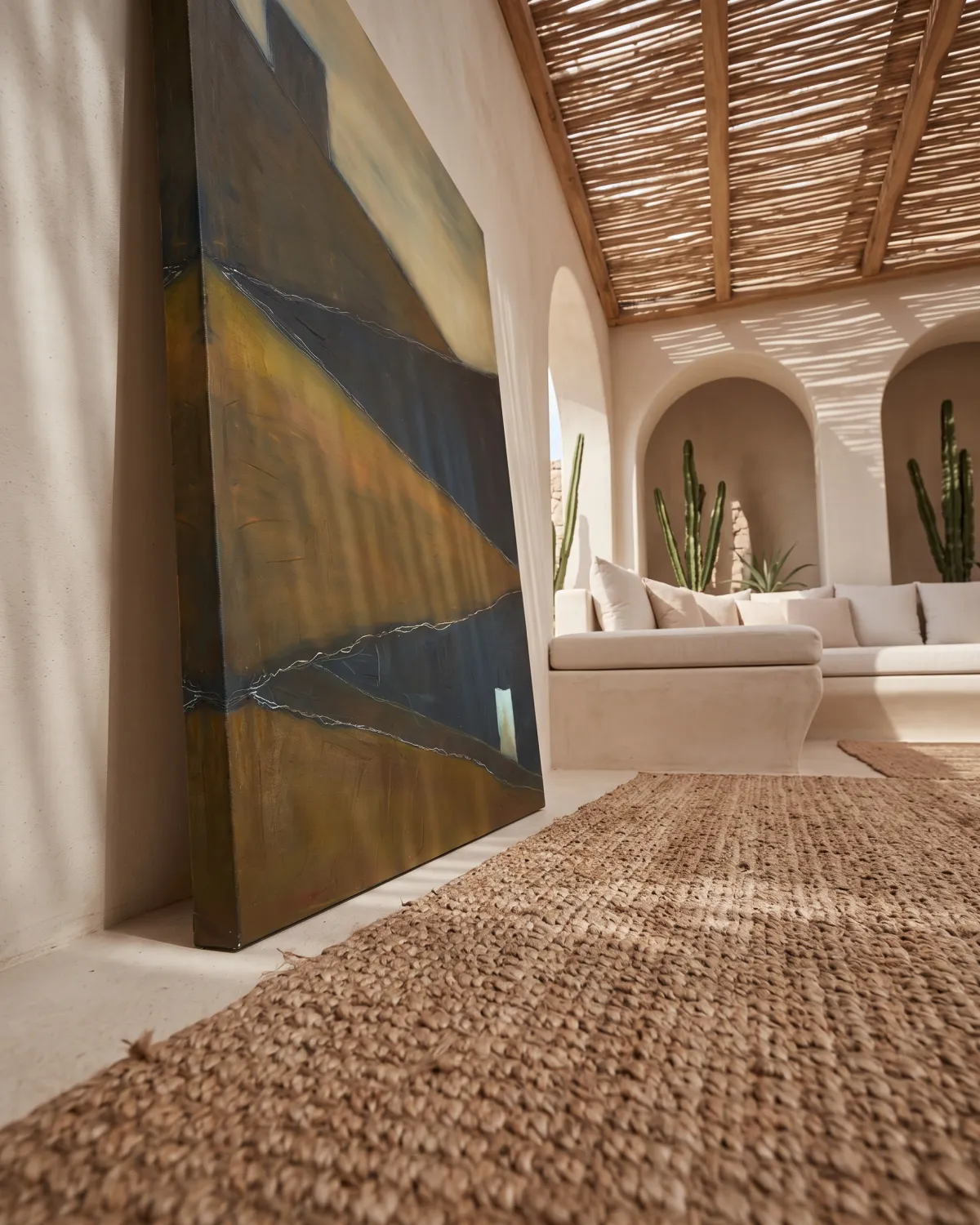
Context study / TENSUM
TENSUM by Maurizio Valch - Earthy Abstract Landscape Painting
From afar, TENSUM does not seem to tilt: it seems to have found a position that no one dares to dispute. The ochre opens in vast earthy expanses, not as a plain but as a surface that has slowly yielded to one side, layer upon layer, without actually sliding. There is an amplitude that attracts the gaze and, at the same time, pulls the ground from beneath it. The eye enters through this broad matter expecting to rest; it soon discovers that it must correct its own weight.
It is not a spectacular slope. It does not ask for vertigo. Its inclination works with a more uncomfortable patience: it slightly shifts the axis of the body, makes the verticality of the wall suspicious, ensures that the upper part is not exactly up and that the lower part concedes no rest. The dark bands cross the ochre field as if they had arrived late to stop something. Or as if they were that which remains when a fall has been interrupted before reaching the impact.
The question begins to move: what kind of fall occurs when not even the shadow accepts to finish falling?
I find an amplitude that does not let itself open entirely and a boundary that does not finish closing. I look at the ochres as if they held a matter too extensive for their own edges, and I look at the edges as if they were learning to contain a force I do not know. I cannot decide if the tension comes from the painting or from the gaze that insists on making it straight. Something in this inclination now appears as a doubt that does not fully belong to me.
Enter Buster Keaton. He was a filmmaker and actor whose comedy turned bodies, buildings, risk, and gravity into choreographies of impassive precision.
His first operation would be absurd and, for that very reason, rigorous: to calculate what body could traverse this plane without slipping. He would not measure the painting with a ruler, but with a knee. He would test the weight of an imaginary shoe on the upper ochre; he would drop a non-existent suitcase on the black band; he would check if a very thin person, perhaps too serious for the danger they run, could walk along those light lines without breaking them.
The geometry of TENSUM seems stable only because no one has tried to inhabit it.
But the calculation becomes useless as soon as the eye approaches the black bands. They are not merely darkness. They do not remain in the background so that the ochre can occupy the foreground. They have visual thickness: they force one to go around them. They curve, interpose, retain something of the neighboring layers, and return a blackness that does not finish absorbing everything. At times they could be ground, but a ground that refuses to receive weight. At times they seem like shadow, but a shadow that has hardened into an edge. Then they seem like a motionless river, and that hypothesis fails too: there is no current, although the eye keeps searching for where the water should go.
Keaton discovers he cannot resolve this situation with an acrobatic feat. There is no facade about to fall behind someone who remains, by miracle or calculation, inside the correct gap. Here the gap does not arrive. The blow does not arrive. The resolution does not arrive. Gravity has been held in a slowness that no pirouette could deactivate.
The light, thin, and brittle lines accompany those bands like a seam that does not want to look like a seam. They do not delimit with serenity. They tremble. They bend. Sometimes they seem to lean against the black to prevent it from advancing; other times they give the impression of being pushed by it. Seen closely, the painting stops offering large fields and begins to impose paths: one must follow the line, lose it in a dark fold, retrieve it further down, accept that it has changed direction without asking permission.
Then the two pale shapes appear.
One above, toward the left: small, vertical, almost discreet against the broad ochre amplitude. Another below, toward the right: also vertical, more isolated, as if it had survived an operation that the rest of the painting is still processing. They explain nothing. Their presence, however, alters all scale. Before, the bands could seem vast; now they seem to cross a distance between two interruptions. Before, the ochre could be terrain; now it could be the necessary extension to prevent those two rectangles from meeting.
There is a child's question that does not diminish the difficulty of the image: does the bottom rectangle know it is holding up a landscape too big for it?
Perhaps it is the only object that has understood how to survive that slope. Not because it is strong or because it has a recognizable function, but because it does not pretend to explain itself. It remains. Its paleness does not illuminate the rest: it makes it more uncertain. The high shape, on the other hand, seems less firm the more one looks at it. It could be a post, an opening, a suspended note, a small wall seen from the front. It could be none of those things. Its persistence lies in not letting the painting be read as pure extension.
Enter Chavela Vargas. She was a singer capable of turning a rough voice, a pause, and an emotional wound into a form of truth.
She does not come to put music over the landscape. She listens to the pressure between its strata. In the light line, she hears a note held until it hurts—a duration that neither rises nor falls because it has been suspended between two layers. In the black, she hears a breath that decides not to become a cry. Where Keaton sought a way to cross with elegance, she discovers that balance may not consist in escaping: it can be the obstinacy of remaining within a tension that offers no handrail.
That listening disarms the confidence of the comic body. Keaton no longer asks only which body would pass without falling; he understands that there are bodies that hold themselves up precisely because they cannot manage to leave. In turn, in that contained voice, he perceives something he recognizes: a precision without show, the gesture of not collapsing even though the entire set has begun to give way. But the painting does not allow them to agree. He keeps searching for the exact spot to place his foot. She keeps hearing that the support has a crack.
I can no longer call what I see a fall without feeling that the word falls short. The painting separates from me when I try to fix its direction: what seemed to descend may be rising very slowly, and what seemed to support may be yielding without moving. My gaze wants to gather the bands, the ochres, and the two light presences into a single balance, but the work insists on keeping a distance I cannot manage to order.
The descent becomes bodily. Breathing shortens not out of fear, but due to attention: following the fine lines demands an almost muscular slowness. The knees seem to receive a secret instruction, as if looking demanded bending them slightly. The balance changes place. It is no longer in the center of the body, but on the edge of a dark band that the eye cannot cross head-on. The desire to draw close appears, to check if the light line is indeed as fragile as it seems, if the black returns light or only lets it pass reluctantly.
And upon drawing close, one loses footing again.
The pale shape at the bottom stops being a small, isolated survivor. It becomes a vertical interruption against the general inclination—a minimal resistance that does not contradict the slope, but does not surrender to it either. From there, the gaze tries to return to the high rectangle. The path is not straight: it must climb back up the dark band, cross the stratified ochres, and listen again to the light edges tensing as if they held an ancient pressure.
The upper rectangle no longer seems to be at the beginning. It seems distant, not because of physical distance but because the painting has altered the ground between the two. Its paleness retains something of its first appearance, but now it carries the awareness of everything that had to be crossed to see it again.
There remains, between the black and the ochre, a light line that bends slightly before disappearing.
- Original artwork
- TENSUM
- Actual dimensions
- 31.5 × 47.2 in / 80 × 120 cm
- Presentation
- Digital contextual visualization
Context references
modern rustic wall art · sienna and earth tone decor · abstract paintings for terrace · geology inspired abstract art · minimalist art in neutral tones
About this visualization
This visualization places the artwork within an architectural context to help collectors and viewers imagine its presence in a real space. It is an interpretive reference, not an exact reproduction: the original work remains the sole authority for scale, color, surface and material presence.