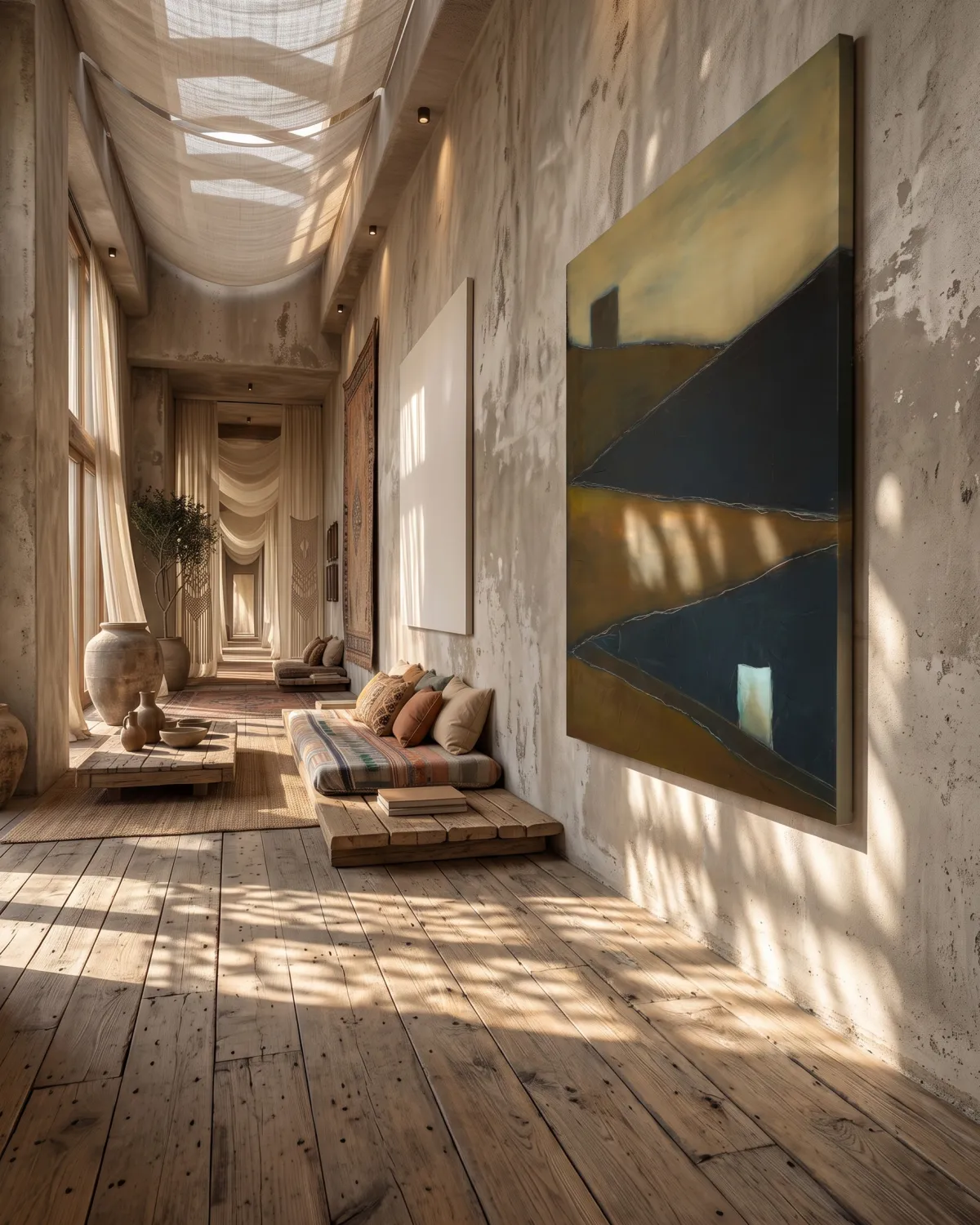
Context study / TENSUM
TENSUM Abstract Painting by Maurizio Valch - STRATA Series
The visual architecture of TENSUM unfolds as a territory of folded forces, where the canvas becomes a map of geological and psychic tensions that challenge the viewer's gaze. The zigzag composition, punctuated by angular slopes shifting between an earthy ochre and a deep, almost nocturnal blue, constructs a sense of depth that is not associated with classical three-dimensional perspective, but rather with a physical fatigue of matter—an ascent or descent that demands effort from both eye and spirit. The color masses do not merely coexist; they push and fracture one another along fine, incised lines—tectonic scars that the artist has traced to divide and, paradoxically, sew the pictorial surface together. At the extremes of this rugged geography operate two poles charged with mystery: in the upper left corner, a dark, monolithic block is sharply silhouetted against a pale, neutral sky, representing closure and the weight of the immutable; at the opposite end, in the lower right, a small, self-illuminated white rectangle emerges from the shadow like a portal or a crack of pure light, establishing an unresolvable tension between the void of the abyss and the promise of a threshold.
When I confront the canvas with acrylic and oil, I understand that my craft does not consist in accumulating layers upon the surface, but in knowing when to remove them, in an exercise where the true generosity of painting manifests itself through subtraction. By sinking the palette knife and the stylus into the still-fresh matter of the dark slopes, I do not seek to draw a decorative line, but to wound the flesh of the painting to reveal the underlying light that breathed hidden beneath the gravity of ochre and blue. This act of scraping and incising is a painful offering, a way of opening cracks of air in a landscape that would otherwise be suffocating. In the same way, I conceived that small luminous portal in the lower corner not as an explanation or a narrative device—for I firmly resist decoding its mystery—but as a visual balm, a gift of light that suspends the viewer's fall and allows them to breathe amid the density of the abyss.
The communion that takes shape in TENSUM does not present itself as a peaceful fusion or a harmonious truce between the elements, but as a negotiation at the very limit of fracture. The canvas attempts to build an impossible bridge between two absolutely opposed psychological and material states: the static, hermetic heaviness of the upper block, which evokes the isolation of the ego or the rigidity of inherited beliefs, and the fragile opening of the lower portal, vibrating with the vulnerability of the present moment. This communion does not occur in a vacuum; it unfolds precisely on "the tactile edge" where the masses of color rub against and repel each other. It is there, along the broken path of the zigzag, where the viewer is invited to traverse the pain of separation to experience the subtle current of energy connecting the shadow of the monolith with the clarity of the threshold.
Looking at the dimensions of the work, this vertical format of 120 by 80 centimeters, I feel that the painting itself stands before me like an autonomous monolith, a presence that questions me and demands absolute surrender. Painting for me is practicing an ascent without a ladder, entering into a depth that no longer belongs to an external landscape, but to an inner skin that remembers every stroke, every stratum of oil, and every regret upon the canvas. Facing this scale, I often doubt whether the space I am founding is a protective shelter or a desolate wilderness; it is in this uncertainty that I decide to let go of control and let the painting answer for itself, allowing the gravity of the oil to dictate its own fall and the support to become the witness of a dialogue in which I am merely a mediator.
Ultimately, TENSUM reveals itself as a profound existential paradox where the three forces of matter unify into a single experience of revelation: it is not possible to achieve communion with our surroundings or with others without accepting the dizzying depth of our own decline, just as there is no true generosity without the honesty of the incision—without that self-inflicted wound on the surface that allows the luminous to breathe. As we step away from the work, Maurizio Valch's canvas returns us to the plane of our own physical reality with the certainty that beauty does not reside in the perfection of the right angle or the calm of a clear horizon, but in the hidden vibration of a rough, honest surface that holds itself with dignity in the tension of its own fall.
- Original artwork
- TENSUM
- Actual dimensions
- 31.5 × 47.2 in / 80 × 120 cm
- Presentation
- Digital contextual visualization
Context references
blue and ochre abstract painting · textured layered painting · brutalist minimalist art · rustic mediterranean living room decor · large vertical wall art
About this visualization
This visualization places the artwork within an architectural context to help collectors and viewers imagine its presence in a real space. It is an interpretive reference, not an exact reproduction: the original work remains the sole authority for scale, color, surface and material presence.