Context study / TENSUM
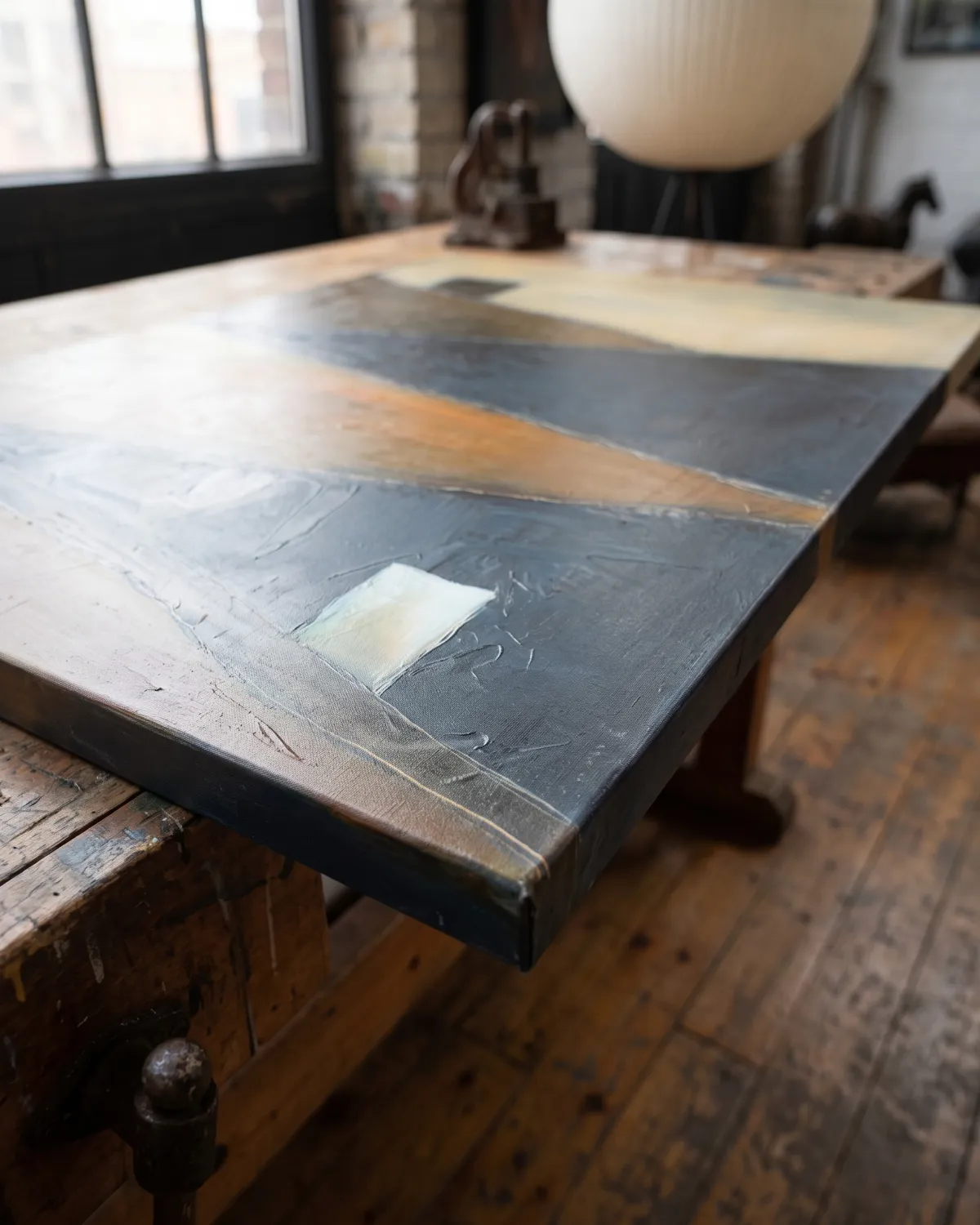
Abstract painting TENSUM by Maurizio Valch on workshop table
The visual journey proposed in TENSUM is inaugurated by a broken trajectory, an abrupt zigzag that cuts through the surface of the canvas with the forcefulness of a rugged path. This particular architecture of ascent and descent opens a profound question about the nature of human transit when confronted with the thought of George Gurdjieff, a mystic who questioned human automatism and proposed the "remembrance of oneself" to awaken from everyday mechanical existence. From his perspective, this inclined and fragmented plane could be interpreted as the ramp of unconscious repetition, the stage where the "man-machine" climbs and descends without a true state of alertness, subjected to invisible inertias. However, contrasting this view with that of Carl Gustav Jung, the pioneering psychiatrist who conceptualized the process of individuation, the broken path ceases to be an external mechanism of alienation and becomes the map of a tortuous interior transformation. Thus, the work stages the fundamental psychic tension between the Shadow—embodied in that upper, dark, and monolithic block watching from the shadows—and the birth of the Self, symbolized by the lower block, a pale, radiant, and vulnerable presence struggling to emerge into consciousness.
When I sink the point into the surface of TENSUM, I do not seek to trace a docile or flat drawing; my intention is to violate the material to force it to reveal its structural truth. These shaking white lines separating the wedges of earth are not mere compositional delimitations, but real physical cuts, deep incisions that tear through the superimposed layers of oil and acrylic. Feeling the resistance of the pictorial paste under my hand is an act of tactile confrontation in which the canvas opposes its physical body while I force the material to open up. Between the large masses of sienna, ochre, and dark asphalt color, each incision acts as an urgent seam, a mental limit that hurts as it is executed but is indispensable to organize the chaos of thought. Scoring the paint is my way of founding a physical boundary on the canvas, a limit that delineates the forces and contains the overflow of the pigments.
This division of the pictorial space introduces an inescapable friction when analyzed from the perspective of Osho, a philosopher and spiritual leader who criticized systems of social control and defended the freedom of the essential self against institutional rigidity. For him, the angular wedges and boundaries of the painting would represent the terraces of domestication, a system of boxing-in where the free and wild flow of life—that chromatic energy pulsing beneath the paint—is forced to submit to strict limits out of human fear of absolute disorder. However, this view of restriction finds a healing counterpoint in the thought of Gaston Bachelard, a philosopher of science and poetic imagination who studied the relationship between habitable space and states of the soul. From his poetics, the lower luminous block ceases to be a cell and becomes a corner of shelter, a lamp or a cabin resisting with warmth against the hostility of the surrounding territory, while the upper dark monolith is transformed into the attic of memory. In this way, the structure not only represses, but provides the only possible ground for desire not to dissolve into nothingness.
Beyond the labyrinths of the intellect, when I stand before TENSUM, what captures me is its dense, almost unbreathable atmosphere, suspended in that upper horizon where the twilight light becomes a yellowish, dirty mist. This tone evokes in me the pulse of my own Mediterranean memory: not the idyllic postcard of the blue sea, but the reality of a dry, dusty land, heavy with silences and sediments that seem to accumulate a time prior to the existence of man. The process of painting this picture was a kind of involuntary archaeology; I did not rationally plan the placement of the two blocks of light and shadow. Seeing that pale square appear at the base and the dark monolith crowning the peak was an instant of absolute strangeness, as if both forms had always been buried in the support, waiting for my hands to remove the successive layers of pigment to finally be able to breathe.
In the end, it is the vibration of the material itself that returns the viewer to the pure and dense physical presence of the work. The incisions that furrow the canvas act visually against the dark masses like scars or urgent seams that prevent this fragmented territory from collapsing under the relentless force of gravity. In this point of contained tension, Valch's painting refuses to offer easy answers and places us on a threshold of total uncertainty. Are we at the beginning of a heroic and uncertain ascent toward the dark monolith of the Shadow, or in a protective and nostalgic descent toward the small light taking refuge on the floor? By suspending the answer, the work demonstrates that its value does not lie in illustrating a moral or psychological dogma, but in sustaining an indissoluble tension between the stillness of the worked material and the constant inner transformation of the one who stops to contemplate it.
- Original artwork
- TENSUM
- Actual dimensions
- 31.5 × 47.2 in / 80 × 120 cm
- Presentation
- Digital contextual visualization
Context references
abstract painting on workshop table · textures painting by Maurizio Valch · details of TENSUM painting · artistic process of abstract painting · oil painting with incisions close-up
About this visualization
This visualization places the artwork within an architectural context to help collectors and viewers imagine its presence in a real space. It is an interpretive reference, not an exact reproduction: the original work remains the sole authority for scale, color, surface and material presence.