Context study / TENSUM
TENSUM Brutalist Painting by Maurizio Valch - Art Gallery
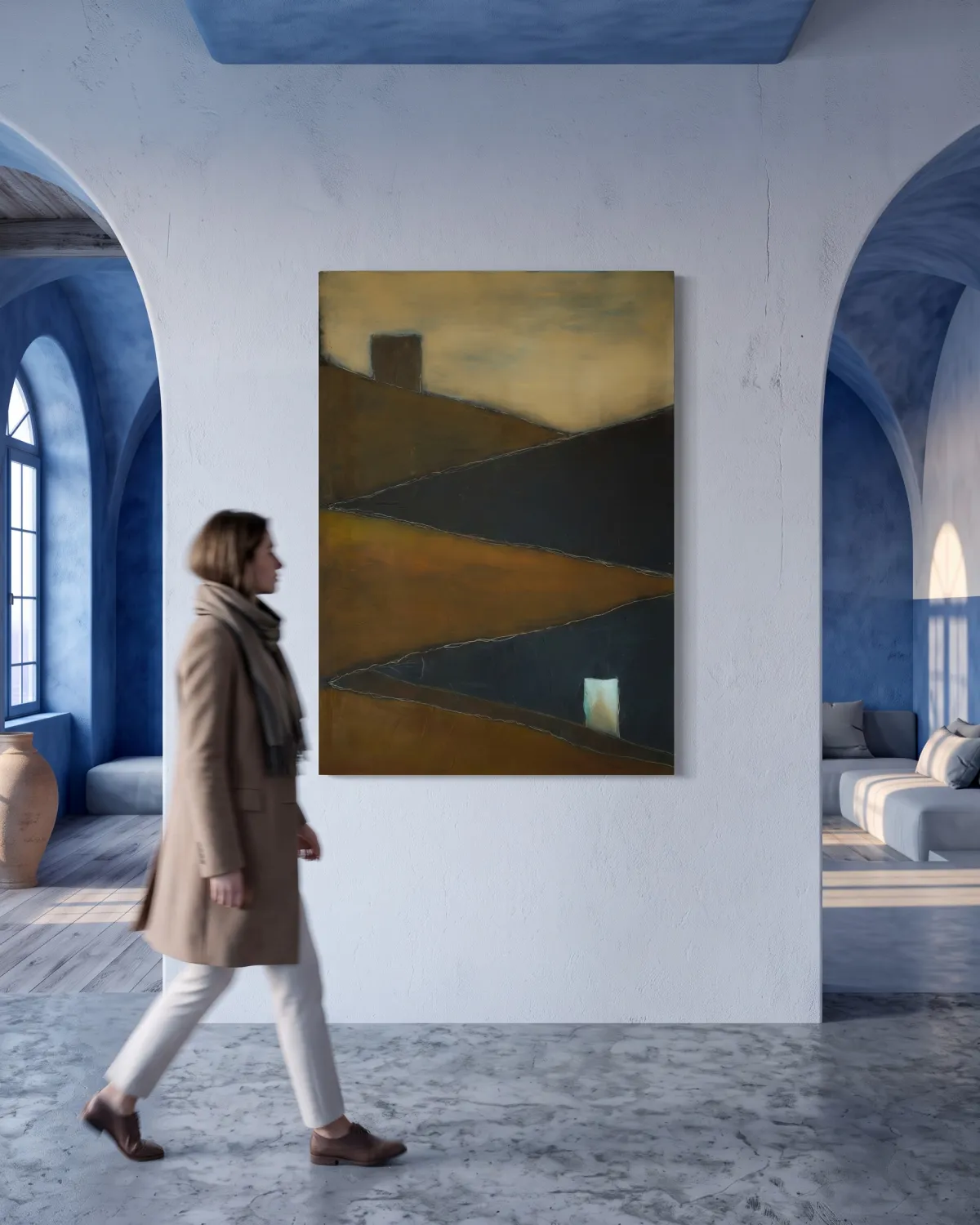
"TENSUM" places us before a vertical geography of almost brutalist character, where the pictorial plane is fractured by a system of zigzagging diagonals that function not as simple outline strokes, but as true incisions. These incised marks act as subtractive cuts on the sedimented surfaces, physical crevices that tear through accumulated layers of pigment to reveal an underlying base of contained clarity. It is in this violent gesture that a fundamental paradox is manifested: the pain of wounded matter, the cut that interrupts the canvas's chromatic continuity, becomes the only possible foundation for a deep structural harmony. Far from destabilising the composition, this sharp, broken line divides the territory and contains the masses that would otherwise collapse onto one another in a disordered gravity. The tension of the canvas is born from this extreme coincidence where the harshest boundary, the scar traversing the linen, reveals itself as the organizing principle sustaining the entire visual scaffolding.
When I sink the tool into the wet density of the oil and acrylic, I experience the incision not as a pre-calculated design, but as a head-on collision between my own impulse and the physical resistance of the support. Feeling how the metal drags and displaces the accumulated matter is a process where pain ceases to be an abstract concept and is transformed into a manual vibration, into the muscular effort required to open a furrow in the sedimented surface. While painting, my gaze constantly drifts towards that monolithic block, dark and heavy, which rises on the upper left slope; I recognise it not as an accident of the landscape, but as the sediment of my own hardened mental structures, rigid certainties that demand to be confronted. Thus, painting becomes for me a labor of relentless excavation, an exercise where each scraping that removes matter hurts in the pulse, but is the only means capable of releasing the space buried beneath the weight of accumulation.
The journey across the surface of "TENSUM" activates a downward impulse that inevitably drags the viewer's gaze through a zigzag of well-differentiated chromatic fields. The earth, ochre, and sienna tones slide and sink progressively towards a stratum of indigo blue, almost nocturnal, which occupies the lower half of the composition. On this path of gravitational descent, the silent and hermetic presence of the upper monolithic block—which seems to press with its dark mass against the slope of the painting—contrasts drastically with the fragility of the small luminous, trembling rectangle situated at the bottom right corner. This tiny insertion of white-blue light seems to resist under the immensity of the somber landscape, temporarily suspending the falling motion and catching the observer in an interval of visual syncope, an unstable but firm truce where the weight of the mountain and the vulnerability of the light balance each other.
Stopping in front of the small portal of white-blue light trembling in the lower right corner, I understand that my search for harmony in "TENSUM" has nothing to do with a peaceful resolution or a decorative balance free of conflict. For me, harmony lies exclusively in the canvas's capacity to sustain and metabolise the extreme pressure exerted by masses upon the void. This small luminous threshold does not function as an emergency exit or an easy spiritual consolation; it is, on the contrary, an exposed body, a thin membrane of light that decides to resist and receive the entire tectonic weight of the strata collapsing from above. In this corner of the canvas, the pain of the fragmented territory and the violent impulse of the descent integrate into a single silent heartbeat, a point of resistance where light does not flee from darkness, but supports it and endows it with meaning.
Finally, the canvas of "TENSUM" reveals itself before us not as the representation of an external landscape, but as a skin or a material archive that preserves the scars of its own genesis. Through the physicality of its layers and its incisions, the work demonstrates that the pain of the cut, the impulse of the creative force, and the harmony of resistance are not successive or contradictory states, but simultaneous forces shaping the very structure of existence. Maurizio Valch confronts us with a painting experienced with the body, inviting the spectator to inhabit this tactile edge where free fall finds its own point of support and the wounded line offers itself as the only possible map to navigate the density of our present.
- Original artwork
- TENSUM
- Actual dimensions
- 31.5 × 47.2 in / 80 × 120 cm
- Presentation
- Digital contextual visualization
Context references
gallery abstract art · blue sienna and ochre painting · paintings with incisions and cuts · high ceiling living room decor · artwork with strong contrast
About this visualization
This visualization places the artwork within an architectural context to help collectors and viewers imagine its presence in a real space. It is an interpretive reference, not an exact reproduction: the original work remains the sole authority for scale, color, surface and material presence.