Context study / TENSUM
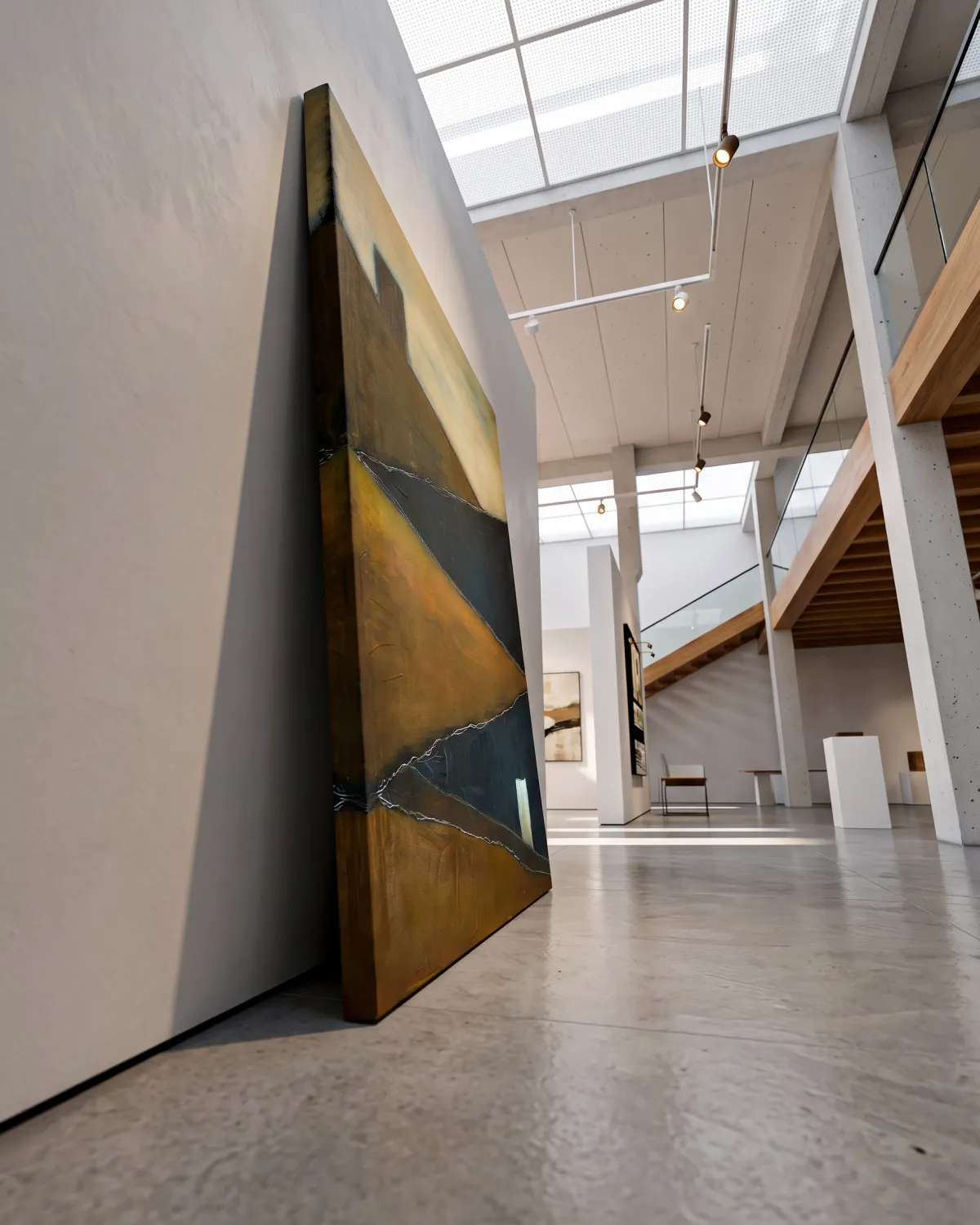
Abstract painting TENSUM by Maurizio Valch profile view in gallery | Artwork Mockups
Paragraph 1: The Geology of the Boundary (External Perspective)
The spatial composition of TENSUM is organized through a rigorous visual stratigraphy, where heavy chromatic fields of dark ochres, siennas, and carbonaceous greys unfold in steep diagonal slopes. These blocks of dense matter convey a sense of geological permanence, as if we were contemplating an ancient ground that has accumulated layers of time, dust, and tectonic pressure under a low, leaden sky. However, this apparent stony stability is interrupted and fractured by incised lines of a calcareous white that zigzag across the surface, delimiting the edges of the slopes. These incisions act as exposed cracks that introduce a deep feeling of helplessness; they are not mere dividing lines, but wounds in the matter that reveal the extreme fragility of territorial boundaries and the latent vulnerability of a geography that seems to slide slowly into the abyss by the sheer effect of its own gravity.
Paragraph 2: The Hand in the Wound (First Person - Voice of Maurizio Valch)
When I confront the physical density of the canvas, I always seek to establish a tactile and violent relationship with the matter. To bring forth those white lines that run through TENSUM, I do not resort to the delicate addition of pigment, but to scraping, cutting, and direct incision upon the overlapping layers of wet oil and acrylic. In this physical process, I experience my own creative helplessness: rational control dissolves before the resistance of the support and the unpredictability of the groove. I do not paint from certainty, but from loss, allowing the palette knife or the stylus to tear the dark crust to reveal the vulnerability of the lower plane. The canvas then ceases to be an inert space of representation to transform into a sensitive skin, a living record that accumulates the marks of my effort, the weight of my doubts, and the inheritance of time settling on the cloth.
Paragraph 3: The Threshold and Wonder (External Perspective)
In the lower right area of the artwork, immersed in the base of the darkest slope, a luminous detail emerges that completely alters the gravity of the painting: a small, sharp white rectangle that functions as a portal or niche of pure light. This geometric flash, far from being absorbed by the surrounding mass of ochre and black, sustains itself with extraordinary fixity in the midst of the half-light. It is the manifestation of a discreet yet resounding wonder, a focus of astonishment that arises precisely from the lowest and most unprotected zone of the composition. Here, painting demonstrates its capacity to generate hope without resorting to eloquence: there is no need for a great display of light to break the opacity of the world, the silent persistence of this minimal glow resisting on the brink of collapse is enough, inviting the gaze to linger on the threshold of mystery.
Paragraph 4: The Oscillation of Silence (First Person - Voice of Maurizio Valch)
Contemplating the finished work, I realize the tense correspondence established between its two extremes: the dark, quadrangular monolith that sits imposingly in the upper left, embodying the obstinate permanence of inherited structures, laws, and certainties that crush us, and that small niche of white light safeguarding wonder at the opposite end. I understand then that my paintings are not places of arrival, but territories of transit and oscillation. I do not seek to offer the viewer a dogmatic refuge or closed mystical answers; my purpose is to force them to sustain their gaze in the magnetic distance that separates the shadow from the flash, inhabiting the silence that vibrates on that inclined slope where the ground seems to vanish beneath our feet.
Paragraph 5: The Seamless Fabric (External Perspective - Conclusion)
In its formal resolution, TENSUM succeeds in unifying permanence, helplessness, and wonder into a single somatic experience that overflows the conventional limits of representation. By dispensing with a containing frame and allowing the layers of color and rough textures to continue fluidly over the edges of the three-centimeter-thick stretcher, the painting becomes a three-dimensional relief that breathes and shares the real space of the observer. This material continuity transforms the wall into an extension of the slope itself. In the end, Maurizio Valch's work confronts us with the honesty of our own decline; it invites us to depose the tyranny of absolute control over our lives to learn, simply, to slide along its tactile surface, discovering that true beauty resides in the acceptance of the fall and in the minimal light awaiting at the bottom of the slope.
- Original artwork
- TENSUM
- Actual dimensions
- 31.5 × 47.2 in / 80 × 120 cm
- Presentation
- Digital contextual visualization
Context references
abstract painting in profile · abstract art in art gallery · rustic textured abstract painting · ochre and black abstract canvas · minimalist decoration with art · exhibition of modern paintings
About this visualization
This visualization places the artwork within an architectural context to help collectors and viewers imagine its presence in a real space. It is an interpretive reference, not an exact reproduction: the original work remains the sole authority for scale, color, surface and material presence.