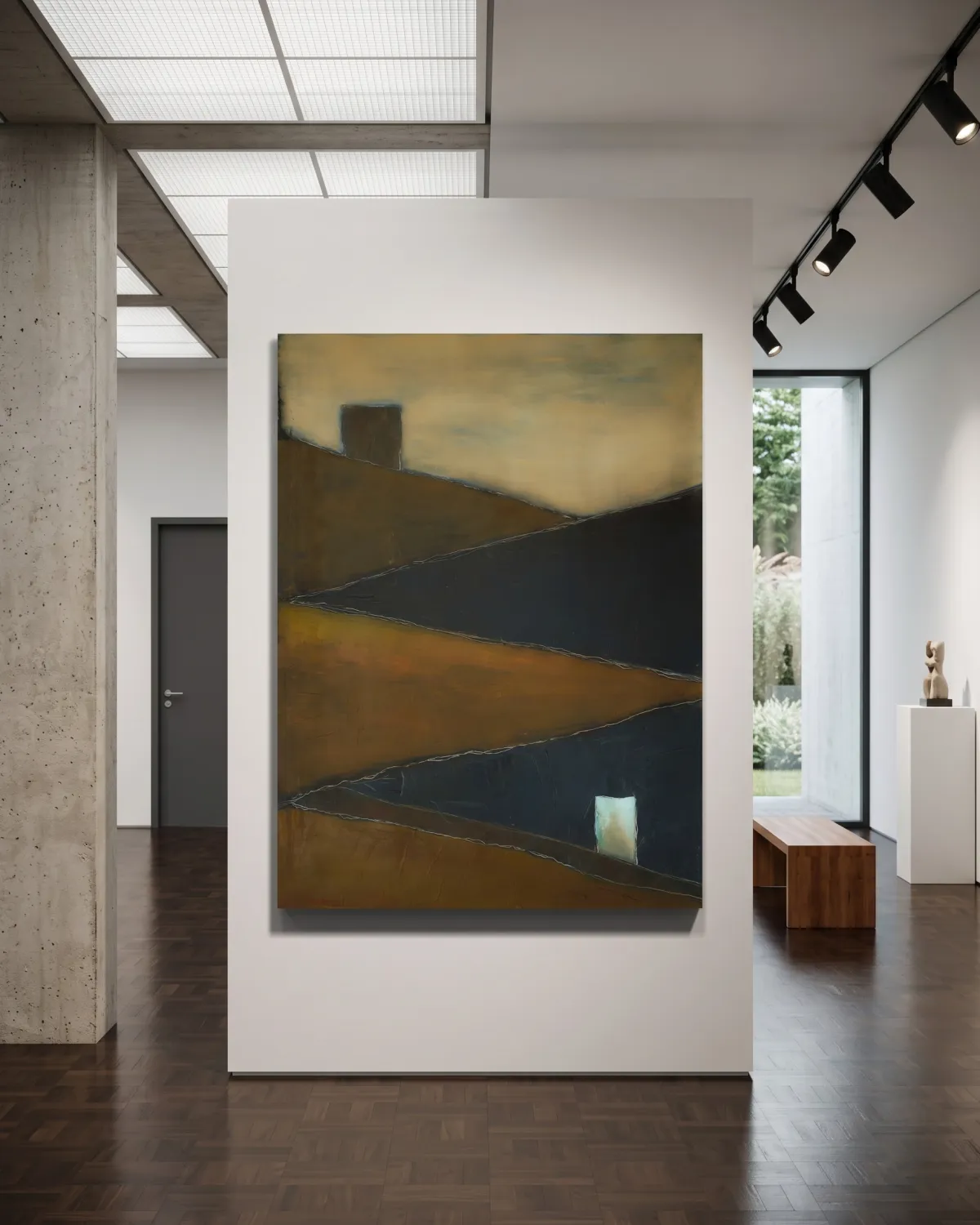
Context study / TENSUM
TENSUM by Maurizio Valch in Art Gallery - STRATA Series
The exposed concrete structure and directed light of the room impose a rigorous order that the painting, however, destabilizes as soon as the eye attempts to fix its boundaries. Looking at TENSUM on the gallery's freestanding panel, the mind's first temptation is to seek an anchor, a ground line that restores gravity to its usual position. But the ochre and dark bands refuse to cooperate: they tilt, collide, and slide over one another on a slope that disobeys the plumb line. What we perceive as a rugged landscape or a series of tectonic planes under a stormy sky is nothing more than an accumulation of pigment subjected to successive pressures. The space of the room seems to widen around the canvas, not because the work simulates a window to the outside, but because it makes evident the speed with which the brain translates matter into a habitable narrative.
When I drag the palette knife or open an incision in the thick oil, my hand performs a strictly physical action: removing paint, offering resistance, letting a previous layer breathe. Yet, I know that when I step back and hang the frame under the light, that material wound will immediately become something else for whoever observes it. Thought does not tolerate the void or the pure presence of color; it needs to populate the plane with horizons, sloping paths, or solemn absences. I watch myself in this process, suspicious of my own haste to find a convincing explanation for what I discover on the canvas. I know that the fact of painting almost always ends up buried beneath its interpretations, and that is why I try to keep the marks bare enough so that the viewer stumbles upon their own desire to order them.
In the opposite corners of the composition, two rectangles of differing luminosity act as points of tension that modify the scale of the entire surface. The dark block at the top and the small light niche below do not function as closed symbols, but rather as anomalies that disrupt the continuity of the bands. Their presence alters the depth of the plane, forcing the eye to constantly recalibrate the distance between what is in front and what seems to remain hidden. It is the mechanism of visual syncopation: a void or an unexpected accent that shifts the focus and demands redoubled attention from consciousness to sustain the structure. The observer believes they see a suspended order, but what they actually experience is the effort of their own nervous system to restore the balance that the masses of color deny them.
I often find myself caught in the belief that I have no right to be at peace as long as there is a line that does not fit or a texture that has not found its exact weight. But that urgency is just another trap of thought, one of those many theories about who I am or what my painting should be that I construct to avoid facing the silence of the studio. By tracing that pale seam that runs along the edge of the central mass of TENSUM, I do not seek to reconcile opposites or delimit an inner territory. I simply record the friction of a contact that does not fully settle, the physical trace of a boundary that is also a shore of tactile encounter. Painting does not have to resolve my disorder or that of the viewer; it is enough for it to sustain the gaze where everyday words begin to lose their usefulness.
In the end, the imposing scale of the architectural space highlights the vulnerability of the painted matter. Against the Cartesian cleanliness of the wooden floor and white walls, the eroded surface of the canvas presents itself as a body marked by time, a record of sedimentations and scrapings that does not hide its seams. The distance between what the painting is—a weave of canvas and oils on a wooden stretcher—and what the viewer experiences before it remains unbridgeable. In this inert interval is where the work finds its true dimension: not as an object of decorative consumption, but as a physical presence that interrupts the inertia of the day and forces us to suspect the fidelity of our own eyes.
- Original artwork
- TENSUM
- Actual dimensions
- 31.5 × 47.2 in / 80 × 120 cm
- Presentation
- Digital contextual visualization
Context references
Contemporary abstract painting in gallery · Maurizio Valch STRATA TENSUM · Ochre and black abstract painting · Minimalist art ideas for living room · Large format painting decor · Abstract canvas with textures and layers · Brutalist contemporary wall art
About this visualization
This visualization places the artwork within an architectural context to help collectors and viewers imagine its presence in a real space. It is an interpretive reference, not an exact reproduction: the original work remains the sole authority for scale, color, surface and material presence.