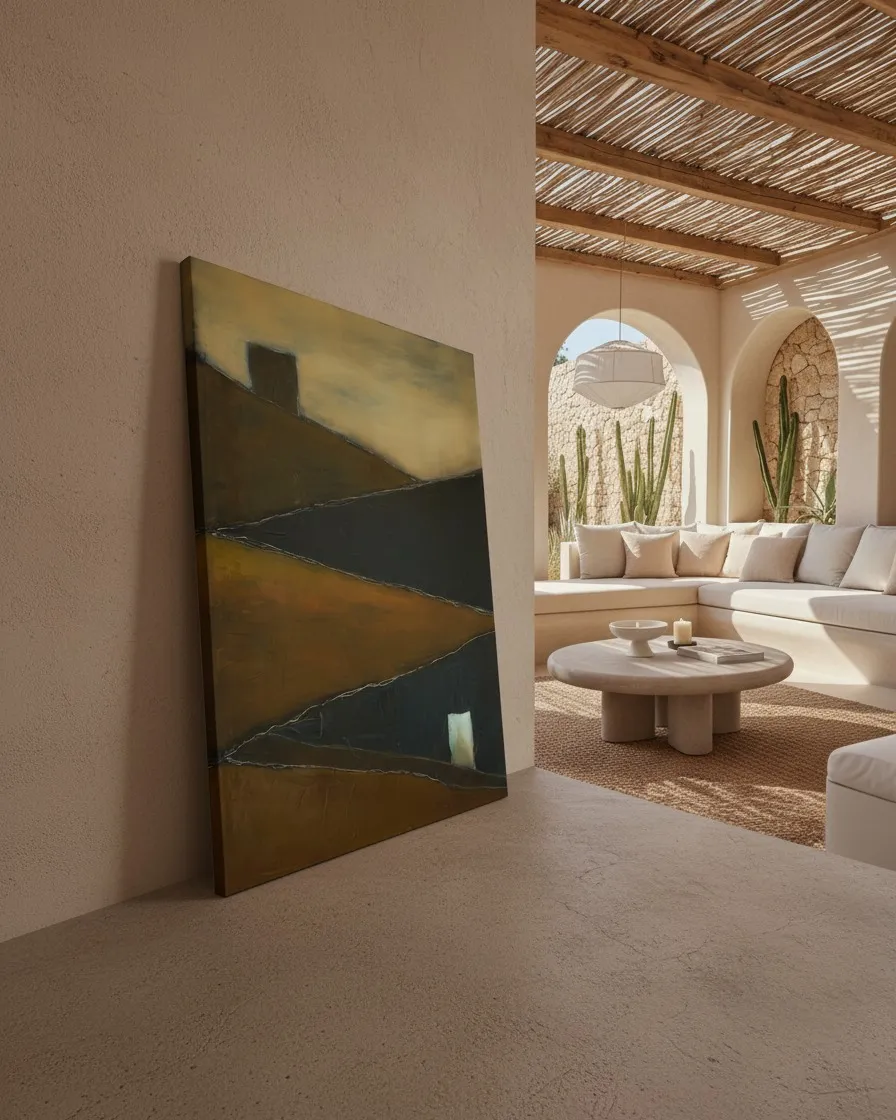
Context study / TENSUM
Abstract Painting TENSUM by Maurizio Valch | Wabi-Sabi Decor
TENSUM
From a certain uncertain height, the bands of TENSUM look like land that has forgotten what it was for. There is an ochre strip that could be parched earth, but also the shadow of a slab separating from another. A dark grey mass rises—or falls—like a collapsed roof. Higher up, a turbid yellow opens with the caution of a light that never quite arrives. Nothing completely stabilizes: each stratum can be ground, fold, fallen wall, slope, low ceiling, or the trace of a construction abandoned before receiving inhabitants.
The gaze attempts to remain aerial, as if looking from above were enough to avoid commitment. But the curves tilt. The bands slide over one another. A light seam cuts through the darkness without obeying the gravity the eye assigns to it. Very soon, an uncomfortable suspicion arises: the painting is not in front. It is beneath one's feet, and the viewer has arrived too late to notice they are walking on it.
In the upper-left area, the first dark rectangle interrupts the slope. It does not open an interior; rather, it withdraws something from the space. It seems like a door with no promise of entry, a window that has decided to look toward an inexistent room, a vertical weight driven into a moving surface.
Frank Lloyd Wright was an architect attentive to the relationship between building, landscape, matter, circulation, and daily life.
One approaches that shape like someone recognizing a problem of support. One looks for which mass receives it, which line discharges its weight, which path would allow passing beside it without falling. The dark and ochre bands could be an architecture stretched across the terrain, almost unable to separate itself from it: an unraised shelter, a room that still retains the shape of the ground. The lower curve seems like a ramp; the upper one, an edge protecting from too long a fall.
But the rectangle does not cooperate. It gives no depth. It yields no scale. The more one attempts to measure it, the less it seems like an opening and the more like an interruption of the very need to orient oneself. There is something almost rude in its blackness: it does not explain whether it is in front, behind, or within the painting. It just stays there, small and stubborn, like a nail holding no board.
Who held the light lines while the slope tilted?
The question hangs suspended over a white, barely broken seam that separates a black band from a strip of dull ochre. It could be the edge of a fault line, a scar of light, an exposed wire, a route drawn by someone who did not want to be found. It does not fall. Or perhaps it falls so slowly that the eye mistakes its descent for firmness.
Below, toward the right, the second rectangle appears with a different clarity. It does not illuminate the space: it weighs within it. It is too small to balance such a large dark surface, and yet it alters all proportions. It seems like a fragment of wall seen from a distance, a door reduced to its temperature, a body that has gone still so no one notices it is trembling. The painting does not treat it as an exit. It deposits it there, near a deep curve, where the light can become a burden.
Shunryu Suzuki was a Zen master who invited inhabiting attention without turning experience into a possession.
He is not interested in deciding what supports what. The urgency to find a firm base already seems like a form of slipping. The eye, the image says without saying, asks for ground because it fears noticing that it too is tilted. The light rectangle does not have to rescue anything; it could be precisely the small trap manufactured by the desire to understand. One wants to reach it, give it a function, place a frame on it, thank it for interrupting the darkness. And in that gesture, a wall is built once again where perhaps there was only a cut.
I find no decision here that can obey me. The image presents itself to me as if it had taken distance from what I thought I recognized in it: one band feels heavier than I remembered, another seems to withdraw, and the two rectangles insist on not being brought together. When I stand before it, I notice my body searching to correct a tilt that is not in the room. Then I understand that the painting is not asking me for an explanation; it is asking me not to pretend I am motionless.
From that point on, it is no longer useful to name the composition as terrain or building. The eye descends along the upper curve, following the turbid yellow that darkens toward the center. It finds the light edge, traces it as if it were an insufficient handrail, and reaches the large black mass. There the gaze loses speed. Not because there is an emptiness, but because the density seems to absorb distance.
The neck leans forward slightly. The breath shifts. An imaginary step searches for a place to land, even though the body has not moved. Then the sight slides downward along a second seam and stumbles upon the light rectangle. It does not rest there out of trust, but out of a kind of reflex: when a surface becomes too deep, anything that juts out feels like support. Even an object that perhaps would not bear the weight of a fingernail.
The painting organizes a minimal and somewhat awkward choreography. Leaning in. Backing away. Looking at the curve like someone looking at a miscalculated step. Approaching again because the light line seems to have shifted. The viewer learns that the bands are not merely zones of color: they are contradictory instructions for balance.
The intelligence of architecture insists that such a tense seam must join two planes, that if it cuts through the darkness it is because it contains pressure, because it prevents something from shifting. Attention without a handrail responds that there is no obligation to turn every line into a support; perhaps the line only shows that the desire to hold oneself up leaves marks.
But a difficult-to-ignore anomaly arises: the central black curve seems to sink and, at the same time, float above the lower ochre band. If read as weight, it is suspended. If read as shadow, it has an edge. If read as an edge, it invades what it should separate.
Then an uncomfortable hypothesis appears: it is not the bands that rest on the rectangles, but the rectangles that keep the fall of the bands open. The problem is that this idea cannot be accepted without turning the painting into a machine of risk. Nor can it be rejected without imposing a ground that it never quite offers.
I look at the light rectangle now and cannot treat it as an answer. Sometimes it seems to be arriving from the depths; other times, it seems trapped on the surface, not knowing which side it belongs to. What previously seemed like an interruption has become a demand: it returns the question of my own position before the work. I do not know if I am observing it, or if it is the small piece preventing my gaze from completely falling apart.
The childhood question returns, but it has changed in size: who held the light lines while the slope tilted? It no longer seems like a curiosity about painting. It feels like a question the body asks when it discovers it has been trusting a drawn handrail.
And the secret question also returns, refusing to be resolved: which of the two small doors supports the other? The dark one, above, seems to hold back a portion of night so the light one does not become too visible. The light one, below, seems to give weight to the darkness so it does not open like a pit. Or perhaps neither supports either, and both are the points where the painting lets the viewer feel their own need for support.
It is wise then to look at an area that is almost lost at first: the barely luminous seam bordering the lower black band, near its contact with the ochre. It is not straight. It does not fully join or separate. It seems to have been traced by a hand that knew the slope but promised to save no one from it.
There, the evacuation plan is interrupted. A directional arrow is not missing: the ground that would allow obeying it is. The painting does not represent a fall; it slowly teaches one to discover that the ground beneath the gaze can withdraw without making a sound.
- Original artwork
- TENSUM
- Actual dimensions
- 31.5 × 47.2 in / 80 × 120 cm
- Presentation
- Digital contextual visualization
Context references
abstract painting modern living room · minimalist mediterranean decor · wabi sabi abstract art · large paintings for living room · interior design with art
About this visualization
This visualization places the artwork within an architectural context to help collectors and viewers imagine its presence in a real space. It is an interpretive reference, not an exact reproduction: the original work remains the sole authority for scale, color, surface and material presence.