Context study / TENSUM
TENSUM by Maurizio Valch in the Painting Studio | Abstract Art
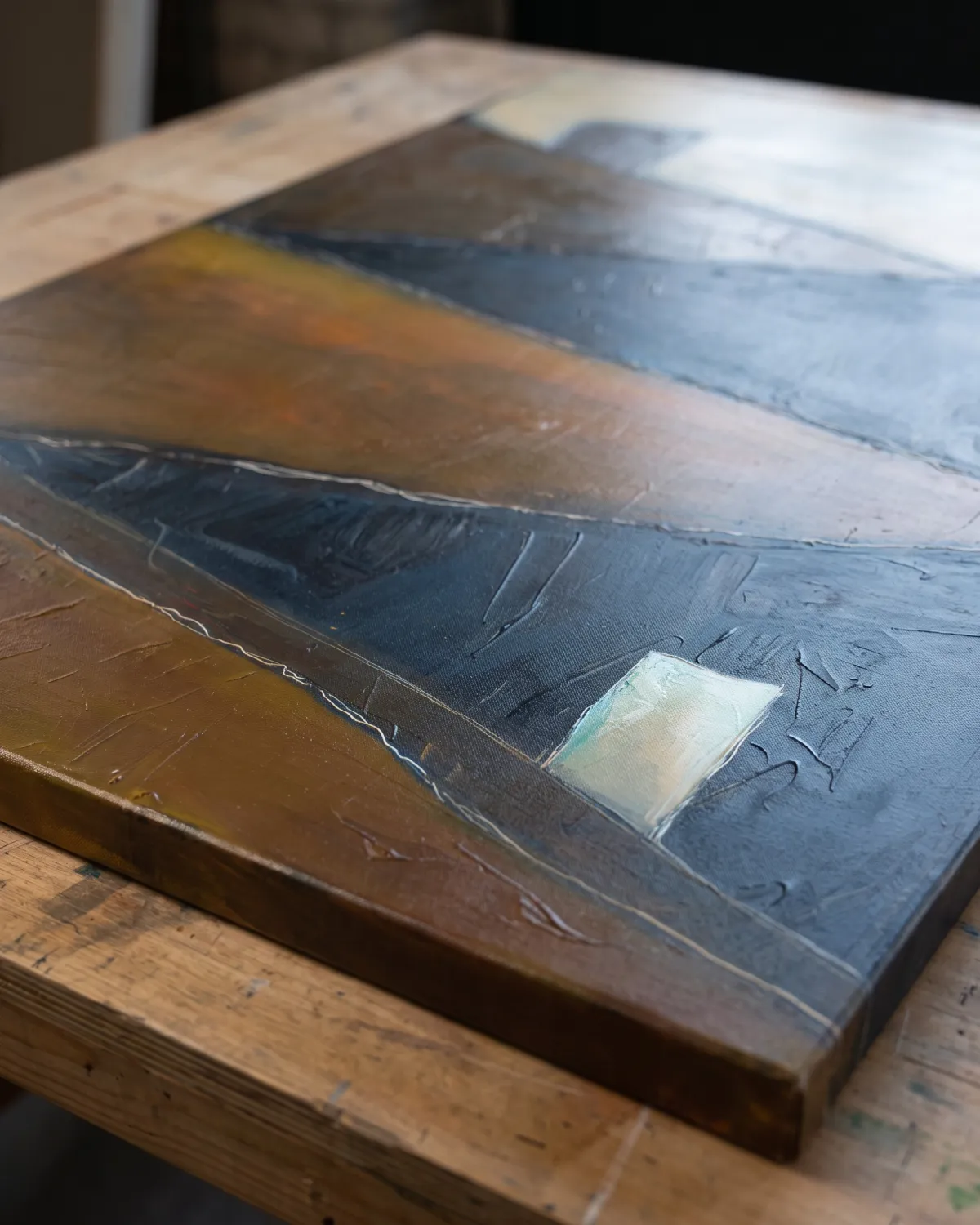
Seen askew on the studio woodwork, the canvas of TENSUM presents itself as a body rather than an image. It is no accident that the painting rests flat, stripped of the protective distance of the wall; in this tactile proximity, the heavy masses of ochre and bluish black reveal a scale that exceeds the purely geometric. There is a gravity in this distribution of forces that seems to reactivate an ancient, almost somatic scale: the way a small body measures the immensity of its surroundings. The broad oblique divisions do not function here as formal abstractions, but as the recreation of a space that presses down, tilting the ground and forcing the viewer to seek a foothold to sustain their gaze.
Sometimes, as I scrape the paint to open that thin, light line crossing the canvas, I recognize a gesture that does not entirely belong to me. It is not a design decision; it is the stubborn impulse of someone making an incision in the bark of a tree or scratching the paint of a low wall to leave proof of having been there. As a child, the world is measured by knee height and the physical limit of things we cannot move. That trembling line sewing together the two large masses of TENSUM is my way of negotiating with those inherited limits, a material scar attempting to unite the weight of what was already there with my own need to open a path.
This wounded and worn materiality connects the surface of the work to the tradition of Antoni Tàpies, where the wall ceases to be a constructive boundary to become a skin and an archive of impacts. In TENSUM, however, the accumulation of strata does not seek pure accident, but rather a tectonic organization that recalls the incomprehensible structures of childhood: giant wardrobes, transitory rooms, dark corners where danger and refuge shared the same shadow. The small, light rectangle resisting in the bottom right, enclosed by the dark mass, embodies this disproportion. It does not illustrate a specific memory of vulnerability; it is the very structure of fragility sustaining its presence against the immense.
I do not paint to remember names or dates, but to recover the temperature of the places I passed through when I still lacked words to explain them. Those harsh winters, the rooms where sleeping was a provisional pact, the feeling that the ground could tilt at any moment if the tensions of the adults became too dense. In the dark block settled at the top left, there is no monument to pain, but the residue of a presence that watched over the space. When I arrange these masses on the canvas, I am not illustrating a trauma; I am simply recreating the muscular and mental tension I learned to sustain so the world would not fall apart.
In the end, the natural light sliding over the rugged relief of the work reveals that the past is not archived in the mind like a photo album, but as a somatic geography. The decline of the crimson and ochre bands does not ask to be corrected or interpreted in a nostalgic key; it demands to be inhabited just as it presents itself, with the honesty of its falls and the resistance of its seams. In the quiet of the studio, TENSUM remains as a threshold where the first spatial relationships—the weight of the sky, the fragility of refuge, the suspicion before a closed horizon—meet matter once again. Childhood has not disappeared; it has sedimented into the canvas, turned into the slope the eye must climb once more.
- Original artwork
- TENSUM
- Actual dimensions
- 31.5 × 47.2 in / 80 × 120 cm
- Presentation
- Digital contextual visualization
Context references
abstract painting detail · textured material painting · studio painting process · maurizio valch artwork · incised lines in painting
About this visualization
This visualization places the artwork within an architectural context to help collectors and viewers imagine its presence in a real space. It is an interpretive reference, not an exact reproduction: the original work remains the sole authority for scale, color, surface and material presence.