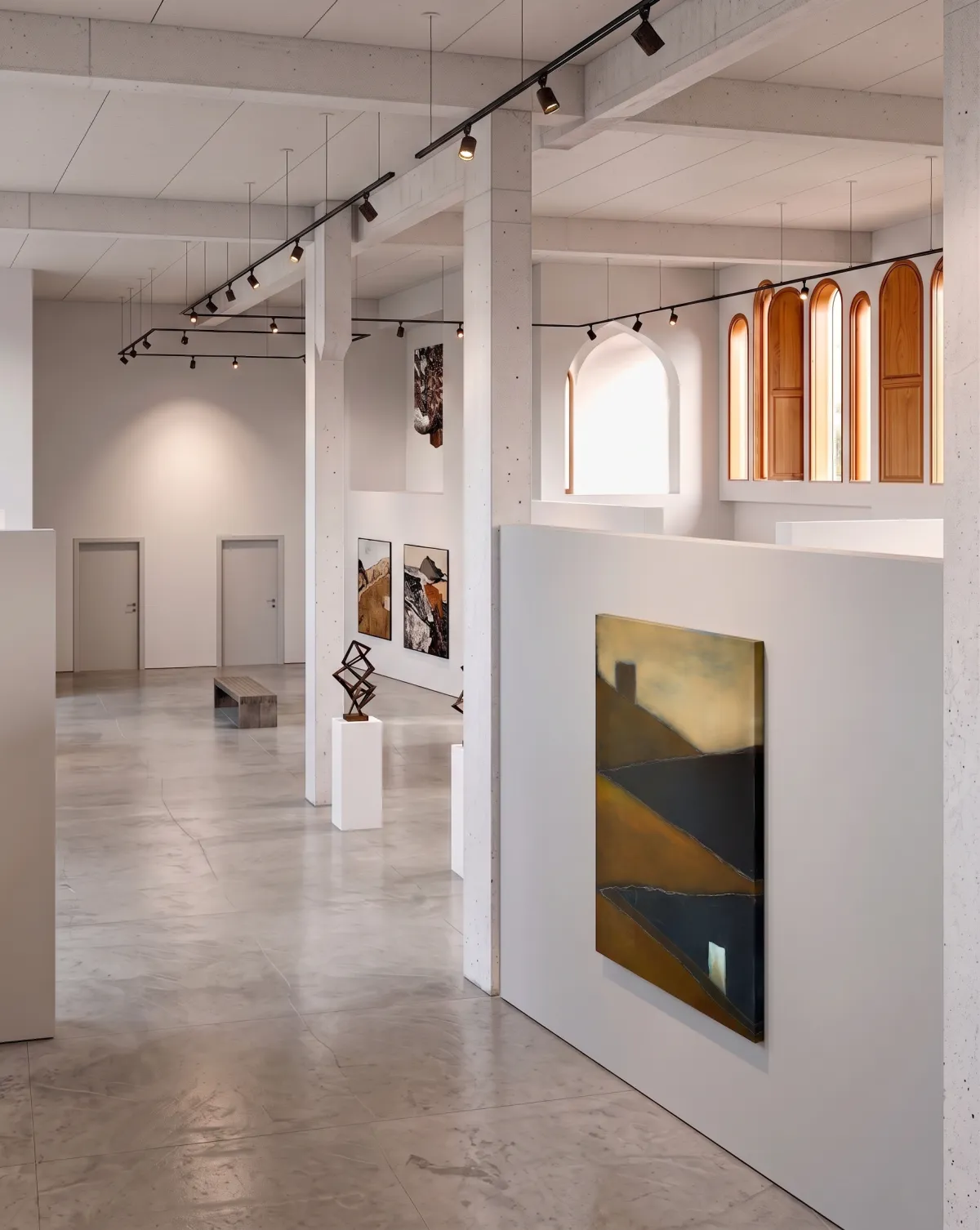
Context study / TENSUM
TENSUM – Maurizio Valch | Composition and Territorial Tension
At a certain distance, TENSUM does not offer a place to enter: it offers a place that is trying not to fall apart. The vertical extension of ochres does not quite end up being earth, wall, slope, or geological cut. It accumulates in sloped planes, in zones that become almost black, in light spots that do not illuminate so much as they delimit. There is a pressure distributed across the entire surface, although one does not know where it comes from. Something pushes from an edge. Something, from below, resists.
The dark bands cross the field with an irregular obstinacy. They are not lines drawn to separate colors. They reveal themselves as seams subjected to tension: some stretch with an almost elastic patience; others advance a stretch and suddenly thin out, detour, seem to give way. None completely closes off what it touches. Each contains a minimal escape.
What is holding this painting together so that its strata do not fall upon one another?
The question begins with gravity. The upper ochre seems to weigh more than the lower ochre, but it does not fall. The large central dark zone tilts as if it could slide to the right, yet it is held back by a light, broken, barely luminous edge. That edge does not seem solid: it seems occupied. Like a very thin rope doing the work of a beam.
There are two pale rectangles interrupting the field. One above, smaller and darker around itself; another below, light and isolated, almost at the edge of the black zone. They do not behave like windows. Nor like signals. They arrive too early to a conversation that had not yet decided what it was talking about. The lower rectangle, above all, has the awkward politeness of one who does not ask permission, but does not want to impose either.
A child's question could cross the painting without apologizing: does the black line know it is holding up everything above it?
It is not a minor question. The line seems to know something, but not everything. It has the thinness of one who has accepted a responsibility without being sure of having understood the conditions.
Constantin Brâncuși sought essential, condensed forms capable of holding an enormous presence with very few means. Here, one would want to withdraw almost everything: the excess vibration, the small bifurcations, the distracting spots. Leave an ochre slope, a large dark opening, a column of light, a rectangle below. Make the painting say with few forms: weight, cut, ascent.
The suspicion is fertile because for a moment it works. The painting seems to obey it. The upper band can be a cornice. The dark diagonal, a slope. The pale rectangle, a minimal reserve of air. Everything concentrates, becomes severe, even beautiful in an almost unshakeable way.
But one only has to get closer for that cleanliness to break.
The edges are not clean. They look jagged, slightly eroded, as if each layer had to negotiate its place. The darknesses do not have a single density: within them appear glazes, changes in perceptive thickness, non-coinciding inclinations. One line accompanies another without becoming its shadow. A light edge seems sewn to the dark one, but further down it no longer fits.
I look at the finished painting and recognize that it no longer belongs to me entirely. The bands present themselves to me as an architecture that did not accept my orders, or as a geography that continues to move even though I remain still in front of it. I wanted to think I could measure their separations, but now I feel that each edge retains its own will and that the tension between them is not there to obey me.
The tension changes direction. It is no longer only that which prevents a fall; it is also that which makes seeing possible. The eye follows the dark lines because they seem to promise an exit. It goes down a diagonal, stops at a light crack, takes up another band, turns back up. It looks like someone tracing a broken seam with a finger to find out where it began to open.
Charles Darwin learned to look at minimal variations, persistences, and slow changes without forcing a hasty explanation on them. He would not tolerate the painting being reduced to a single slope, a single opening, or a single balance. He would see that no edge repeats the previous one exactly: one trembles, another breaks; one supports a dark mass, another barely touches an area of ochre; one becomes thick like a scar, another thins until it almost disappears.
Then the painting ceases to be a pure form and becomes a family. Its strata resemble each other, but do not obey each other. There are kinships, not identities. Each line carries an inherited inclination and its own deviation.
Brâncuși would have to accept the correction, though not entirely. The essential form does not disappear from being wounded. It can continue to be a form and, at the same time, show the effort to maintain itself. It can contain an enormous presence precisely because it is not finished closing. The column does not have to be straight; the opening can breathe sideways; a slope can be made of small refusals.
Darwin, for his part, would stop before one of the rectangles. Perhaps the lower one. He would try to place it in the series of changes, find a function for it, a continuity, a reason for its pale insistence. But that rectangle does not cooperate. It does not seem to have evolved from the neighboring band nor to be heading towards it. It is there with an almost absurd calm. It does not adapt to what surrounds it. It explains nothing.
Try something brief now: cover the lower pale rectangle with your hand, without covering the dark bands passing near it. Keep your hand there for a few seconds. Then withdraw it slowly.
The space is not exactly the same again. The dark zone seems to have gained a depth it did not have before, or perhaps it has lost a necessary interruption. The hand reveals that the rectangle was not an added detail: it organized a distance. Without it, the bands are left lonelier, more tilted, as if they had to work suddenly without relief.
But neither can it be assured that it supported anything. Perhaps it was in the way. Perhaps its function was to introduce a useful discomfort, a small pause so that the eye would not believe too soon in the continuity of the bands. There are elements that keep a whole united not because they fit, but because they do not fit and force everything else to recalculate.
The question has changed. It is no longer just what physical force keeps the layers in place. Now it asks why the eye needs to traverse those boundaries as if it were looking for an exit, a descent, a practicable opening. The painting does not deliver a stable direction. Each line that seems to lead somewhere becomes, further down, a border.
There remains an unmeasured zone between the ochre that seems terrestrial and the black that seems to absorb it. It is not a vacuum. Nor a passage. The gaze reaches there and loses for a moment the habit of naming what it sees.
I no longer think that the tension only supports the painting. In front of it, my body looks for where to lean and discovers that what seemed to hold the forms together also separates them. I do not know where one band ends and the other begins; the two rectangles do not seem to be doors or objects either, but interruptions that have learned to look back. That possibility inquietudes me more than any balance.
Intimacy enters without the need for symbols. There are days, gestures, agreements, silences that do not remain united by being firm. They remain united because they pull in different directions and, for now, none has won. There is no need to convert the dark bands into fear or the light ones into relief. The painting is more precise than those equivalences: it shows a coexistence of pressures.
One line does not save another. It barely delays it.
And that delay can be enormous.
In the end, the minimal ripple of the light edge crossing the black band, just before reaching the lower rectangle, no longer seems like an imperfection: it seems like the point where the entire surface holds its breath.
- Original artwork
- TENSUM
- Actual dimensions
- 31.5 × 47.2 in / 80 × 120 cm
- Presentation
- Digital contextual visualization
Context references
buy abstract painting online · gallery contemporary art · ochre and black paintings · designer wall decor · artworks from the strata series
About this visualization
This visualization places the artwork within an architectural context to help collectors and viewers imagine its presence in a real space. It is an interpretive reference, not an exact reproduction: the original work remains the sole authority for scale, color, surface and material presence.