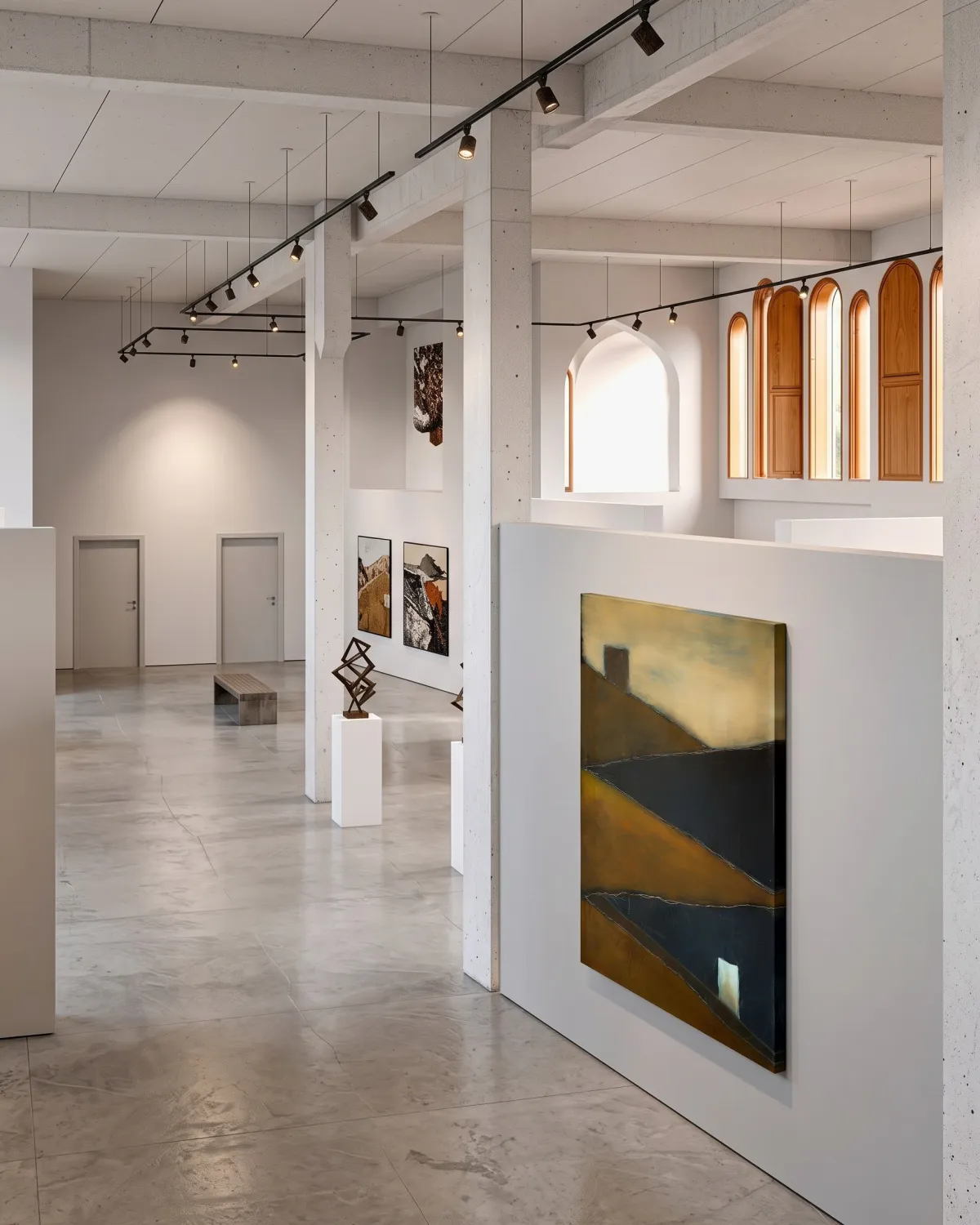
Context study / TENSUM
TENSUM by Maurizio Valch | Abstract Painting from the STRATA Series
The surface of "TENSUM" unfolds before the viewer as a topography of earthly tensions, dominated by a sharp zigzag of light incised lines that rawly segment the composition into planes of ochre, sienna, and deep black. This geometric fracture, crowned at the upper edge by a hazy, diluted atmosphere, seems to contain a rigid, almost predetermined dynamism. In observing the path of these lines bouncing from one edge of the canvas to the other, it becomes inevitable to invoke the ideas of G. I. Gurdjieff, a mystic who questioned human automatism and advocated for the necessity of self-discovery and awakening. From this perspective, the zigzag does not function as a fortuitous topographical accident, but as the visual representation of a mechanical journey—a structure of horizontal rebounds where human consciousness, asleep in its daily routine, moves mechanically without managing to ascend or free itself from pre-established inertias. One might ask whether these incisions scoring the pictorial matter are the scars of an alienating repetition or the borders of a confinement that numbs the vital impulse; a doubt that is heightened when contrasting the rigidity of this grid with the upper mist, that indeterminate space that seems to resist the logic of the imposed map.
When facing the support of "TENSUM", the process was not one of mere translation of ideas, but a direct combat with the physical density of the materials. I patiently accumulated successive layers of acrylic and oil, feeling the resistance of each stratum as it dried and gained gravity on the canvas. For me, tracing that zigzag was not about drawing a superficial line, but about making a physical incision—a violent, calculated cut that penetrated the sedimented layers to reveal the hidden substrate. I feel that this gesture of scratching and wounding the matter arises from an insoluble internal tension: on one hand, the imperious need to compartmentalize and order the initial chromatic chaos to make it intelligible; on the other, the latent suspicion that every limit I impose on the pictorial plane is also a self-inflicted wound, a restriction that imprisons the natural fluidity of the paint under the yoke of my own constructive will.
Within this cartography of limits and divisions, the drama of the composition is polarized through two monolithic blocks embodying opposing forces. In the upper left zone sits a dark, rectangular, and oppressive volume, while in the lower right corner emerges a small, vertical, white, and light-emitting structure. To decipher this spatial confrontation, it is enlightening to turn to Carl Gustav Jung, a psychiatrist who explored the deep images and structures of the unconscious. Under his lens, the dark upper block emerges as a manifestation of the collective or institutional Shadow, that which by its weight and inertia exerts a rigid, structural domination from above. In contrast, the lower luminous receptacle operates as an incipient Self, a core of essential consciousness that, though cornered at the base of the canvas, remains incorruptible. The considerable geometric distance separating them sustains the latent tension of the work, raising the question of whether the incised zigzag path is a bridge of integration or the condemnation to an endless oscillation that prevents the ultimate meeting of these polarities.
That small white block at the lower edge was not born from prior planning or a rigid conceptual program, but from a physical demand of the paint itself, which claimed a vanishing point, a breathing space against the suffocating accumulation of browns, ochres, and blacks. I decided to work that light not as an ethereal glaze, but through a dense, material impasto, applying the white oil paint with a palette knife to give it body and three-dimensional resistance. As I meticulously scraped its edges to define its silhouette against the adjacent darkness, I experienced the extreme fragility of that which seeks to manifest and keep itself pure in an environment dominated by sedimentation and the weight of gravity. Painting that stronghold of clarity was an exercise in manual resistance, an attempt to preserve a space of visual cleanliness against the pressure of the dark tones threatening to bury it.
By integrating these conflicting forces, "TENSUM" reveals itself as an existential battlefield that can be read in the light of the teachings of Osho, a philosopher and mystic who contrasted the freedom of being against the moral and institutional conditioning of society. The work poses a fundamental dilemma: are we witnessing the representation of a system of domestication where the individual is trapped in a labyrinth of mandatory routes under the watch of the upper monolith, or does the lower luminous block represent the possibility of a silent, radical disobedience? This latter path suggests that true liberation does not consist in laboriously climbing the ramp predetermined by the incisions, but in stopping and dissolving into the immediate space of self-awareness. In the end, returning one's gaze to the details of the canvas, one appreciates how the subtle irregularities of the texture, the overflows of the pigment, and the imperfections of the impasto wear away the severity of the incised lines, showing that the flow of life and physical change always end up eroding any rigid structure that attempts to contain them.
- Original artwork
- TENSUM
- Actual dimensions
- 31.5 × 47.2 in / 80 × 120 cm
- Presentation
- Digital contextual visualization
Context references
contemporary abstract painting · minimalist abstract paintings · living room wall art · modern interior design · textured painting with relief
About this visualization
This visualization places the artwork within an architectural context to help collectors and viewers imagine its presence in a real space. It is an interpretive reference, not an exact reproduction: the original work remains the sole authority for scale, color, surface and material presence.