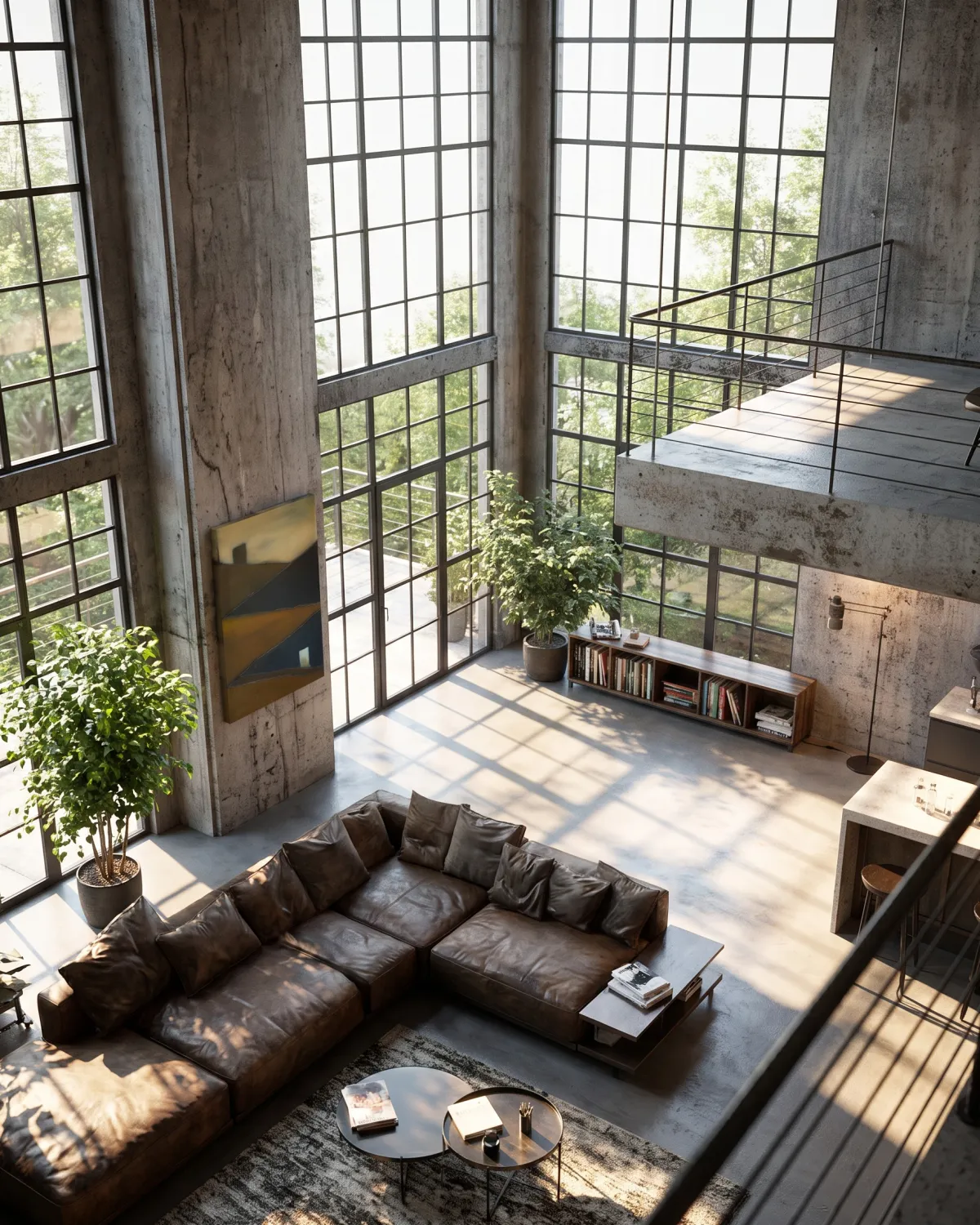
Context study / TENSUM
Abstract painting TENSUM in industrial loft | Maurizio Valch
The tectonic composition of TENSUM unfolds like a territory under suspicion, a vertical plane where the earth fractures through an implacable zigzag of dark slopes and strata of dense ochre and scorched earth. Space is not offered here for contemplation; it imposes itself through a severe orography that renounces all ornamentation to reveal that the essence of the landscape—and, by extension, of the existential experience that inhabits it—does not reside in stillness, but in internal pressure. The chromatic planes do not border each other peacefully, but collide at diagonal edges that continuously threaten to slide under the weight of their own gravity. This elemental structure, stripped of artifice, reminds us that what sustains the world is not a static harmony, but a precarious, physical equilibrium—a pure tension where each mass of color must actively resist the push of its neighbor to avoid collapsing into the void.
When I stand before the eighty-by-one-hundred-and-twenty-centimeter canvas, I understand that my task is not to accumulate pigment, but to dispute space with the opacity of matter. Those fine white incised lines that I trace to separate the large blocks of earth are not born from a desire to ornament, but from a demand for clarity. For me, clarity has never been a complacent, zenithal light that bathes the surface homogeneously; it is, on the contrary, a sharp cut, a gesture of violent subtraction with which I scrape away the accumulated layers of dark oil and acrylic to unearth the original ground. Carving that white line into the canvas is to open a necessary wound in the painting's relief: an absolute boundary that prevents the chromatic masses from merging into an undifferentiated chaos. It is at this narrow and painful border, where the pigment has been removed with surgical precision, that the space breathes and acquires its true metric sense.
Upon examining the surface closely, a formal correspondence becomes evident, endowing the work with a highly sophisticated internal architecture: the relationship between the monolithic, dark block settled in the upper-left quadrant and that small niche or window of pale light, an almost spectral turquoise blue, shining timidly at the lower-right edge. This binominal pair reveals the law of reciprocity governing all of Valch's painting. Far from acting as isolated poles of a simple duality, these two regions sustain a dialogue of compensatory forces: the crushing gravity of the upper mass requires, in order not to sink the composition, the small but stubborn luminous resistance pulsing below. A silent transaction is thus established, where the densest shadow and the faintest clarity pay their mutual debts of weight and volume through the diagonal slopes, proving that in this map of tensions no void is sterile and no mass is truly autonomous.
Concluding the work and observing the relief emerging from the lower areas, where the paint accumulates and cracks, I assume the loss of control that every genuine pictorial process demands. In that rough skin recorded upon the support, I recognize that reciprocity is not merely an internal rule of forms on the plane, but a physical pact between my hand and the unpredictable behavior of the material. I cut, press, and delimit the canvas, but the pigment, as it dries, imposes its own fractures, its subtle reliefs, and its geographical accidents that I cannot—and do not wish to—fully govern. The true essence of my search does not lie in subjecting the canvas to a rigid will, but in accepting this dialogue of frictions where matter responds to my gesture with its own mineral voice, transforming me in the same degree that I alter its rough and changing surface.
Ultimately, TENSUM solidifies as a field of forces where the three core concepts are indissolubly knit together. The clarity of its sharp incisions, the tectonic reciprocity of its chromatic masses, and the unstable essence of its decline merge to offer the viewer not an illusory window into a distant landscape, but a tactile, dense shore that appeals directly to the body. Standing before this canvas, one experiences the vibration of a structure holding itself at the limit of its own material resistance. Valch delivers a stripped-bare territory that, far from comforting us with false certainty, confronts us with the necessity of inhabiting the present in the very way its forms hold themselves on the plane: accepting that to live is to resist at the exact point of friction where the gravity of the earth and the insistence of light meet and sustain each other.
- Original artwork
- TENSUM
- Actual dimensions
- 31.5 × 47.2 in / 80 × 120 cm
- Presentation
- Digital contextual visualization
Context references
Paintings for high ceilings · Industrial loft decor with art · Large living room abstract painting · Maurizio Valch painter · Large format contemporary art · Leather sofa and art · Modern living room design
About this visualization
This visualization places the artwork within an architectural context to help collectors and viewers imagine its presence in a real space. It is an interpretive reference, not an exact reproduction: the original work remains the sole authority for scale, color, surface and material presence.