Context study / TENSUM
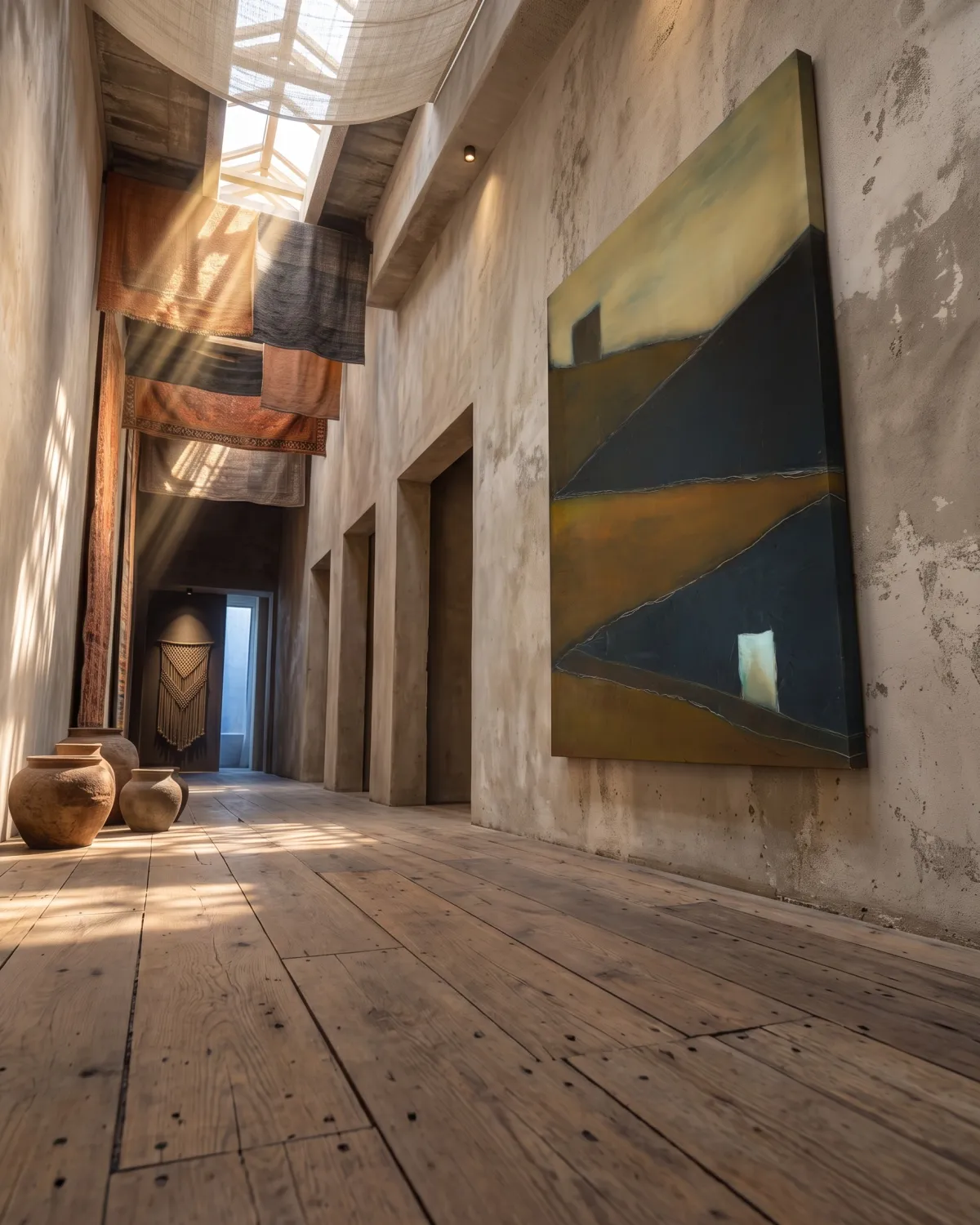
Artwork TENSUM in minimalist rustic hallway | Maurizio Valch
At a distance, TENSUM does not surrender itself as landscape or architecture. It seems, rather, a vertical extension that has been arrested mid-transformation: a ground that ascends instead of receding, a wall that retains the memory of having been a floor. The ochre, black, and yellowish bands do not form a recognizable view; they pile up, shift, and lean with a slowness that is not peaceful. There is a kind of pressure within them, as if the painting had been caught beneath something too heavy and, upon that weight being withdrawn, had preserved the traces of resistance.
Then comes the question that prevents us from looking with innocent eyes: what has occurred on this ground for two small rectangular presences to be separated by a geology of bands, as if one wished to speak to the other but the earth had learned to stretch out time?
Before deciding that these bands are slopes, cuts, levels, or corridors, it is worth looking at what they do. The light lines bordering the dark areas force the eye to descend diagonally; they do not allow a stable reading. One of them seems to offer support and then suddenly pulls away. Another gives the impression of holding up the top band, but following it reveals that it also pushes it downward. The body responds even while remaining still: the breath drops slightly, as if descending a poorly lit ramp; the gaze slips, regains its balance, and loses it again.
Slowly trace one of those lines with a finger, without touching the screen if you prefer. Start near the left edge of a dark band and follow it until it curves, thins, and becomes almost a tremor. Notice where you stop. It is not a line that leads: it is a line that delays. By following it, the eye does not travel across a surface but seems to pass through a resistance, as if the distance between one point and another had been stretched from within.
Mary Anning was a fossil hunter capable of reading stories in terrestrial strata that others did not know how to see. Here, she would linger a moment before the bands, not to translate them into geology, but because she would recognize something more unsettling: the way times can be compressed without becoming visible. The ochre would not simply be ochre; the black would not simply be shadow. Each extension seems to have covered the previous one without completely burying it. The painting offers layers, but it does not offer readable remains.
That would disconcert her. There are no bones, shells, or the unmistakable curve of an ancient creature. There is no proof to allow one to say: here lived something, here something ended. In TENSUM, the fossils might be the intervals: the band of dark air between two yellowish fields, the pressure that makes a light edge vibrate, the imperceptible displacement with which the gaze leaves one area to enter another. Perhaps the remains are not objects, but separations. Perhaps what has survived is the time it took for one form to stop touching another.
I felt that the bands did not want to stay in place. I was looking for orientation, and each light edge gave it back to me altered, like a taut sheet that appears flat until the light reveals the fold that diverts it. I could not look at one line without the next becoming more distant. I perceived that space was drawing away from me and that, the more I tried to order it, the more it insisted on behaving like a question.
In the upper-left area remains the first rectangle: dark, compact, barely separated from the large band that seems to support it. It could be a closed opening, a hardened shadow, a small structure without an entrance. But it is best not to decide. Lower down, towards the right, the second appears: pale, vertical, almost luminous, as if it had retained a light that fails to expand. Nor is it clearly a door, a window, a sign, or a figure. Both seem to have witnessed something. They do not participate in the movement of the bands; they endure it.
There is a childish, exact, and hard-to-abandon question: why are these two small things still waiting on opposite sides if neither knows how to cross? The painting does not answer, but the question changes the weight of the rectangles. They are no longer interruptions within the terrain. They are silent witnesses to a separation prior to them, or perhaps responsible for that separation continuing.
Balkrishna Doshi was an architect who imagined buildings and cities where space could be lived as an organism, a journey, and a community. Before this painting, he would first reject the idea of an immobile terrain. The bands could be traversable levels, landings, shadows where the body protects itself from excessive light. Their inclinations seem to ask for displacement: going down an edge, crossing an ochre extension, stopping at the dark limit, ascending again along another band. They would not be understood from above; they would demand to be walked by the gaze.
But the journey fails. The dark rectangle guarantees no access and the pale one promises no exit. Neither organizes a dwelling. Neither opens a community. If they are rooms, they lack doors; if they are buildings, they have forgotten what they were built for; if they are signs, they do not point in any direction. Doshi might attempt to make a home of this territory, but the painting would return to him an architecture without a fixed use: a house inhabited not with the feet, but with the eye, and even then, it leaves the eye outside.
There, Anning and Doshi do not agree. She suspects that the bands have been deposited over a duration too long to be crossed. He insists that every layer contains the possibility of a trajectory. She sees compressed times; he sees spaces still available. However, both are halted before the same problem: between the two rectangles, there is no neutral void. There is an active extension, an area that separates because it is working. The bands are not the background against which two forms stand out. They are that which prevents—or prepares—their meeting.
Now look alternately at the dark rectangle and the light rectangle. Do not look quickly: linger a moment on one, then on the other, and return. At first, the intermediate space seems a measurable distance. Then the bands widen, their light edges grow tauter, and the separation no longer belongs only to the painting. The eye fabricates it every time it jumps from one presence to the other. That ground stretches out time because it forces us to look in layers; each transition modifies the previous one.
Now it does not seem to me that the two rectangles are calling to each other. I see them as two forms that have learned to keep silent in different ways. The dark one feels more closed to me, but the light one offers no more comfort. I do not know which arrived first or which will outlive the other. I only recognize that between them lies a distance I cannot possess, because it changes every time I return to it.
Perhaps what has occurred on this ground is not a catastrophe, nor a construction, nor a precise memory. Perhaps the bands are an excavation that has not found its object, a plan for an impossible dwelling, an interior topography, or something that still lacks a name. What remains is not an answer about the two rectangles, but the pressure of the space keeping them apart: one band after another, one delay after another, while between them something continues to occur that language cannot yet reach.
- Original artwork
- TENSUM
- Actual dimensions
- 31.5 × 47.2 in / 80 × 120 cm
- Presentation
- Digital contextual visualization
Context references
Paintings for long hallway · Wabi-sabi decor with art · Rustic abstract art · Wood abstract painting · Maurizio Valch artworks · Vertical wall art · Residential art exhibition
About this visualization
This visualization places the artwork within an architectural context to help collectors and viewers imagine its presence in a real space. It is an interpretive reference, not an exact reproduction: the original work remains the sole authority for scale, color, surface and material presence.