Context study / TENSUM
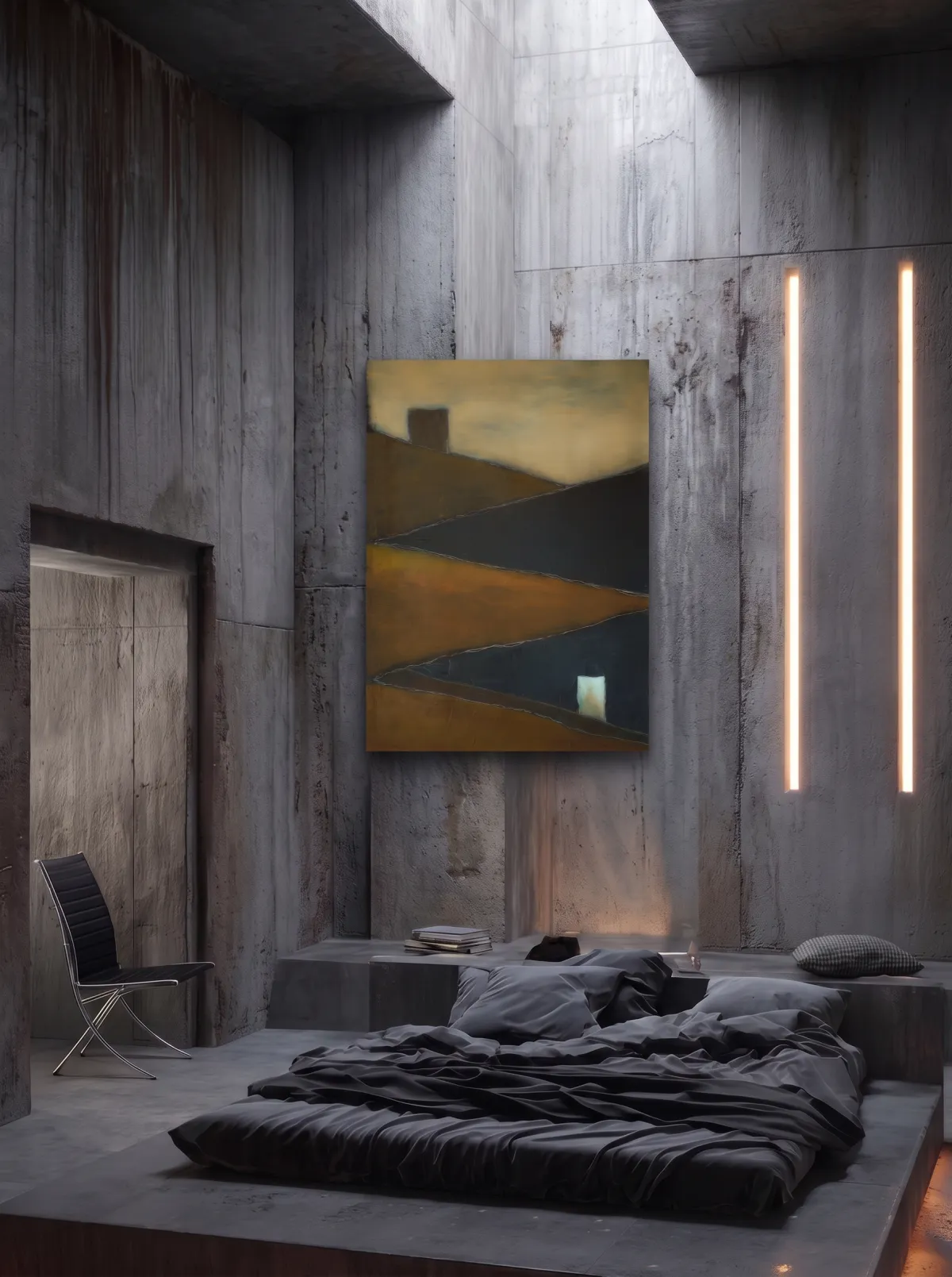
Abstract painting TENSUM in brutalist bedroom | Maurizio Valch
Exposed concrete, with its formwork marks and curing scars, surrounds TENSUM not as a neutral backdrop, but as a material echo of its own nature. In this bedroom of monastic atmosphere, the painting functions as a window that opens not to the outside, but to the geological depth of human time. The dark blocks and ochre bands that cross on the canvas do not represent an isolated geographical accident; they are the sedimentation of a shared journey, a heritage of divisions and slopes where the wear of generations seems to have settled. The brutalist architecture of the space and the textured surface of the painting speak the same language: that of matter retaining the trace of an ancient effort, reminding us that every ground we step on is, in reality, a graveyard of decisions and collective memories.
When I trace that light line that wounds the meeting between ochre and black in TENSUM, I am not drawing a boundary in a void. In my hand, I feel the weight of the thousands of steps I took on my Caminos de Santiago, but also the invisible footprint of those who walked those same paths centuries before me. The incision is not a sovereign gesture of authorship; it is an excavation in a soil that was already occupied by the fatigue of others. Scraping the oil paint to reveal the underlying light, I search for that seam where my individual memory dissolves into a wider geography, a common territory where the sloped hillsides do not belong to my biography, but to a somatic heritage of resistance and fall that we all share.
This territorial articulation connects the work with the sensibility of Richard Diebenkorn, where abstract planes retain the vibration of oblique horizons and lived distances, but in Valch’s work the space contracts under a much denser and more nocturnal pressure. The painting behaves like a weathered skin—a formal analogy that Antoni Tàpies explored thoroughly through the erosion of his pictorial walls—that has been exposed to the elements of history. The chromatic bands of TENSUM do not function as pure fields of color; they contain wrinkles, pressure variations, and small imperfections that betray a process of temporal accumulation. Here, territory becomes an archive of collective experience, a map where the borders between bodies and the earth have collapsed to reveal the same vulnerable geology.
For a long time, I believed that painting was a personal quest, a way of proving my strength by conquering the summit of a blank canvas, as if the artist were a hero forced to return with a trophy. However, in front of TENSUM, that pretension seems to me like a trap of thought. The dark rectangle I hung in the upper left is not a banner of victory; it is a mute presence, a monolith I found there that stared back at me, reminding us that the true movement is not individual ascent, but the acceptance of the slope. I have stopped fighting against the slant of the ochre; I have understood that painting is not inventing a new world, but learning to listen to the voices buried beneath the noise of my own story.
The skylight bathes the work in a vertical light that changes with the hours of the day, revealing the three-dimensionality of the impasto and the vibration of the yellowish glazes in the upper area. At the foot of this vertical composition, the light rectangle on the lower right edge flickers like a lamp lit in an abandoned room, a minimal sign of persistence amidst the dark mass. No resolution is offered to the viewer observing from the low concrete bed; the work remains there, suspended in its exhausted stillness, like an archaeological fragment that has survived its own era. It invites us to drop the urgency to explain what we see and to rest, simply, in the suspicion that we are the ones inhabiting a plane that has already been written by others.
- Original artwork
- TENSUM
- Actual dimensions
- 31.5 × 47.2 in / 80 × 120 cm
- Presentation
- Digital contextual visualization
Context references
Abstract painting for bedroom · Brutalist decor with art · Minimalist painting on concrete wall · Maurizio Valch STRATA · Dark abstract paintings · Industrial contemporary art · Monastic interior design
About this visualization
This visualization places the artwork within an architectural context to help collectors and viewers imagine its presence in a real space. It is an interpretive reference, not an exact reproduction: the original work remains the sole authority for scale, color, surface and material presence.