Context study / TENSUM
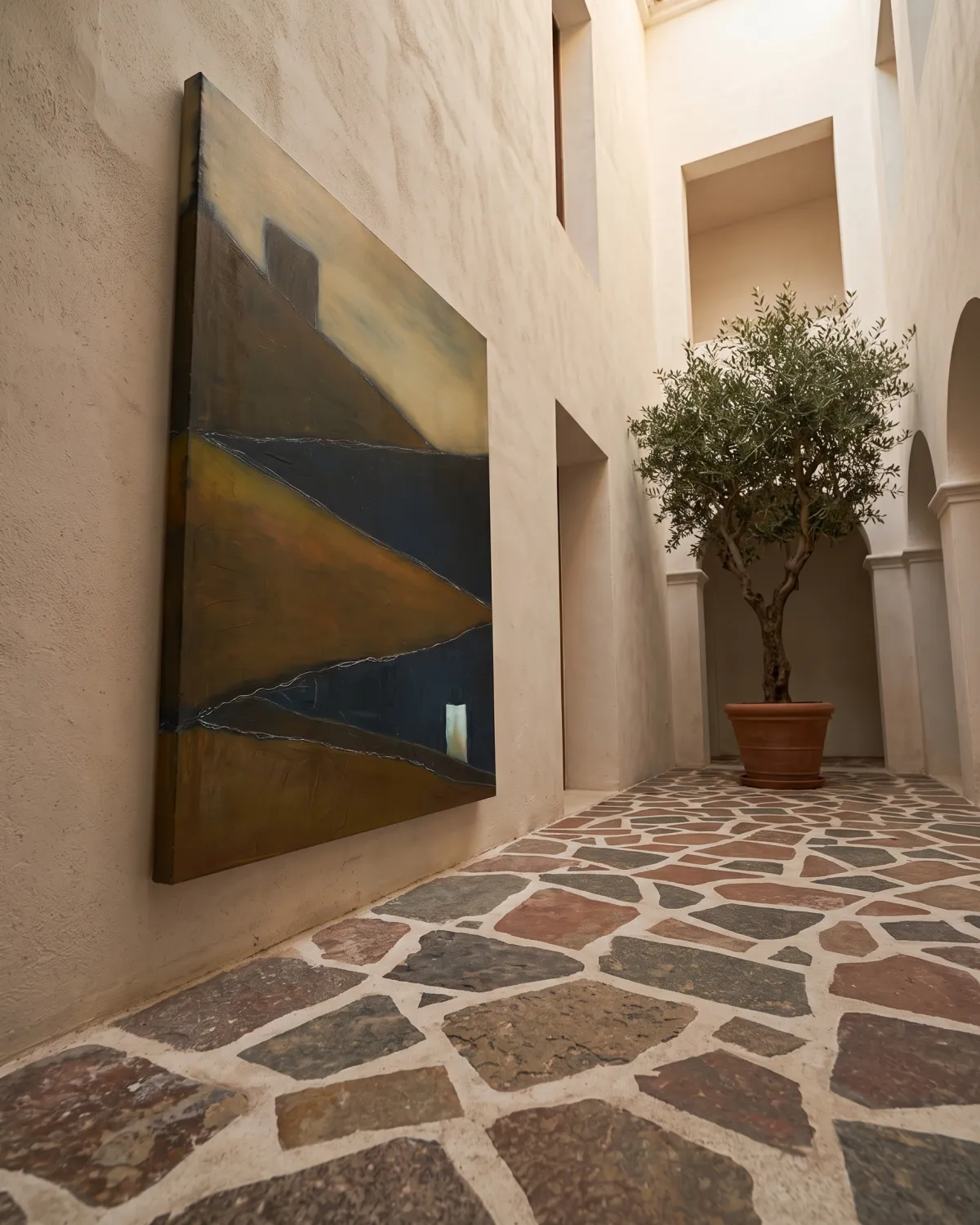
Abstract painting TENSUM in Mediterranean courtyard | Maurizio Valch
Structured in a vertical format of 80 by 120 centimeters, the artwork TENSUM imposes a severe geometric tension from the very first visual impact, dominated by diagonal planes that break and alternate in a rigorous descending zigzag. The pictorial surface is not organized through a harmonious transition of color, but through almost tectonic faults, delimited by incised white lines that cut through the matter with sharp precision. This compartmentalization of space immediately evokes the thought of the Armenian mystic George Gurdjieff, who dedicated much of his work to investigating the mechanical nature of human existence and the urgent need to provoke "conscious shocks" to awaken the individual from their automatic sleep. Contemplating the fractured structure of the painting, one might wonder if this violent and interrupted zigzag path functions as a ladder of conscious effort through which perception must ascend, fighting against the gravity of the dense chromatic fields, or if it represents the design of an implacable territorial machinery tasked with domesticating the void of the canvas plane.
When I face the blank canvas, I do not seek a docile representation of nature, but a physical confrontation with matter; therefore, the execution of TENSUM demanded that my own hand intervene in the pigment not with the delicacy of a brush, but with the violence of the incision. Those white lines that shape the zigzag are not superimposed strokes, but wounds I opened directly into the accumulated layers of paint, revealing the painting's internal memory. This practice is rooted in my experience of the southern Mediterranean, a territory where the dry, clay-like earth cracks under an absolute sun, opening into crusts that expose the hardness of what lies hidden. In this painting, the scar is the foundational element: a physical, three-dimensional border that holds the blocks of color, preventing them from collapsing onto one another and forcing the gaze to linger on the material limit of the paint.
From an analytical viewing distance, the composition reveals an absolute polarity that organizes the visual drama of the work through two opposing geometric landmarks. In the upper-left corner sits a dark, heavy, and impenetrable block, reminiscent of an archaic monument of European prehistory, like a Neolithic dolmen or menhir claiming the weight of tradition and the unrevealed unconscious. In contrast, in the lower-right corner, a small, white, and seemingly translucent quadrangular block shines, acting as a subtle emanation of light. It is in this tension where the thought of Carl Gustav Jung and his exploration of the collective unconscious intervenes; the upper block behaves as the archetypal Shadow, the dense weight of the inherited past, while the lower gleam symbolizes the "Self", the first spark of individuation struggling to define itself at the base of the territory. Thus, a conceptual friction is generated between the mechanical nature of the Gurdjieffian shock and the slow maturation of the Jungian symbol within this map of forces.
In the intimacy of the studio, preparing the palette for TENSUM was an exercise in restraint and weight, seeking a direct confrontation between earth ochres, loaded with oxide and organic density, and a blue of almost nocturnal depth that pushes from the background like a silent tide. My interest did not lie in illustrating an external landscape or documenting a personal psychological crisis, but in conducting a rigorous investigation into the concept of the threshold and the notion of situs—that is, the exact position a body occupies in space and how that position determines its existence. Observing the small luminous block in the lower corner, I find myself struggling with an unfathomable ambiguity: I do not know if that light is painstakingly managing to emerge from the dark matter surrounding it or if, on the contrary, it is about to be definitively buried by the implacable weight of the ochre plane descending upon it.
Ultimately, the viewer's gaze must return to the physical and textured surface of the canvas, where the wound of the engraving becomes the true support of the work. There is a direct link between the contemporary rigor of this painting and the first geometric strokes our ancestors engraved on the rocks of Paleolithic caves to delimit the sacred and the habitable against the chaos of nature. TENSUM places us before an existential and formal paradox that remains open and unresolved: the incised zigzag path is rough, fractured, and demands a violent effort of perception to be traversed, but it is, at the same time, the only structural element that holds the composition together, preventing the work from collapsing into a flatland of absolute silence and docile stillness.
- Original artwork
- TENSUM
- Actual dimensions
- 31.5 × 47.2 in / 80 × 120 cm
- Presentation
- Digital contextual visualization
Context references
Maurizio Valch TENSUM · Mediterranean abstract painting · Abstract painting in patio · Minimalist art decor · Large abstract paintings · Original contemporary art · Spanish territorial art
About this visualization
This visualization places the artwork within an architectural context to help collectors and viewers imagine its presence in a real space. It is an interpretive reference, not an exact reproduction: the original work remains the sole authority for scale, color, surface and material presence.