Context study / TENSUM
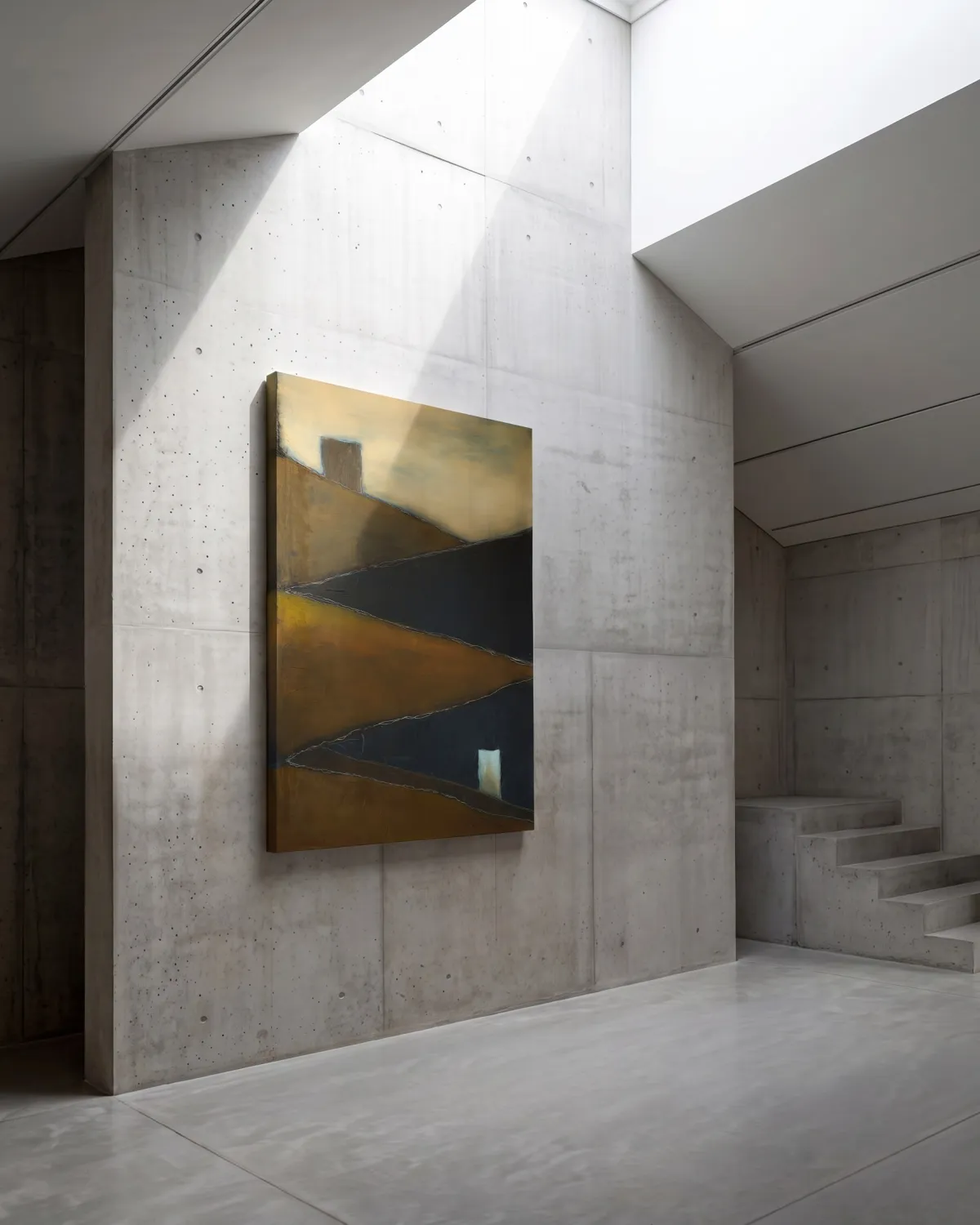
Painting TENSUM by Maurizio Valch in brutalist concrete space
The overhead light sliding down the exposed concrete wall does not merely illuminate the surface of TENSUM; it places it in a time that seems in no hurry. In this presentation, the brutalist scale of the space and the presence of the stone staircase in the background act as a frame that strips the painting of any decorative temptation. The bands of ochre and black color do not represent a private geographical accident, but behave as a parallel architecture, a relief of strata and pressures that dialogues with the solidity of the surroundings. The painting ceases to be a window hung on the wall to become a wall that remembers, a surface where the density of the pictorial material and the severity of the concrete space coincide in the same language of resistance and permanence.
When I work with the incisions on the thick oil paint, I do not seek to draw a precise boundary, but to open a split that reveals what has been buried beneath the successive layers of color. In the studio, as I drag the spatula to define that pale line winding in TENSUM, I know I am not inventing a new path, but recovering the trace of an old wear. It is a physical gesture, one of subtraction, that returns me to trodden paths, to temporary rooms, and to that fatigue shared with so many others who have stepped on the same earth before me. Those two rectangles, the dark one that interrupts the clarity at the top and the light one that resists below, are not symbols with a closed translation; they are silent presences holding up the painting, like the stone milestones that travelers leave at the edge of the path to signal that an encounter occurred there.
The zigzagging line that organizes the composition functions here as a suture, an irregular seam that attempts to hold together two masses pushing in opposite directions. This formal tension evokes the materiality of Antoni Tàpies, where the surface is understood as a weathered skin or a wall exposed to the erosion of time, capable of registering the traces of a collective action. By renouncing traditional perspective, Maurizio Valch's work proposes a navigation map discovered by subtracting material, allowing the vibration of the paint to act as a tactile threshold. The wound on the canvas ceases to be a purely individual conflict to become a symbolic bridge: a common mark where any viewer can recognize the friction of their own limits and the memory of the structures that sustain or divide us.
For a long time, I harbored the belief that each painting had to be the testimony of a great inner quest, another step in a definitive ascent toward some kind of resolution. However, observing TENSUM in this silent space, I understand that the true strength of the work appears when I accept the decline, when I renounce the tyranny of the ladder that claimed to lead me to a non-existent summit. The zigzag crossing the canvas is no longer a path of self-improvement, but the acceptance of a weight and of a controlled fall, a dynamic balance sustained in pure matter. By deposing the need to explain myself through paint, the picture empties itself of my psychological theories and becomes fresh earth, a territory free of my nights and my sorrows that simply offers itself to the gaze of the other.
The exhausted stillness emanating from the work integrates into the architecture of the room without competing with it, transforming the distance between the viewer and the canvas into a zone of somatic resonance. The two blocks of color, functioning as counterweights of a suspended scale, do not impose a narrative reading, but guard a secret that resists being domesticated by verbal analysis. By collapsing the analytical distance, the inside of the painting and the outside of the room unify in a continuum of pure presence. TENSUM then reveals itself as that tactile shore where the private experience of the creator and the collective memory of the viewer meet in a fabric without borders, demonstrating that the true cultural bridge is not built with discourses, but with the honesty of a surface that does not hide its cuts.
- Original artwork
- TENSUM
- Actual dimensions
- 31.5 × 47.2 in / 80 × 120 cm
- Presentation
- Digital contextual visualization
Context references
abstract painting in brutalist space · minimalist decor with exposed concrete · avant-garde art for modern interiors · Maurizio Valch painting with natural light · decoration with large format paintings
About this visualization
This visualization places the artwork within an architectural context to help collectors and viewers imagine its presence in a real space. It is an interpretive reference, not an exact reproduction: the original work remains the sole authority for scale, color, surface and material presence.