Context study / TENSUM
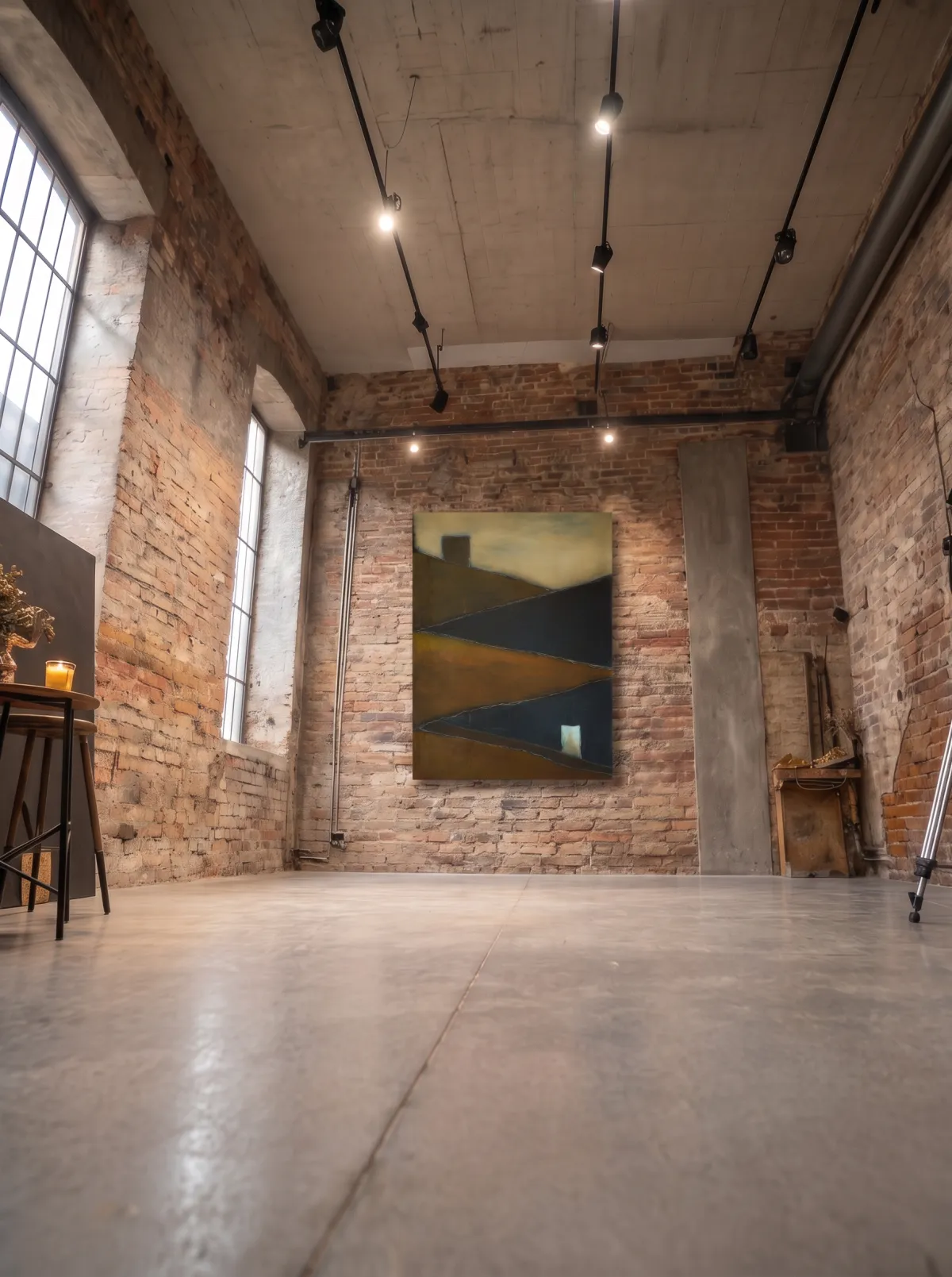
Abstract artwork TENSUM by Maurizio Valch on brick wall
From a distance, TENSUM seems to have found a temporary way to avoid falling. Nothing is horizontal, yet nothing plunges. The ochre, yellow, and blue-black bands drift as if each had chosen a different gravity; they lean on one another without quite meeting. It is wise not to decide yet which is the ground. The bottom edge could be a wall noticed too late. The upper zone might be descending. Look first without correcting the image with your body: let your neck want to tilt, and do not help it.
There is a question that organizes the risk: which of the two small openings holds up the tilted world of TENSUM, and which is about to make it fall? The dark one, on the upper left, seems to have been installed before the landscape learned to tilt. The pale one, on the lower right, seems to have arrived later, too straight for this place. Neither quietly accepts the name of door. Neither offers a reliable scale. Rather than opening, they interrupt.
Go down along one of the light lines. Do not follow it as one follows a contour, but as one feels a seam with a fingertip. The line does not completely separate the bands: at times it seems to hold them together under tension. At times it seems to contain a leak. Why do the light lines not fall if everything else is tilted? That is the question of someone who still believes things must obey the ground, and for that reason, it serves better here than an adult question.
I do not know for certain where one band ends and the next begins. The tilt does not present itself to me as an effect I can master; it behaves as a resistance that began to grow outside my will. There are areas where the surface seems to retain a decision that no longer belongs to me, as if it had been tensioned before I could withdraw my hand.
At the bright edge appears Lise Meitner. She was a physicist whose way of thinking helped explain how a nucleus can split and release a previously invisible energy. Here she does not search for an explanation hidden behind the paint; she distrusts its visible continuity. She sees a mass of strata pretending to be a single thing and suspects it is already split. Not by a spectacular crack, but by the minimal distance between two planes of color that no longer share exactly the same tilt.
Her hypothesis is uncomfortable: the pale opening, the one at the bottom, could be the anomaly. Not because it shines or because it seems to escape the dark surroundings, but because it remains vertical where everything else has accepted deviation. This small insistence reorganizes the weight of the nearby bands. If you imagine it removed, the lower bluish band ceases to contain the ochre that precedes it; it becomes less of an edge and more of a spill. Meitner does not call this a fall. She refuses, with a certain stubbornness, to call "ground" something that behaves like a suspended decision.
Try a simple maneuver now. Cover the dark rectangle on the upper left with one hand. Keep your other hand still and watch which zone begins to weigh more: perhaps the high ochre widens, perhaps the central black becomes too long. Then cover the lower pale rectangle. Do not compare quickly. Wait for two breaths. If, by hiding it, the composition seems to tilt to the left, the light opening was not a detail; it was holding back part of the painting. If, instead, the weight becomes more stable, perhaps it was the one introducing the error.
The test does not resolve the dispute. It worsens it. When you return your hand, both rectangles seem less like objects and more like errors of measurement: one makes the painting stretch upward; the other forces the eye to descend. The dark one ceases to be solely a heavy presence. The pale one ceases to be solely a point of relief. Each seems to have learned to depend on the other without admitting it.
Halfway down the slope enters Eileen Gray. She was a designer and architect who imagined spaces where bodies, furniture, and light could negotiate a different way of living. Her first attempt is not to decipher; she tries to inhabit. She looks for a slope to rest her palm against, a corner where the shoulder does not have to correct itself, an edge that allows the knee to bend. She finds very little. In TENSUM no one quite knows how to sit. A chair would slide, a table would choose its own angle, and even a glass of water would have excessive opinions.
Gray believes at first that the problem is one of circulation and shelter. The dark opening could be too narrow an access, an entrance that admits the gaze but not the body. The light one, below, might seem more hospitable due to its restrained size and low position. But as she gets closer, the straightness of the pale rectangle strikes her as suspicious: it does not behave like a window. It seems like an object that has remained standing out of obstinacy, with no wall to protect it and no room to claim it.
Then she discovers what her first physical measure had left out: there is an energy that fits in no room. The bands are not moving walls, because they do not offer a stable inside; they are surfaces negotiating their proximity without ever fully touching. The architect can no longer decide where she would enter. She can, instead, notice that the light line does the work of a hand holding a cup about to spill.
Meitner, hearing that imaginary hand, must also correct herself. The division she saw is not enough. A fissure does not only release or separate; sometimes it distributes care. The light lines do not calculate; they insist. They seem to run along the edges to prevent the bands from ignoring one another. But the physicist retains her suspicion: that this attention is holding up precisely what will eventually break.
After that friction, I no longer believe the two rectangles are there to answer anything. The dark one does not allow itself to become an entrance, and the pale one does not accept being an unreserved support. One of them, perhaps both, seems to observe the tilt with a patience that the painting does not grant the viewer. The distance between the bands keeps something I cannot cross, and that distance matters more than any promise of balance.
Return now to the initial area, to the dark opening at the top. It no longer weighs solely because it is dark, nor does it stand apart solely because it is upright. It has become capable of retrospectively tilting the bands that seemed to support it. Gray would maintain that the light one needs to be protected: without it, there is no place where the body can stop, even poorly. Meitner would reply that the dark one contains the decisive irregularity: one only has to imagine it shifted a few centimeters for the entire system to change pressure.
Do not choose yet. Look for a few seconds at a light line bordering a dark band. Ask yourself if it is delimiting a territory, patching a rupture, or trying to prevent part of the painting from breaking away. Keep your eyes there until the line ceases to look like a passive edge. Perhaps it is working. Perhaps it is trembling. Perhaps it holds up the tilted world of TENSUM while one of the two openings, without warning, learns to let go.
- Original artwork
- TENSUM
- Actual dimensions
- 31.5 × 47.2 in / 80 × 120 cm
- Presentation
- Digital contextual visualization
Context references
abstract painting in industrial living room · modern painting on brick wall · contemporary art for loft · Maurizio Valch STRATA series · minimalist large format paintings
About this visualization
This visualization places the artwork within an architectural context to help collectors and viewers imagine its presence in a real space. It is an interpretive reference, not an exact reproduction: the original work remains the sole authority for scale, color, surface and material presence.