Context study / TENSUM
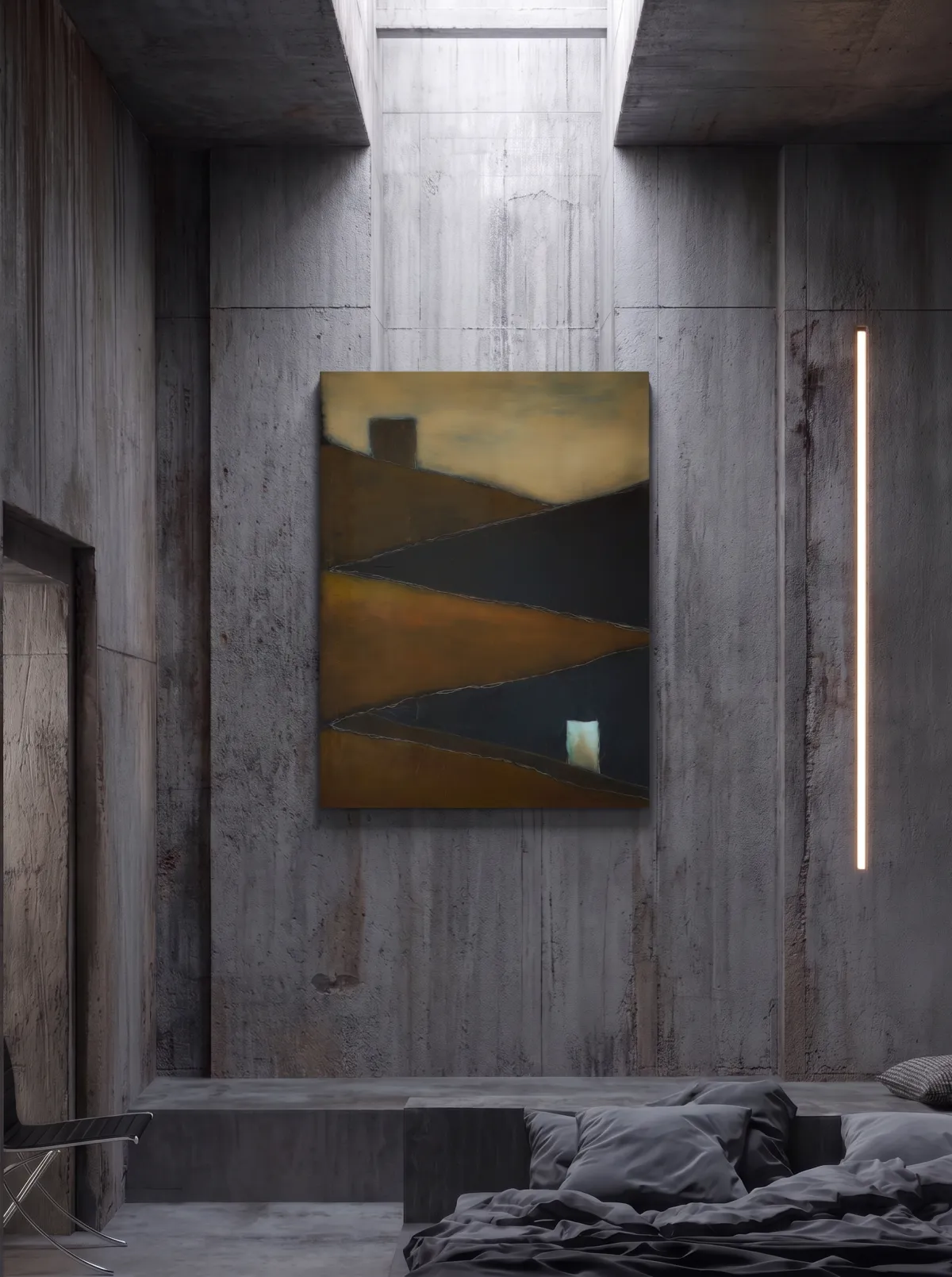
TENSUM Artwork by Maurizio Valch in Brutalist Bedroom
Hanging beneath the relentless verticality of a brutalist skylight, the painting seems to wound the surrounding concrete orthopedia, disrupting the perpendicular peace of the bedroom with a violent instability. While the series to which it belongs seeks the stillness of sediment and the compression of horizontal layers settling like skin or silent geography, this piece introduces a dynamic fissure. The composition does not accumulate; it slides. The ochre and dark bands do not rest upon one another but collide in an oblique zigzag that disobeys the law of the level, forcing the gaze to enter along a slope that seems to be crumbling into the real space of the room.
Working on this canvas, I immediately felt the resistance of the material to being flattened under the order I had established for the other surfaces in the series. I was looking for the safety of the compact stratum, but every white incision and every glaze dragged by the palette knife demanded a decline, a falling motion that broke the pact of silence of the previous works. I realized that the visual coherence I was trying to protect was becoming a comfortable trench, a way of avoiding the accident. By allowing the terrain of the painting to tilt in this manner, I accepted that the true tension of a system is only revealed when it is pushed to the brink of its own collapse.
The presence of the two rectangles—the opaque block in the upper left and the small luminous niche in the lower right—radicalizes this formal insubordination. Instead of functioning as the stable monoliths that anchor the space in the rest of the series, here they act as precarious counterweights on a scale about to tip. The upper block seems to press down on the light mass, while the lower one resists with almost physical obstinacy in the darkest corner, altering the scale and weight of the entire structure. This exception throws the viewer's contemplative reading into crisis: it is no longer possible to look at the work from the distance of one deciphering a map; the body is forced to find an invisible support to avoid slipping down the diagonals.
Now that I see it installed in this high concrete vault, I am struck by how that small, light block in the lower corner supports the entire black mass coming down upon it. I did not paint it as an exit or as a symbol of hope, but as the record of a muscular effort, the mark of something that refuses to yield even though all the territory around it has decided to slide. Sometimes, the only way to understand the strength of a structure is not by observing its symmetry, but by inhabiting the very moment it begins to break. This painting is the witness of that suspicion: a physical fact that destroys my own theory about the order of the canvas.
Ultimately, the work is situated on the frontier where the viewer must decide whether to cling to the known rules of the series or surrender to the uncertainty of the slope. By betraying the compact horizontality of the sediment, this piece does not destroy the whole, but endows it with a new vibration, proving that the solidity of any territory is always a temporary truce. The painting remains suspended before us like a visual clinamen, a minimal detour that introduces danger and movement into a world of concrete, reminding us that the most honest beauty does not reside in perfect balance, but in the imminence of the fall.
- Original artwork
- TENSUM
- Actual dimensions
- 31.5 × 47.2 in / 80 × 120 cm
- Presentation
- Digital contextual visualization
Context references
minimalist interior art · contemporary bedroom paintings · large scale vertical art · concrete wall decor ideas · dark abstract wall art
About this visualization
This visualization places the artwork within an architectural context to help collectors and viewers imagine its presence in a real space. It is an interpretive reference, not an exact reproduction: the original work remains the sole authority for scale, color, surface and material presence.