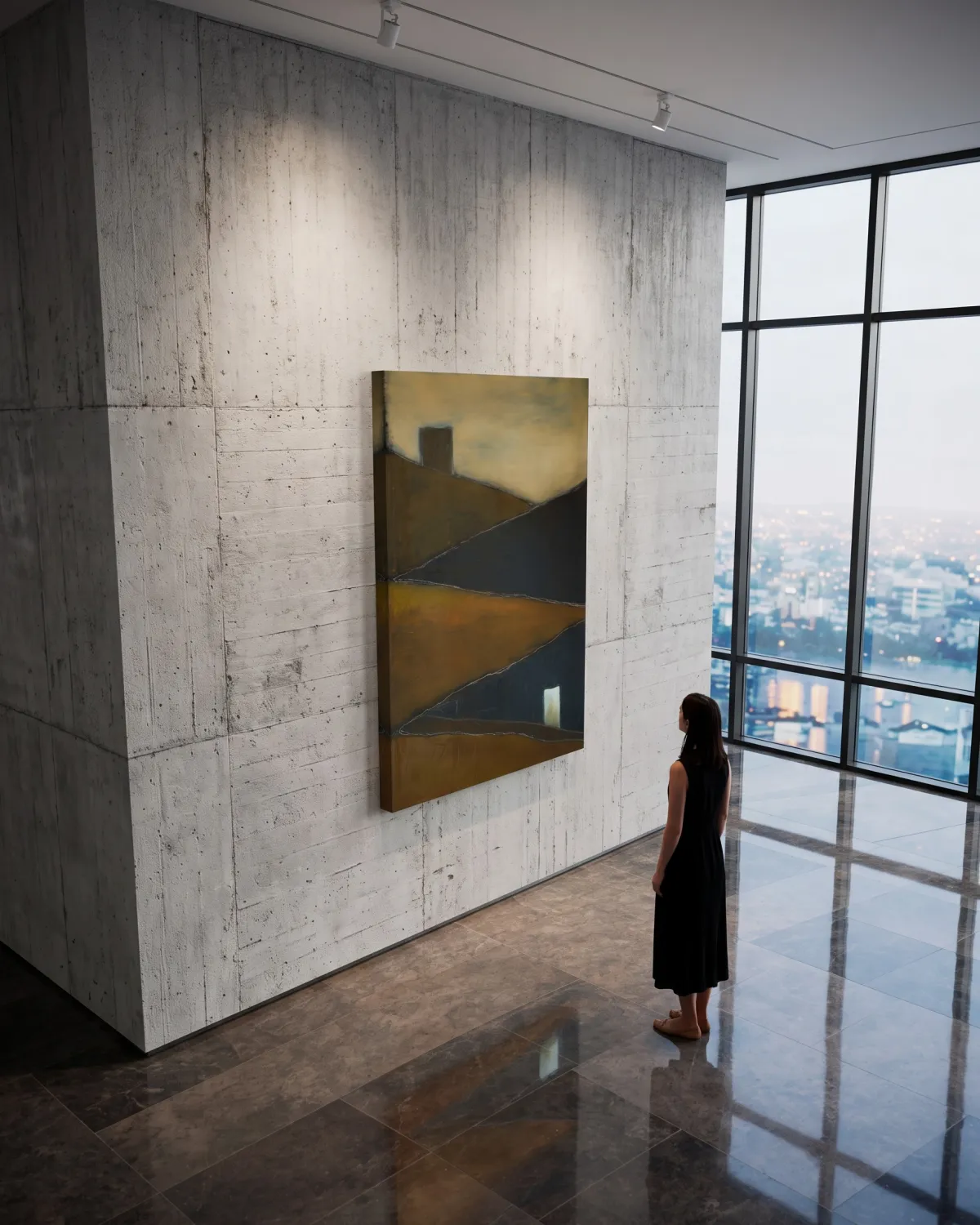
Context study / TENSUM
TENSUM — Context Study
The imposing verticality of TENSUM asserts itself in space like a piece of brutalist architecture carved in two dimensions. On its eighty by one hundred and twenty centimeter surface, the canvas is organized through a rigorous geography of tensions where the earth seems to have folded under immemorial tectonic pressure. The composition is articulated in a series of broken zigzag planes, chromatic bands of ochre, brown, and an almost absolute mineral black that segment the canvas into steep slopes. These chromatic masses do not meet softly; they are flanked and delimited by thin whitish incisions, lines that operate as seams or exposed wounds on the crust of the painting. This sinuous and rugged flow plastically embodies uncertainty: the path proposed to the gaze does not offer a linear trajectory or a peaceful horizon, but a broken transit that forces detours, exposing us to the instability of a terrain that abruptly changes direction. However, against the disorientation caused by this constant fracture, the wide blocks of dark color act as a counterweight of tectonic gravity, offering a dense and protective refuge. They are masses of compact matter that arrest the fall of the eye, a sanctuary of material where the fatigue of the search settles and finds a truce against the void of the slope.
When facing the wet material of this canvas, my gesture does not seek the complacency of a fluid stroke, but friction with the very resistance of the pigment. It is a physical process of subtraction: I sink the palette knife and the stylus into the dense layers of oil paint to scrape the surface, opening those incised lines that separate and tension the planes of the composition. Each white furrow I carve is an act of force where I sculpt uncertainty directly into the body of the painting, an incision that interrupts the continuity of the land and reveals the underlying layers of hidden light. In the upper left corner, I erected a dark and monolithic block, a heavy, geometric presence that crowns this abstract landscape. While working on it, I wondered if this structure acts as a monument silently watching over the decline of the slope, or if it represents a firm, definitive stone boundary—a buttress offering a definitive refuge to the exhausted mind that has managed to climb through the detours of the painting to finally seek shelter from the elements.
At the lower right end of the composition, suspended over the darkest and most abyssal plane of the painting, emerges a formal anomaly that subverts the geological gravity of the work: a small rectangular niche vibrating with a cold light of turquoise nuances and pure whites. This point of contained luminosity acts as a radical counterpoint to the telluric heaviness that dominates the rest of the surface of TENSUM. It is at this precise threshold where the concept of jubilance manifests. In the austere universe of this proposal, jubilance does not translate into a loud celebration or an overflowing chromatic explosion; it is, on the contrary, a muted joy, a clandestine and latent vibration. It is the silent birth of light sprouting from the deepest, innermost layers of the pictorial material, a reminder that beneath the accumulated weight of earth and shadow there is a core that resists, a flash making its way through the darkness to testify to the persistence of a clarity that cannot be buried.
Painting joy or the flash within such an austere palette, dominated by the tones of stone, coal, and wet clay, poses a paradox that guides my entire practice. That small luminous niche I decided to place at the base of the work is not an accident, but the exact moment in which I allow the dense matter to breathe, opening a channel of air and clarity in the middle of the canvas's opacity. For me, true jubilance is not found in reaching the peak of the painting—there where the hermetic monolith watches from its isolation—but in the capacity to sustain, inch by inch, the insoluble tension between the protective shadow that offers us refuge and the crack of uncertainty that destabilizes us. My work consists in forcing these two opposite states to coexist on the surface of the canvas, allowing the painting to be the physical territory where the wound of the path and the promise of permanence are reconciled.
When contemplating TENSUM in its entirety, the work ceases to be a passive landscape to become a true "tactile shore," a boundary where the viewer is invited to bodily experience the forces of gravity, detour, and ascent. The textured surface of the canvas annuls the intellectual distance of the observer, dragging them into a plane of physical confrontation with the material. The genius of the painting lies in how it collapses the border between the body that looks and the represented territory, proving that refuge, uncertainty, and jubilance are not successive stages of an existential transit, but strata that overlap and feed each other beneath the skin of the paint. In this plane of chromatic sediments and incised lines, we are handed a cartography of resistance: a space where the sanctuary of shadow and the wound of doubt meet under the silent light of a jubilance that, though hidden, remains unyielding.
- Original artwork
- TENSUM
- Actual dimensions
- 31.5 × 47.2 in / 80 × 120 cm
- Presentation
- Digital contextual visualization
Context references
large vertical abstract painting · spanish contemporary art · paintings by maurizio valch · minimalist brutalist decor · original oil artworks
About this visualization
This visualization places the artwork within an architectural context to help collectors and viewers imagine its presence in a real space. It is an interpretive reference, not an exact reproduction: the original work remains the sole authority for scale, color, surface and material presence.