Context study / TENSUM
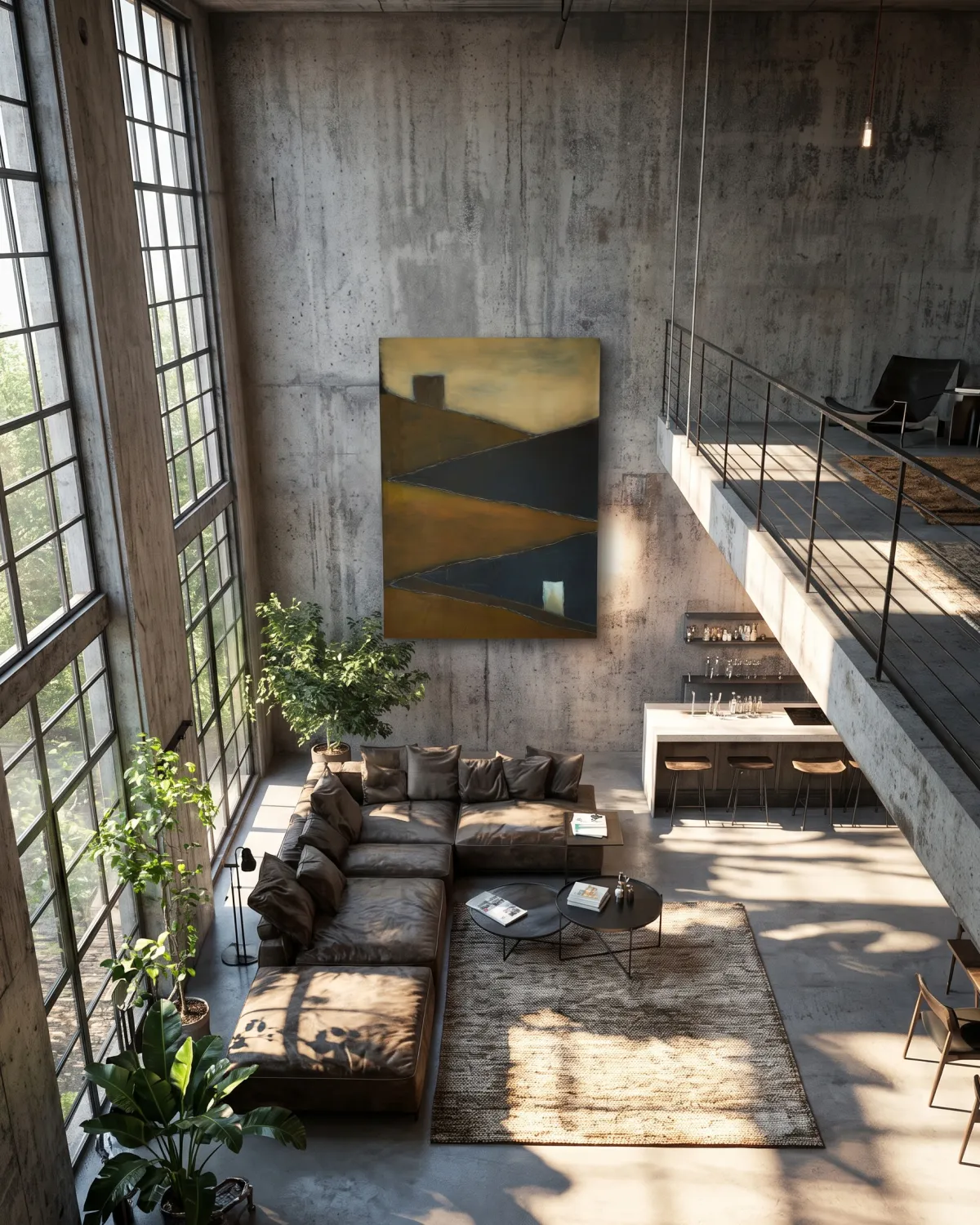
TENSUM by Maurizio Valch in a brutalist industrial loft
The Map That Refuses to Stand Still
From afar, TENSUM seems to offer a slanting geography: ochre, brown, and golden lands that do not stretch toward a horizon but instead plunge, one after another, down diagonals of varying density. The eye enters from above, where the color opens into a turbid clarity, and immediately encounters a first dark mass. Then another. And another further down. There is no stable ground from which to look at these bands; each seems to displace the weight of the previous one, as if the painting had decided that gravity should change direction halfway through.
In the upper section, a dark vertical rectangle cuts through the expanse like something that does not quite belong to it. It could be a closed door, yes, but also a measuring post, a tower without a building, a well that has stood upright. Its darkness does not absorb everything around it; rather, it forces the nearby lands to tilt toward it. The band passing beneath that shape does not look like a road or a hill; it has the tension of a surface that has been pushed from a remote edge. The landscape, if it is one, is not describing a place. It is enduring a pressure.
Alexandra David-Néel was a traveler and writer who knew that traversing a territory is not equivalent to exhausting it.
Her rule of orientation would be strange: not to advance toward the clarity below, not to take it as a destination, but to follow the fine contours bordering the diagonals. Each of those light edges looks like a barely visible seam, a line that someone might have tried to sew to prevent two surfaces from separating entirely. It is best to travel them slowly. Not to cross them with your gaze as one leaps over a ditch. Follow them until they become uncertain. The explorer would suspect that the diagonals do not represent ground, but a journey subjected to a force that alters the terrain as it is traversed. But here, walking is not equivalent to arriving: the more one follows a seam, the more one discovers that the line does not lead; it delays.
I do not know when a surface begins to behave like distance. I look at these expanses and I do not know if I am building a place, a separation, or a force that diverts the gaze from what it believes it is searching for. If there is a journey, it is not made of reaching a point: it is made of losing the point while trying to preserve it.
Upon drawing closer to one of the luminous lines, the painting ceases to look like a landscape. The edge has a slight, undulating, almost fragile irregularity. It does not cleanly delimit two bands; it wavers between them. There are areas where it seems to rise, others where it fades and blends with the ochre. The gaze wants to read it as a scar, but the line itself disobeys that certainty: it does not possess enough drama to be an open wound. It wants to be seen without becoming an emblem.
It is like trying to find your bearings in a crumpled sheet upon waking: a rise looks like the edge of the bed, then a shadow, then simply a part of the fabric that has refused to lie flat. Something similar happens here. The upper diagonal seems to approach; the next retreats; the large central band draws close once more, but does not allow itself to be touched. The eye slips along it, and in doing so, loses track of whether it is descending or ascending.
Breath is held upon reaching the central dark band. It is the gravest expanse of the painting, though not because it heralds danger or represents a night. Its darkness has thickness, but not closure. Within it, slight variations persist: a bluer area, another almost black, another where the light edge thins until it resembles a weary thread. There, a suspicion is born: perhaps these bands are not separate lands, but the trace of a force bent on preventing the two rectangles from recognizing one another.
The dark shape above and the light one below are then left too far apart. Not only because of the distance between their positions, but because of the bands that interpose themselves like layers of sediment, folds, barriers without walls. If the upper rectangle absorbs light and the lower one seems to return it, the diagonals could be the work of a separation: not a wall, but a mechanism of postponement. Each band says: not yet. Each seam adds: not so fast.
“Why is the light door at the bottom if the dark one is looking down from above?”
The question remains suspended over the large central band with a precision that more solemn names fail to achieve. Because it does not assert that they are doors. It merely notes a disproportion: a dark presence above, a light presence below, and between them a series of tilts that do not allow for a simple relationship. Perhaps they do not look at each other. Perhaps the painting has twisted space so that looking is insufficient.
Just as the reading is about to decide that those lines are obstacles, Simone Weil appears. She was a philosopher who understood attention as a demanding way of not taking possession of what is looked at.
Her intervention does not propose another explanation; it calls for a pause. Not before the bright rectangle, which easily attracts, but in an ochre interval beneath the dark band, where barely anything visible occurs. There, the color seems to hold a muted light, without triumphant brilliance, without promise. Looking at that area for a moment longer forces one to renounce the impatience of finding a way through. To pay attention is not to assign a hidden meaning to the ochre, but to admit that its apparent poverty is perhaps a form of resistance. The explorer wants to know if there is a crossing. The philosopher suspects that searching for it too soon might ruin the only area where the crossing has not yet become an answer.
Then the seams return. They are no longer borders to be respected for fear of getting lost, but places where the gaze learns to pause without remaining motionless. Attention travels along them. Exploration, for its part, ceases to advance like one conquering a route and begins to tilt its head, almost with a gentle awkwardness, to check if the painting moves. It does not move. But the relationship between above and below changes when the neck is tilted: the dark rectangle ceases to dominate from a safe height, and the light one no longer seems like a simple arrival.
I look again at the two rectangles and feel I cannot ask them to explain one another. The dark one retains a tension that does not reach the light one, and the light one returns a presence that does not correct the dark one. The finished painting resists my need to bring them together; that distance no longer entirely belongs to me. The more I try to bring them closer, the more the bands between them assert themselves, as if they were necessary precisely because they prevent too comfortable an answer.
Near the lower rectangle, the scale alters once more. Its clarity does not illuminate the entire painting; it occupies a small, vertical portion, with edges that do not quite impose themselves over the bluish, dark band surrounding it. It could be a door. It could be an opening. It could be a measuring piece forgotten on a terrain that has ceased to accept measurements. Its light does not rise or fall: it remains there, held back, as if the painting had tilted the world so that even clarity had to lean on something.
The question returns, modified by the long descent: “Why is the light door at the bottom if it does not seem to want to climb?” Now it does not seek a spatial answer. It notes that climbing would be a simplification. Perhaps the light shape does not wish to reach the dark one; perhaps both remain separate because their recognition would destroy the tension that keeps them visible. Or perhaps none of that: perhaps the bands do not separate them, but are the only way they manage to be together without touching.
Beneath the light rectangle lies a region of ochre and shadow that does not yield. It is not a background, not a path, not an end. The gaze can draw close until it feels it has found a final contour line, but that curve opens up again, letting through a different darkness, less closed than the previous one. There, the map refuses to stand still.
- Original artwork
- TENSUM
- Actual dimensions
- 31.5 × 47.2 in / 80 × 120 cm
- Presentation
- Digital contextual visualization
Context references
living room decor with exposed concrete · paintings for high ceiling lofts · brutalist style abstract art · leather furniture and contemporary art
About this visualization
This visualization places the artwork within an architectural context to help collectors and viewers imagine its presence in a real space. It is an interpretive reference, not an exact reproduction: the original work remains the sole authority for scale, color, surface and material presence.