Context study / TENSUM
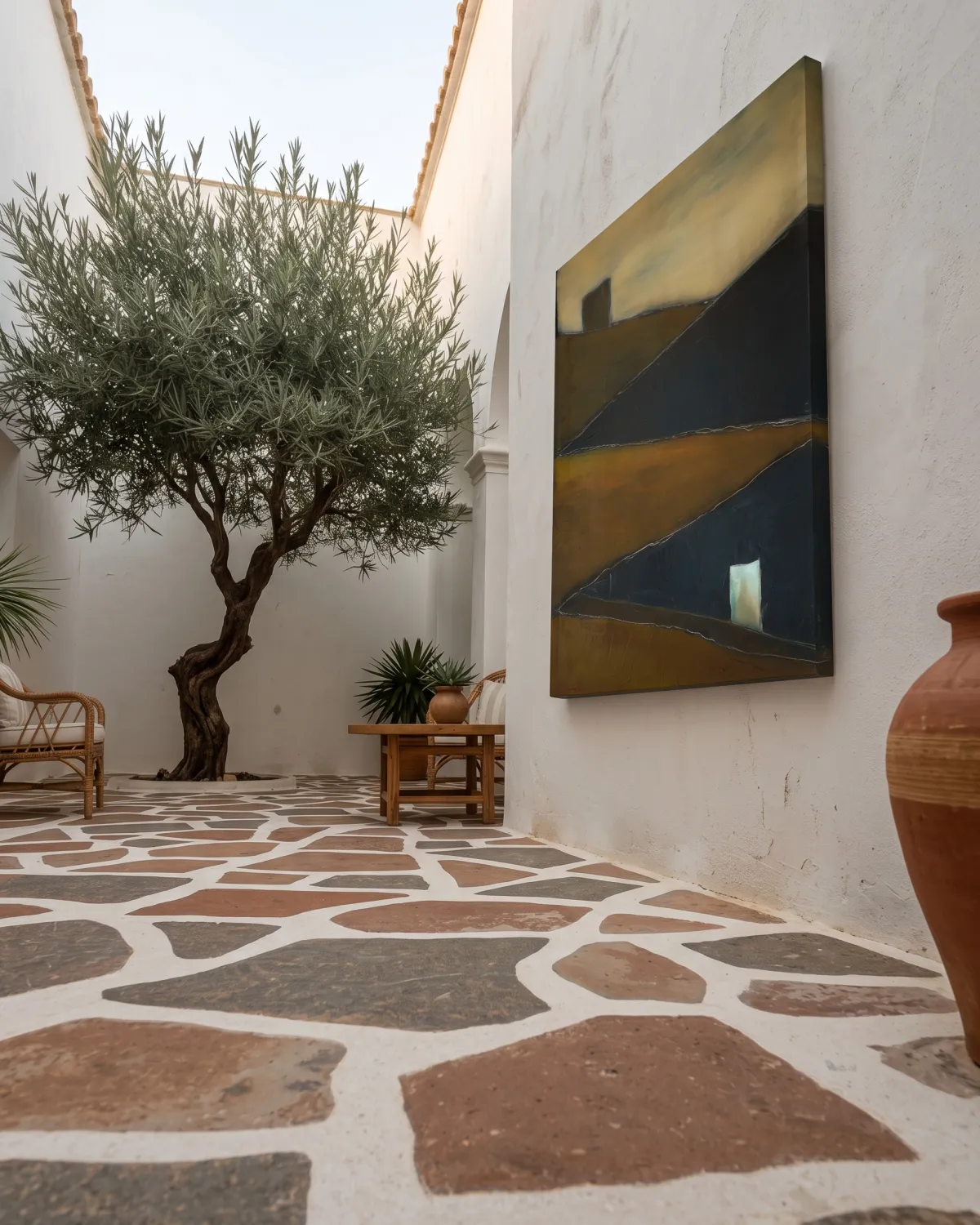
TENSUM by Maurizio Valch in Mediterranean Patio - Art and Nature
The sun crosses this whitewashed patio slowly, casting the shadow of the olive tree onto the cobbled ground and modifying, minute by minute, the temperature of the natural light that grazes the canvas. Outside the painting, time continues its course of wear and ordinary transition; the wood of the bench ages, the leaves tremble, and the clay of the vessel cools as evening falls. Yet, hanging on that wall, the work TENSUM operates as an absolute dam against the current. Within it, the tilt of the large ochre band, the weight of the dark mass, and the trembling seam of the pale line remain suspended in an unstable balance that, if subject to the laws of external physics, would have already collapsed in an inevitable slide.
When I work on the canvas, I am haunted by the need to capture not a static form, but a force in mid-journey. That ochre plane ascending to the right is not a firm surface: it is a slope captured at the exact instant before yielding under the pressure of the black mass. I know that thought always seeks to resolve the slope, to straighten what is twisted, or to find a comforting explanation that restores order to the territory. But painting allows me to interrupt that inertia; I scrape the material, score the pale incised line, and arrest the fall just in time, forcing the gaze to inhabit the pure imminence of collapse without ever consummating it.
This arrest of physical time is organized through mute counterweights that challenge the gravity of the patio. The dark rectangle breaking into the upper clarity and the small luminous block resisting below, in the opposite corner, do not function as elements of static balance, but as temporal anchors of a structure under tension. If we were to contemplate the composition through the lens of Alexander Calder, we would see a system of dynamic forces where each mass presses and responds to its opposite in constant negotiation. But unlike Calder's mobiles, which surrender to the current of the wind and the constant change of the air, TENSUM freezes the oscillation; the movement remains trapped in the dense matter of the paint, transforming what outside the painting would be an imminent collision into a mineral and permanent silence.
I often find myself caught in that silent urgency that tells me I have no right to be at peace as long as there is something pending in the studio, in the house, or on the journey. It is an inertia that turns existence into an endless quest, a step that always demands the next. Painting this work was a way to confront that internal noise; by fixing the two rectangles in their asymmetrical positions, I opened a space where everything is suspended, where tensions are not resolved but do not destroy anything either. In the stillness of the support, I discover that peace does not arrive at the end of a resolved path, but in accepting the vibration of the unfinished, sustaining the gaze right where psychological time has stopped pushing me.
In the end, the work offers the viewer an experience of permanence that contrasts with the transience of the surrounding Mediterranean environment. The clouds will pass and the golden sunset light will eventually extinguish behind the patio walls, plunging the architecture into nocturnal shadow. But the pale seam joining the strata of TENSUM will continue to sustain its vibration, indifferent to the rush of the day and the erosion of the hours. The painting remains there not as an image to be deciphered, but as a threshold where the flow of the world stops so that consciousness can, at last, recognize its own weight against the width of silence.
- Original artwork
- TENSUM
- Actual dimensions
- 31.5 × 47.2 in / 80 × 120 cm
- Presentation
- Digital contextual visualization
Context references
patio decor with art · mediterranean abstract paintings · minimalist art for terraces · ochre and black painting outdoors
About this visualization
This visualization places the artwork within an architectural context to help collectors and viewers imagine its presence in a real space. It is an interpretive reference, not an exact reproduction: the original work remains the sole authority for scale, color, surface and material presence.