Context study / TENSUM
Brutalist painting TENSUM by Maurizio Valch in concrete space | Artwork Mockups
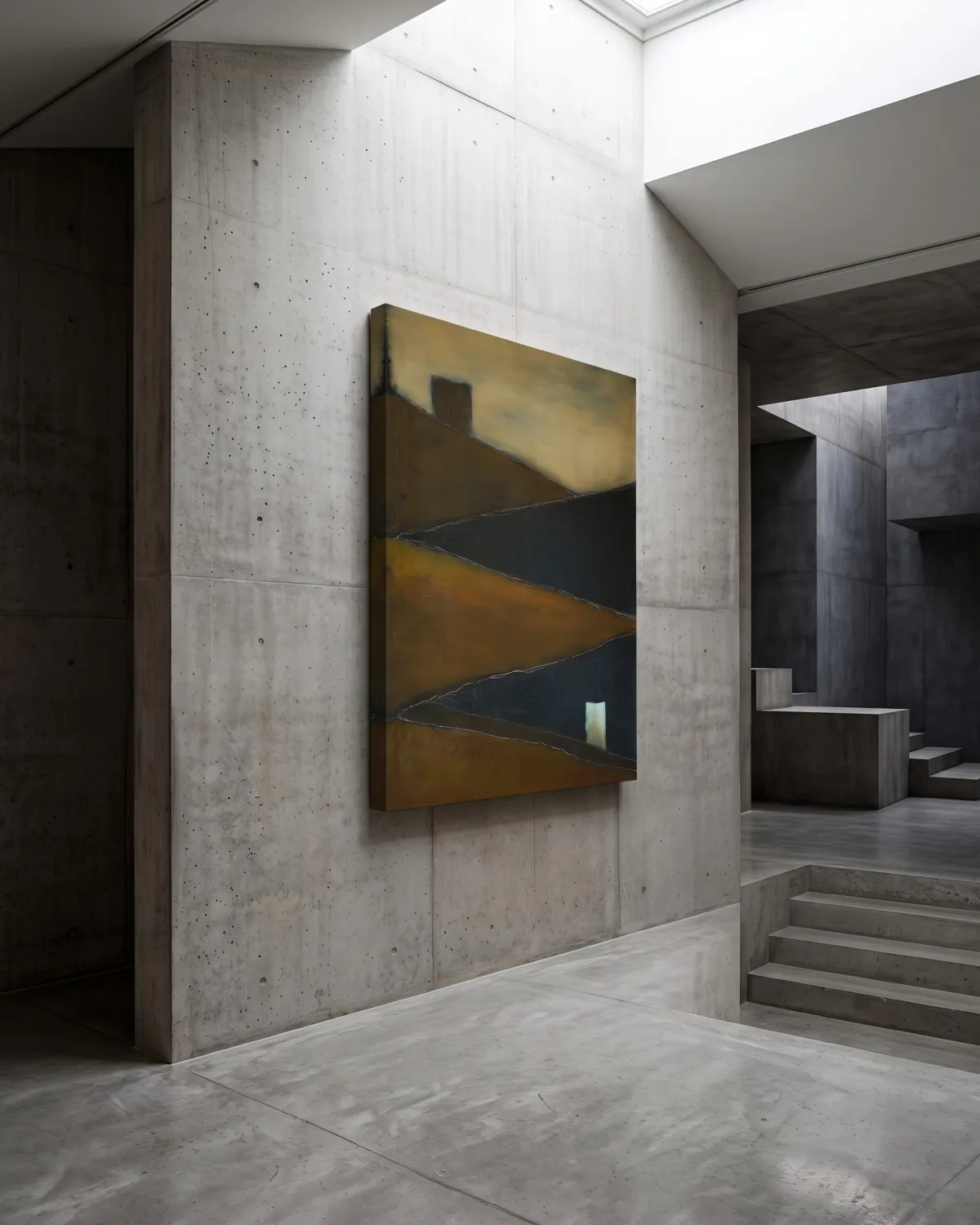
The surface of TENSUM unfolds before the viewer as a field of tectonic forces in permanent friction, where the flatness of the pictorial plane is sabotaged by a violent oblique segmentation. Large wedges of mineral darkness seem to descend and press inexorably upon a central band of ochre and earth tones, imprisoning it in an acute angle that demolishes any attempt at static balance. Facing this compact mass, confrontation with the canvas demands an attitude of somatic listening, a state of alert that is not auditory but physical, capable of registering the dull vibration and the invisible creaking of these overlapping strata. The fine whitish incisions delimiting the planes act not as mere geometric contours, but as seismographic scars, traces of wounded light that reveal the exact point where matter yields under the accumulated pressure, turning the composition into a record of contained geological forces.
When I confront the eighty by one hundred and twenty centimeter support, I understand that each incision executed on the accumulated matter constitutes a deliberate act of abandonment. It is the voluntary renunciation of absolute control over the clean line and the smoothness of the immaculate surface to enter the uncertainty of the physical accident. As I drag the stylus or the metal palette knife through the dense layers of still-fresh pigment, the metal experiences the real resistance of the oil and acrylic, revealing lower strata that alter the intended direction of the stroke. The true warmth of this work does not reside solely in the chromatic temperature of the sienna and ochre tones burning dully in the center of the canvas, but in the residual energy accumulated during that process of scraping and excavating; a latent heat springing from the body's effort against the density of the material and from the destructive friction that gives rise to form.
The spatial polarity of the piece establishes a dramatic tension that prevents passive contemplation, articulating itself between an impenetrable, dark, monolithic block situated in the upper left corner, and a mysterious vertical rectangle of pale, greenish light at the lower right end. This diagonal axis forces the gaze to traverse a winding pass of broken planes descending without possibility of truce. At this point in the composition, abandonment manifests in the viewer as the loss of any reference of logical perspective or a navigable horizon line; the painting refuses to function as a window to the outside. We are forced to inhabit the uncertainty of transit, suspended between the oppressive weight of the upper mass threatening to collapse the space and the containment of that small luminous window perceived below, not as an exit, but as a spectral and confined presence.
In the half-light of the studio, I conceive that luminous, whitish rectangle in the lower area as a zone of absolute listening, a threshold where the noise of the palette knife ceases and color retreats to allow the canvas to breathe by itself under a faint light. It is a visual silence contrasting with the physical brutality of the dark bands surrounding and delimiting it. For me, the warmth of the palette—those melancholic ochres, burnt earths, and oxides emerging in the heart of the painting—represents the temperature of a buried memory, a warm, organic substrate surviving tenaciously beneath the later layers of carbon black and cold Prussian blue. Painting consists of modulating that thermal oscillation between what remains buried by the shadow and what resists through the open wound on the surface.
In closing the analysis of TENSUM, it is evident that the work consolidates at the exact point where these three forces collide: the rough warmth of chromatic friction, the attentive listening to a structure vibrating in its own silence, and the abandonment of any pretense of mathematical ordering in favor of pure material contingency. The painting ceases to illustrate an abstract landscape to stand as a tactile, dense shore, a pictorial body resisting gravity and the passage of time. Through its formal rigor and its harsh sobriety, the painting does not seek to please the eye, but to establish a brutalist presence pulsating under its own physical laws, offering itself as a fragment of earth's crust marked by pressure, wear, and contained light.
- Original artwork
- TENSUM
- Actual dimensions
- 31.5 × 47.2 in / 80 × 120 cm
- Presentation
- Digital contextual visualization
Context references
art for exposed concrete walls · brutalist style abstract painting · interior decoration with cement and art · rustic ochre abstract painting · paintings for modern minimalist architecture
About this visualization
This visualization places the artwork within an architectural context to help collectors and viewers imagine its presence in a real space. It is an interpretive reference, not an exact reproduction: the original work remains the sole authority for scale, color, surface and material presence.