Context study / TENSUM
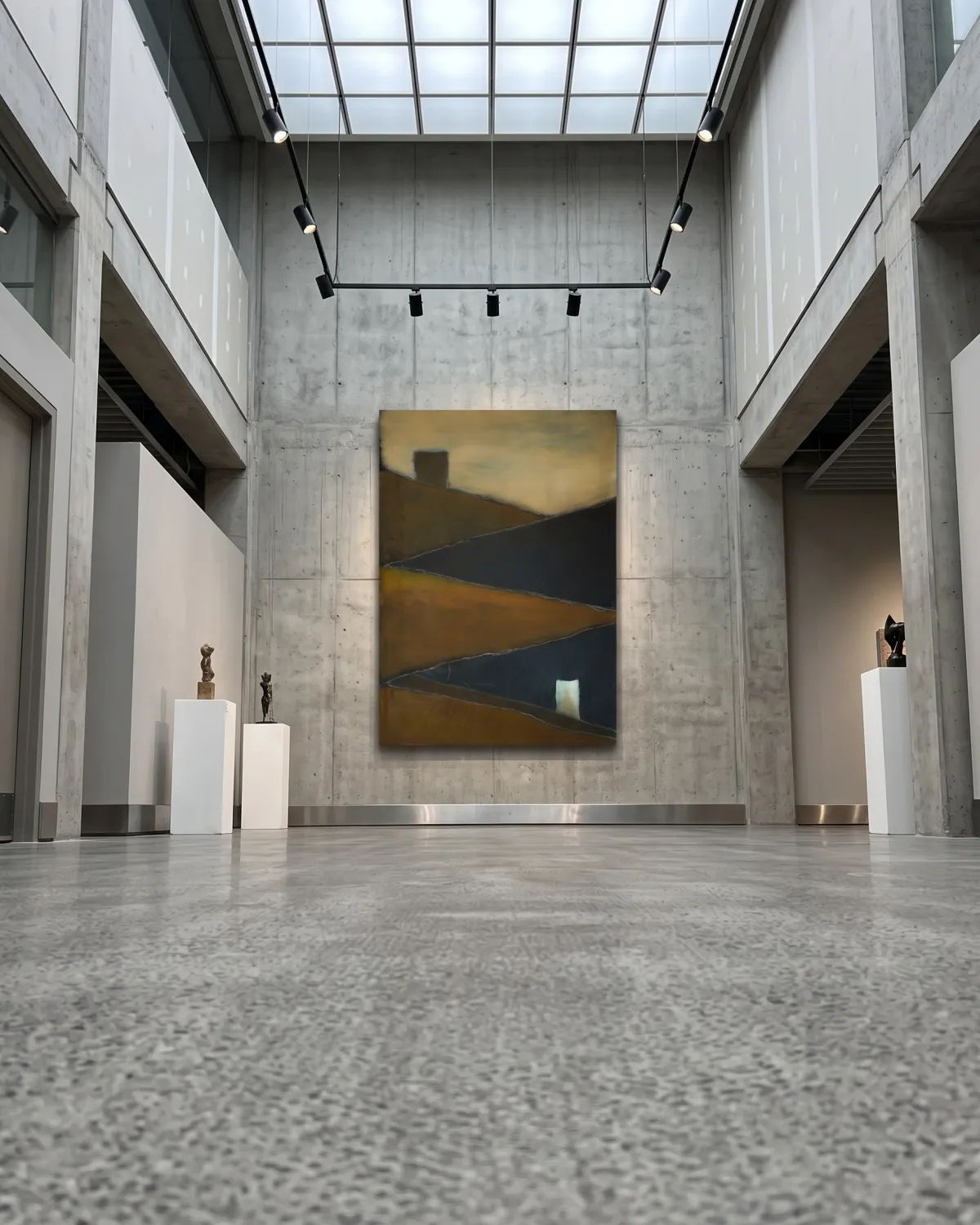
TENSUM abstract painting presiding over a large brutalist exhibition room
The tall rectangle appears first as a reserve of shadow within the ochre: small, vertical, almost held back by the band surrounding it. It dominates nothing. Rather, it seems to have been left there while the ground sloped around it. Its edge does not quite assert it as a figure; it leaves it vulnerable to the incline. From it, the gaze searches for a horizontal and fails to find it. It descends along a dark band, brushes past a pale line, and veers toward another expanse of muted earth. The painting offers no ground: it offers plates that seem to have shifted slowly, without the clash of a rupture, yet without ever fitting back together.
The pale lines between the bands have something of a seam and something of an alarm. They do not explain the division; they keep it alive. One borders the ochre as if to prevent it from advancing. Another holds the black mass without managing to domesticate it. Near them enters Wassily Kandinsky. He was a painter attentive to how a form can be felt as sound and movement.
Under this attention, each edge begins to emit a different pressure. The upper diagonal could be a low, prolonged tone, falling unhurriedly. The next has the dryness of a muffled strike. The ochre does not sound luminous: it weighs like a note held for too long. The central black, by contrast, seems to ask for silence around itself, a thick silence that makes it difficult to gauge its depth. The pale seams act as a beat, yes, but an unstable one: they mark the tempo of something on the verge of losing it.
I perceive that tension appears before I can recognize it. I try to follow a line and discover that my attention tilts with it, as if the painting had shifted the place from which I look. I cannot decide whether those edges contain the bands or push them toward a fall that remains suspended.
Listening would like to order the diagonals: one above, another below; a descent, a pause; the central shadow as a dominant bass. But that large black mass resists. It is not quite an interval or a musical pause. It has too much surface, too much density, to obey a score. Upon reaching it, the eye stops moving with ease. It lingers over a field that seems to absorb the direction of the neighboring bands and return it skewed.
A brief test can make this palpable: follow one of the pale seams with your eyes from the left edge until it is lost on the right, without adjusting your head to recover an imaginary horizontal. Breathing usually notices it before words do. For a moment, the line does not seem to go down: it seems as though the body itself has been slightly tilted by it. Then the central black ceases to be just a dark area. It becomes a gravity.
It is at that moment, when the gaze already expects the bands to tell a story of ascent, fall, or transition, that Jiddu Krishnamurti appears. He was a thinker who asked us to look before immediately turning what is seen into an explanation.
What happens when the mind calls that diagonal a "path"? What does it gain by calling the black patch an "abyss", the high ochre a "horizon", the whole a "landscape"? Names settle disquiet too soon. They place a before and an after where there might only be lateral pressures, expanses brushing against each other, weights refusing to become a narrative. The painting seems to admit these words while simultaneously returning them with a slight deviation. None of them ever fully lands.
Yet, looking without naming is not enough either. The two rectangles force us to want something from them. The upper one, dark by contrast, and the lower one, pale like a small remnant of light retained beside the bluish band, insist on a relationship. They do not allow themselves to be reduced to signs, yet they are not confused with the terrain. They seem to be attentive to one another across a space that does not favor communication. Between them, the diagonals cross like layers of weight; between them, the seams do not unite, though they do not permit a clean separation either.
A child's question then alters the entire scale: does the small pale square below know that the black stripe above is tilted toward it?
After that question, the lower rectangle can no longer be seen as a decorative detail or an arrival. It seems to sustain a tiny part of the composition, precisely because it is so insufficient. It is surrounded by a dark band that could swallow it up, yet its pale tone does not behave as a defense. It is more fragile than a defense. It has the presence of something that has arrived late and yet modifies the weight of everything before it.
I look at the low rectangle and do not recognize it as an answer to the one above. I feel it separated from me by the same distance that traverses the bands. I accept that its clarity remains illegible, even when it seems to touch the edge of something I might have understood.
The discrepancy continues to vibrate. The listening learned alongside the edges perceives calls, interruptions, a sort of silent transmission between zones of color. Attention that distrusts explanations prevents these calls from becoming a decipherable message. But between both ways of looking, another possibility emerges: perhaps the pale lines are not delimiting territories, but preventing each band from falling into the other; perhaps they are small resistances against a single, total, breathless darkness.
The tall rectangle does not visibly respond to the lower one. The lower one does not ascend toward it either. Each remains in its zone, held by a different incline. But the distance separating them is not empty: through it passes the ochre turning to shadow, the shadow acquiring a blue edge, the edge that seems to tense without breaking. In the end, near the lower rectangle, a pale seam brushes the dark band and remains suspended there, too thin to bear so much weight, too alive to disappear.
- Original artwork
- TENSUM
- Actual dimensions
- 31.5 × 47.2 in / 80 × 120 cm
- Presentation
- Digital contextual visualization
Context references
Abstract paintings for concrete walls · Large-scale brutalist contemporary art · Painting exhibitions in modern museums · Wall decoration with concrete blocks and art
About this visualization
This visualization places the artwork within an architectural context to help collectors and viewers imagine its presence in a real space. It is an interpretive reference, not an exact reproduction: the original work remains the sole authority for scale, color, surface and material presence.