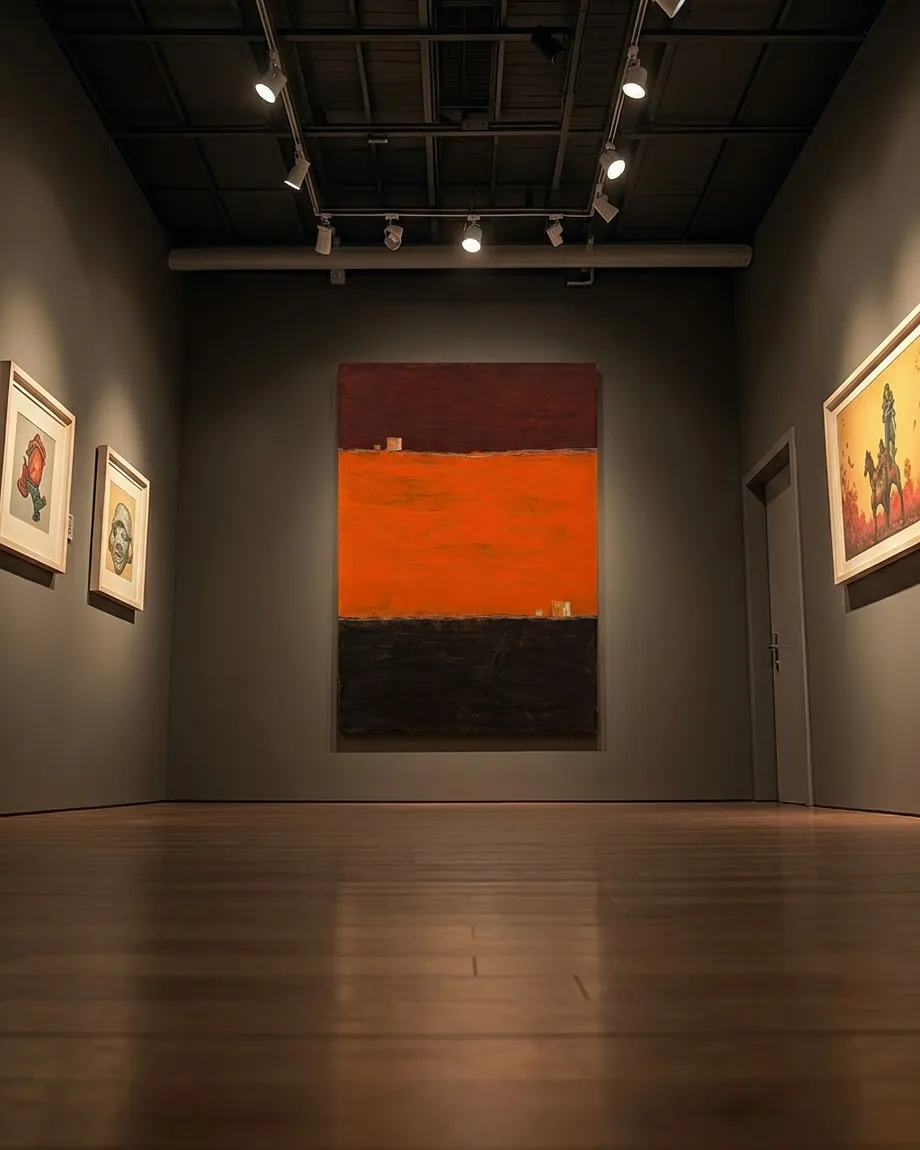
Context study / Spinoza's Lens
Spinoza's Lens in Intimate Exhibition Space - Maurizio Valch
I. The Gaze of the Mystics
Before the canvas, two men hold their breath, captured by a boundary that vibrates like a string stretched to the limit. On the left, Isaac Luria—the mystical sage who imagined a cosmos born of a divine breath turning back on itself—contemplates the orange mass with squinted eyes, searching for the gleam of a wounded divinity. Beside him, Ibn Masarra—the Andalusian ascetic who found in the silence of the mountains of Córdoba the idea that even the darkest matter is a temple of sleeping light—caresses the air just inches from the pictorial plane. Luria, fascinated by the violent contrast, points to the lower black third with a sharp gesture: "Here is the fall, the sterile abyss where the divine light has been completely extinguished after the shattering of the vessels." Ibn Masarra, however, gently shakes his head and asks him to come closer. With the tip of his finger, he points to the ultra-fine incised line carved into the pigment, right where the burning orange grazes the dense black. "You are mistaken, Isaac," whispers the Andalusian. "Look at this groove. It is not a wall, but a threshold of accumulated dust; black is not the absence of God, but His most compact veil, a primordial matter holding the vibration of orange under a crust of silence."
II. The Artist's First Voice
When I hold the palette knife before that orange plain I have just built, I feel an almost physical fear. It is the fear of desecrating what is already full. Why wound such a vibrant field of color, so brimming with light, to carve that scar separating it from the lower black? The gesture of sinking the steel into the wet oil is not an act of violence, but of geometric necessity; I need to open a decompression channel for the paint to breathe. As I carve that groove, I am struck by the doubt of whether I will be able to control the uncertainty of what emerges from the deep layers of the canvas, or if the color will eventually swallow my will. In the end, what remains is not the perfection of the plane, but the tension accumulated at the edge of the wound, the trace of a pulse that trembles between the law of order and the abyss of living matter.
III. The Dilemma of Contraction
The discussion between the two sages shifts toward the base of the canvas, where the blackness seems to weigh as heavily as the earth itself. Luria insists on seeing in this lower third the result of the Tzimtzum, the contraction necessary for the world to exist, a void that has become dense and opaque. Ibn Masarra, on the other hand, argues that matter is a darkened mirror that still reflects the First Intellect. It is then that a third gaze intervenes, almost childlike, embodied in the space separating both thinkers: an observation on the absurd smallness of those monolithic blocks resting on the fault lines. Why do those tiny fragments of earth and gold seem so fragile and yet so solemn, like toys forgotten at the edge of a cosmic cliff? This simple vision disarms the theological architecture of the mystics: if the universe is as vast and terrifying as those three horizons of color, why does the sacred choose to manifest on the scale of the minuscule, in the openness of a grain of dust suspended over nothingness?
IV. The Artist's Second Voice
I often think that the studio is a machine for simplifying time, an attempt to empty the archive where I accumulate my many selves—those noisy characters that inhabit me in everyday life. When painting "Spinoza's Lens", I was thinking of Baruch, of his infinite patience in polishing glass while the world fell apart outside in sterile debates. I too seek that cleanliness of gaze, a simple life that does not need to explain itself. However, I know this canvas surpasses me; there is something in the density of the upper third, in that rust brown that seems loaded with unlived memories, that knows something about me that I have not yet managed to decipher. Painting does not lie: while I seek silence, it exposes the vibration of my own unfinished conflict.
V. The Secret Law of the Text
In the final stretch of the road, the gazes of Luria, Ibn Masarra, and the reader themselves finally rise toward the upper band of the painting. That dark brown, tinged with rust red, is not the sky of the painting, but the weight of the thought observing the scene. Here is revealed the secret law that unifies this encounter: the paradox that we can only experience the immensity of the absolute through a physical limit, through a lens polished by human hands. Is this triptych perhaps the portrait of someone who has lost their face to become pure gaze? Facing the matter that remains silent, we are left with the question suspended over the canvas: are we looking at the origin of the world through a clean glass, or are we ourselves the reflection that someone, from the other side of the rust, is trying to decipher in the penumbra?
- Original artwork
- Spinoza's Lens
- Actual dimensions
- 31.5 × 47.2 in / 80 × 120 cm
- Presentation
- Digital contextual visualization
Context references
mystical abstract painting · Maurizio Valch Spinoza's Lens · focalized light painting · dark and orange abstract art · large format abstract art for living room · artistic interior decor
About this visualization
This visualization places the artwork within an architectural context to help collectors and viewers imagine its presence in a real space. It is an interpretive reference, not an exact reproduction: the original work remains the sole authority for scale, color, surface and material presence.