Context study / Spinoza's Lens
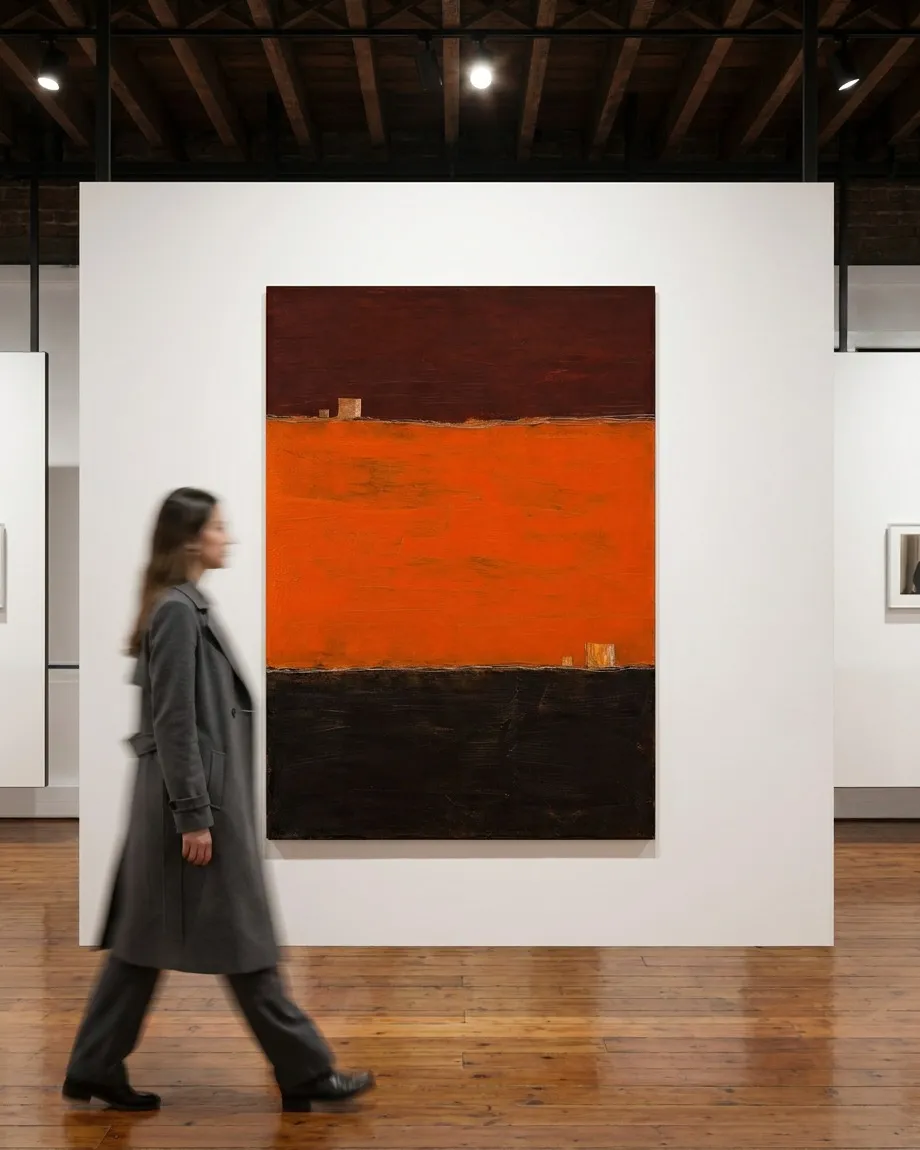
Scale of Spinoza's Lens in Exhibition - Maurizio Valch | INCARNATE
I. The Traditional Eye and the Fracture of the Cosmos
For Seyyed Hossein Nasr—an Iranian philosopher and scholar who has dedicated his life to defending the sacred dimension of nature, traditional art, and the mystical encounter between Eastern and Western civilizations—to stand face-to-face with Spinoza's Lens is to participate in a liturgy of the limit. In this geography of three realms, Nasr does not perceive a mere modern abstraction, but rather the provinces of a cosmos whose channel of continuous revelation has been fractured. The central orange is no ordinary color; it is the fire of the World Soul, trapped in an intermediate zone of maximum material agitation, suspended between a burgundy sky that refuses to pour out its grace and a floor of dense tar that threatens to swallow every vestige of light.
As his gaze lingers on the micro-monoliths balancing precariously on the wounded edges, Nasr experiences a profound metaphysical melancholy. These tiny cubes are not geometric whims; they are besieged temples, frontier altars of human thought trying to sustain the dialogue between East and West right on the lip of the crevice. However, what disturbs the scholar is the physical wound dividing these realities. Maurizio Valch’s palette knife has not painted subtle transitions, but has torn open the oil paint, exposing a rough crust. For Nasr, this violent scraping is the symptom of a profane modernity: the painful record of a world that no longer communicates organically with the transcendent, but rather through the wound, the trauma, and the forceps of individual will.
II. The Confession of Matter
I accept the aggression that Nasr sees in my hands, but my truth in the studio is much more cluttered and urgent. When I drag the palette knife across the canvas, I am not thinking about the fall of tradition; I am fighting against the boredom of my own skill. I applied that vibrant orange seeking a pure presence, but seeing it there, so absolute and flat, I felt a physical panic at the fixity of my own ideas. I realized that a perfect horizon is a comforting lie that I cannot afford.
That is why I attacked the matter. The scraping was not a conscious desecration, but an act of survival: I needed to wound the paint to breathe, to see what layers of memory and regret dwelt beneath that burning surface. Those small blocks I placed on the ledges are my own petrified fears; they are the control fetishes I build to avoid being devoured by the space I open myself. Inhabiting that orange strip is to burn, and those blocks are my ridiculous, tender attempt to bring order where the fire of matter has already won the game.
III. The Courage to Stand in the Rift
This agitation of the painter is precisely what summons Rollo May—an American existential psychologist who explored art as an act of courage in the face of the void, understanding that anxiety and human connection are the materials with which we sculpt our freedom—. Observing the work, May smiles at Nasr's sacred nostalgia. For him, the health of the spirit does not reside in the stillness of a seamless cosmos, but in the courage to inhabit the rift itself. The small monoliths tottering on the edge of the dark abyss are not fallen temples, but the human self trying to maintain its center against the neurosis of the void.
May reads the physical trace of Valch’s palette knife as the record of a fertile trauma. Scraping the canvas is the act of an analyst tearing through neurotic defenses to expose the existential anxiety of the dark base. The black below does not represent damnation, but the fertility of the unconscious, the reservoir of unclaimed potential that only reveals itself when we dare to look at the wound of connection. The courage to create, according to May, is precisely the strength needed to sustain these blocks of identity on the very edge of disintegration, knowing that the void is not avoided by fleeing from it, but by giving it an honest, trembling shape on the canvas.
IV. The Third Perspective
Let us imagine for a moment that the voices of Nasr and May cross in the dim light of the exhibition room, losing their conceptual firmness before the mute presence of Spinoza's Lens. The lens of Baruch Spinoza, the lens grinder whose trade gives the work its title, is the third element that dissolves the dispute. What if this painting is not a window into Nasr's cosmos, nor the map of May's existential self, but the very glass lens that Spinoza patiently polished by hand in his Dutch exile?
If we look through this pictorial lens, the opposition between the divine and the human vanishes. The burgundy light of the sky and the dark tar ground are not opposing forces in conflict, but the same Substance expressed in different attributes. The thinkers suddenly realize that the microscopic blocks do not need to be defended from the abyss, because the abyss also sustains them. Spinoza’s lens was not designed to focus on the infinite exterior, but to concentrate the gaze on the exact point where melancholy for what is lost is transformed into an intellectual love for what exists. Painting ceases to be a theoretical battlefield and becomes a plane of immanence where all pain, once understood in its geometric structure, ceases to be pain.
V. The Return to Silence
I have heard their voices bounce off the studio walls, their beautiful words trying to colonize this plane of color, and I can only take a step back. At the end of the day, when I turn off the spotlights and the sun begins to set over the canvas here in my Valencia studio, Nasr and May's discourses fade with the light. My dogs lie down beside the easels, tired from the day's noise, and the painting returns to its original muteness.
I am left alone with that lower black third. It is a space that needs no psychologists to explain it, nor philosophers to rescue it; it is simply heavy paint, an indecipherable night that I myself fear and respect. I know the work is finished because it no longer belongs to me, because it has ceased to be a series of technical decisions with the palette knife to become an autonomous portal. Everything I have painted—the orange wound, the suspended blocks, the shadow at the base—is nothing more than an invitation for whoever passes by to stop, take a deep breath, and learn to love that which they will never fully understand.
- Original artwork
- Spinoza's Lens
- Actual dimensions
- 31.5 × 47.2 in / 80 × 120 cm
- Presentation
- Digital contextual visualization
Context references
Maurizio Valch exhibition · Spinoza's Lens painting scale · abstract painting 120 x 160 cm · abstract palette knife painting · Spanish contemporary art · monumental art decor
About this visualization
This visualization places the artwork within an architectural context to help collectors and viewers imagine its presence in a real space. It is an interpretive reference, not an exact reproduction: the original work remains the sole authority for scale, color, surface and material presence.