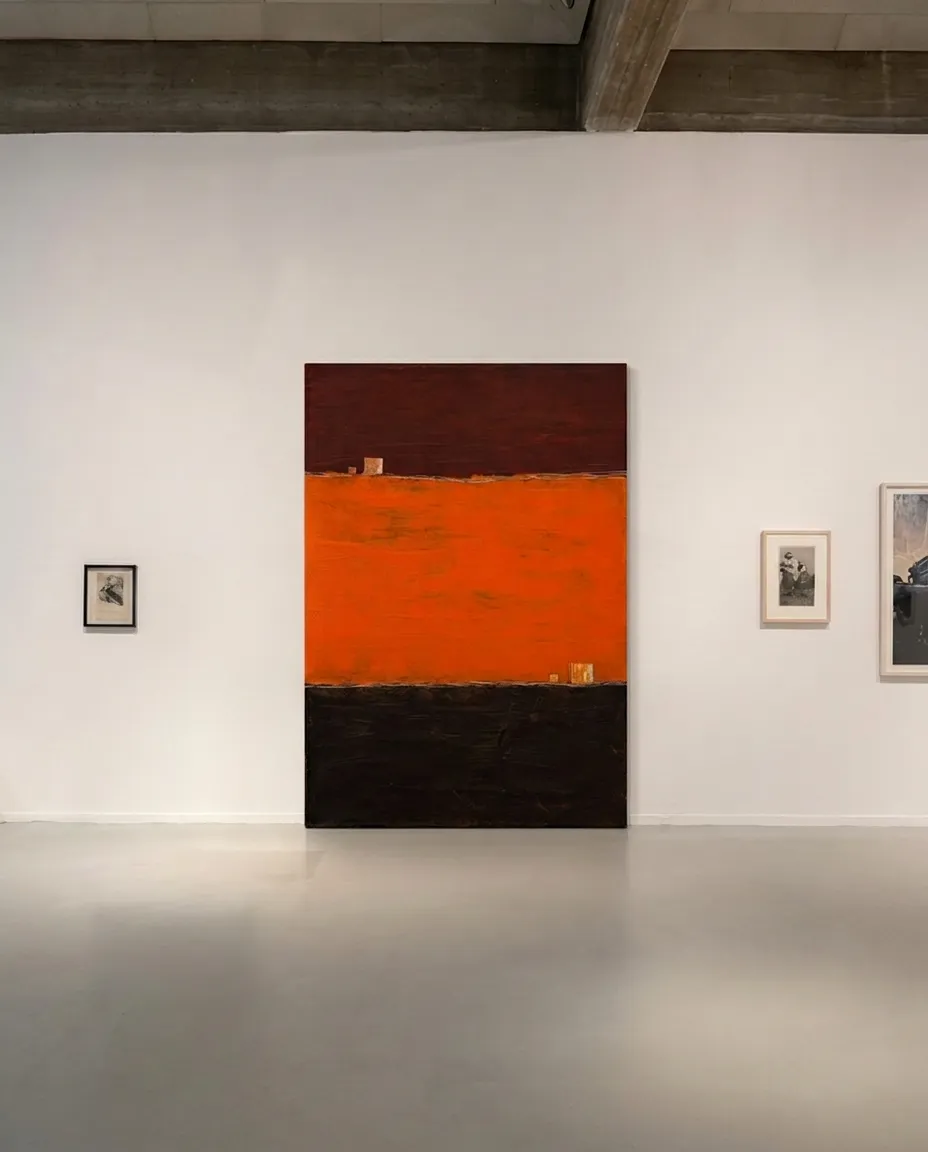
Context study / Spinoza's Lens
Spinoza's Lens in Gallery - Maurizio Valch | INCARNATE Series
Fragment I: The Refraction of the Observer
The sage of Arunachala, Ramana Maharshi, remains motionless before the dull vibration of Spinoza's Lens. His eyes do not wander across the surface; they receive it as one receives the impact of a constant temperature. Before him, the great orange field is not a painted space, but a shadowless midday pressing against the retina. At the base of this incandescent plain, right on the boundary where color drops toward the dark lower stratum, a tiny golden monolith holds itself in suspense. To the ordinary gaze, that minute particle of gold leaf is a foothold, an anchor for the eye that fears losing itself in the void. But under the silent inquiry of the sage, that gleam reveals its true nature: it is the primordial thought, the subtle "I" trying to cling to a border to avoid being swallowed by immensity. The sage does not interrupt the silence; his very presence formulates the question that wears away the physical support of the canvas: Who is the one observing this light? Where does the witness rest when the horizon itself catches fire? The golden monolith does not answer; it trembles imperceptibly under the weight of an attention that seeks not to interpret, but to dissolve.
Fragment II: The Wound in the Lens
When I plunged the steel spatula into the upper area of the canvas, I was not looking to draw a line, but to stop a tide. The acrylic was still tender, offering that pasty and cold resistance that matter has before sealing itself forever. I pressed with the strength of my shoulder, dragging the edge from left to right, feeling the metallic vibration of the grain of the canvas against the metal. I expected to find the solidity of the plane, the firmness of a limit that would order the chaos of that upper burnt ocre. However, upon lifting the spatula and removing the excess paint, what remained was not a constructive scar, but an open crack through which the painting began to lose weight. A filament of raw light, an empty groove revealing the wood of the stretcher, began to breathe with violent force. In that instant, I understood the paradox of the craft: the more violent the scraping, the purer the void revealed behind it. I am not the author of a structure; I have carved a wound in the lens so that light stops bouncing off the surface and begins to pass through it.
Fragment III: The Cascade of Being
The last great scholarch of Athens, Proclus, raises his index finger to trace in the air the sacred geometry governing the canvas. To his understanding, Spinoza's Lens is not an exercise in abstraction, but the exact embodiment of divine hierarchies: "Everything that proceeds from a cause turns back toward that from which it proceeds," he murmurs, recognizing in the dense, dark brown upper band the ineffable One, the pre-existing darkness from which all reality emanates. Below this border, the wound opened by the spatula marks the threshold of procession (próodos): the burning orange is the plane of pure Intelligence, an intellectual fire pouring and expanding without losing its substance. Finally, the lower abyss of dark matter represents the passive receptacle awaiting rescue by return (epistrophé), signaled by those small gold monoliths acting as geometric beacons in the density of the physical world. Proclus attempts to calculate the mathematical distance between both incisions, searching for the exact proportion to reconcile the soul with the cosmos. However, the relentless silence emanating from Fragment I subtly sabotages his speculative framework: each time the philosopher defines a hierarchy, the orange of the painting dilates, overflowing the boundaries and reducing the sage's measurements to a handful of mute numbers.
Fragment IV: The Museum of Many Selves
I have spent years crossing borders, packing stretchers in damp ports, accumulating passports, and patiently constructing the persona of the artist who knows what he is doing. I designed an armor of gestures, theoretical discourses, and technical certainties to protect myself from the elements. But looking today at these small gold leaf monoliths that I applied with a trembling hand on the incisions of Spinoza's Lens, I recognize myself in them with a strange mixture of pity and detachment. They are not monuments to beauty; they are like my own past "selves," floating debris of identities I once believed definitive and which are now only mineral dust suspended on a horizon that belongs to no one. The one who traveled, the one who accumulated fears, the one who signed this painting... all of them are useless sediments. The painting has outlived me because it does not preserve my trace, but my disappearance. In the end, the studio remains in semi-darkness and only the physical vibration of the scraped matter is left, reminding me that my entire personal history is nothing more than a thin film of dry oil on the verge of cracking.
Fragment V: The Crumbling of the Witness
Before the hundred-and-sixty-centimeter-high canvas, Proclus's words and Ramana's silence cease to be opposing positions. The painting is no longer offered to the sight; it is offered to the skin. The great central field is no longer "orange," but a thermal radiation warming the hands and temples of the spectator. The philosopher's celestial hierarchies crumble under the heat of pure consciousness, and the inquirer's questions dissolve in the vibration of the thick acrylic. Personal identities, the names we carry, and the old museum of our memories are revealed here as unsustainable fictions, shadow toys abandoned at the base of a sacred fire. When personal history is completely emptied and the observer gives up trying to understand, what is it that remains intact, pulsing faintly like a grain of gold at the base of the darkness? It is not an intellectual answer, but a state of naked presence: a witness who no longer claims possession over what they look at, but simply accepts being consumed by the light of the lens.
- Original artwork
- Spinoza's Lens
- Actual dimensions
- 31.5 × 47.2 in / 80 × 120 cm
- Presentation
- Digital contextual visualization
Context references
Spinoza's Lens Maurizio Valch · large format abstract painting · orange and black painting · material abstraction · minimalist contemporary art · INCARNATE Maurizio Valch · original work on canvas
About this visualization
This visualization places the artwork within an architectural context to help collectors and viewers imagine its presence in a real space. It is an interpretive reference, not an exact reproduction: the original work remains the sole authority for scale, color, surface and material presence.