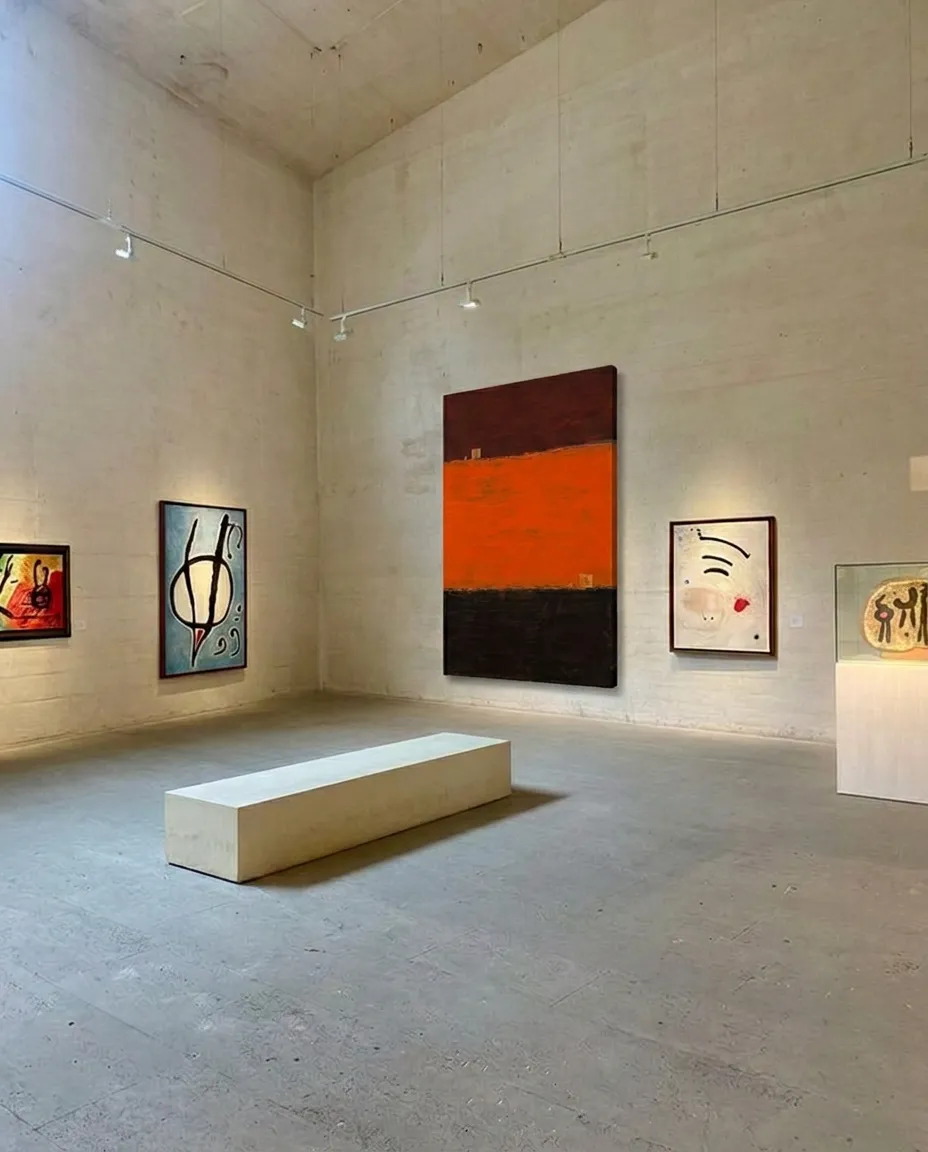
Context study / Spinoza's Lens
Spinoza's Lens in Brutalist Space | Maurizio Valch
I. The Threshold of the Single Substance
To look directly at Spinoza’s Lens is to submit oneself to the grinding of light. At the base of the canvas, a black, dense abyss, textured by successive sedimentations of matter, supports a central band of incandescent orange that seems to vibrate with the frequency of an open wound; above, a deep reddish-brown sky closes the space with the gravity of an ancient silence. For Martin Heidegger, the thinker of the Black Forest who sought to rescue the meaning of our existence from oblivion, truth is not a logical statement but Aletheia—the unconcealment of Being—an event made visible here in the Riss, that physical and violent rift carved into the material where World and Earth collide to reveal their mutual belonging. Facing this topography of being stands Max Scheler, the philosopher who placed the heart of phenomenology in living sympathy and the Ordo Amoris, defending that the human being is a "person" constituted by acts of love irreducible to reason, forcing us to experience this central orange not as mere flat pigment, but as the radiation of a pure affective force pulsing with ontological warmth.
Where Heidegger sees in the groove of the spatula the necessary fracture for truth to breathe, Scheler trembles before the radiance of the center, insisting that the painting is not a cold map of being, but a sensing body that loves and suffers. What is this canvas if not the reverse of a mirror that has decided to stop reflecting the external world to embody its internal dynamism? Sliding one's gaze across these three fields, consciousness experiences the ebb and flow of an immanent light that ascends from telluric opacity, erupts in the intermediate combustion, and gathers in the superior mourning. It is the meticulous polishing of a lens seeking Spinoza's single substance: that in which physical extension and thought fuse into a single plane of absolute immanence.
II. The Weight of the Limit (Maurizio Valch)
Sinking the steel of the spatula into the layers I raised myself over weeks is not a gesture of destruction; it is a descent to the origin. I feel the physical resistance of the oil mixed with acrylic, that almost organic crust resisting being opened, as if the material had its own memory and defended its right to remain hidden. By dragging the metal and cutting the plane, I am not drawing a line: I am stripping away the excess of the world to find the bone of space. It is an exercise in subtraction where each detached fragment is a relinquishment of my own will. My thought stumbles against the density of the paint; I understand, with a physical lucidity that exhausts me, that there is a point where words solidify and only the wound of the groove remains. By carving that horizon, by uncovering the lower layer pulsing in the darkness, I wonder if art does not consist precisely in this: in creating a sacred limit so that the mystery does not overflow, in opening a rift to see if, behind the color, the silence still retains its human temperature.
III. The Scar of Memory and the Incarnata Mystery
At the boundaries where the three chromatic fields touch rest minimal monolithic blocks, barely suggested, acting as buoys or lookouts on the fault lines. What are these small fragments of suspended geometry? Are they the consolidated ideas of the lens polisher resisting dissolution in the immensity of the plane of immanence, or are they the remains of a shipwreck of individual memory seeking a hold between the black abyss and the orange fire? Here lies the mystery of the Incarnate/Incarnata: the miracle of giving pictorial existence to the multiplicity of being without resorting to explanation or illustrative symbol. The painting does not describe the tension; it is it.
The coexistence of the incision—the physical wound in the pigment—and the breathtaking beauty of the pure color generates a vibration that questions our own consistency. One might ask: Is the orange of this lens the place where thought burns to become pure presence? What part of us remains intact in the stratum we decided to cover with dark paint? Matter thus becomes a geological record of the soul, where each glaze and each trace of the spatula is a temporal layer of consciousness resisting disappearance under oblivion.
IV. The Breathing of Silence (Maurizio Valch)
Sometimes, while the studio grows dark and only my dogs breathe in a corner of the workshop, I look at this large canvas and feel a dull dread before what I have left suspended there. There is a silence in this painting that does not entirely belong to me. Those small blocks I placed on the cut horizons are not theoretical decisions; they are the guardians of a secret I fear to name, the silent witnesses of a loss or a waiting that I do not know how to put into words. My animals move in the half-light, oblivious to metaphysics, existing simply in a perfect immediacy that I deeply envy. I wish my painting had that same animal purity: not needing to justify itself to philosophers, retaining its mystery intact, wild and blind. I have wounded the surface of the canvas not to explain the void, but to give it a refuge where it can exist without being profaned by language. The painting must remain there, closed in its own physics, like a body breathing slowly in an empty room.
V. The Passage of the Sluices
The gaze finally travels the full arc of the experience. The architecture of Spinoza's Lens functions as a system of spiritual sluice gates: the lower black retains the weight of our gravity and our densest pains; the central orange opens the floodgates of an overflowing affection, a cosmic sympathy connecting us to the whole; and the upper reddish-brown acts as the closing of an eyelid assimilating the light received. A final question pulses at the bottom of this secret law governing the canvas: Can an incision in matter be the only place through which a soul that has decided to remain silent breathes?
If we removed the minimal monolithic blocks guarding the carved horizons, would the entire space collapse under the weight of its own chromatic masses, or would our irreversible passage to the other side of the lens finally begin? There is no answer on the flat surface. Maurizio Valch's work is not contemplated to decipher an enigma, but to inhabit the vibration of its matter, accepting that truth is not possessed: it is suffered and loved in the same indivisible instant that light decides to incarnate in paint.
- Original artwork
- Spinoza's Lens
- Actual dimensions
- 31.5 × 47.2 in / 80 × 120 cm
- Presentation
- Digital contextual visualization
Context references
brutalist interior design with abstract painting · large orange and black painting · Maurizio Valch art collecting · exposed concrete walls with artworks · painting of metaphysical and contemplative atmosphere · large format contemporary art for high ceilings
About this visualization
This visualization places the artwork within an architectural context to help collectors and viewers imagine its presence in a real space. It is an interpretive reference, not an exact reproduction: the original work remains the sole authority for scale, color, surface and material presence.