Context study / Spinoza's Lens
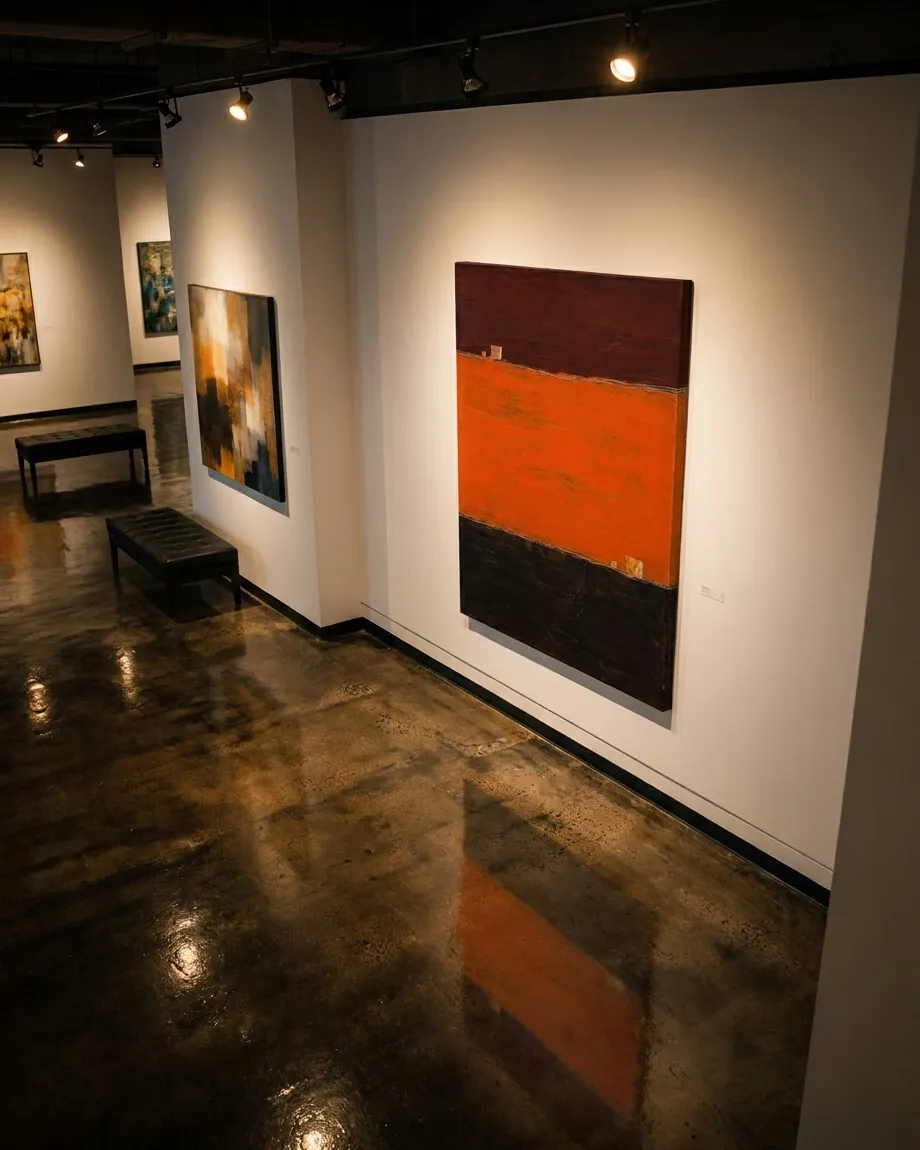
Spinoza's Lens (120x160 cm) - Maurizio Valch | Modern Gallery
I. The Trace of the Spatula (Voice of Maurizio Valch)
I know the canvas has a memory because my hands still hold the pain of its resistance. When painting Spinoza's Lens, I wasn't looking for an image; I was looking for a temperature. I remember the day I applied the central orange: it was an untamed fire, a scream of acrylic that threatened to devour the gravity of the stretcher. I had to contain it. I had to wound the material with the spatula, carving those two horizontal incisions that now separate the canvas into three realms. Near the end, almost without thinking, I placed those tiny blocks of matter on the fracture lines. They were mere accidents, remnants of accumulated paint that I decided not to clean away—small sentinels of a physical boundary. Now, seeing the work hanging under the gallery spotlights, I wonder if those blocks were not there before me. Is it the painter who imposes the border, or is it the material that demands its own law so as not to disintegrate into the void?
II. The Fire and the Vessel (Voices of the Constellation)
Before the canvas, two men share a silence that seems to hold the very air of the room still.
Dov Ber of Mezeritch—the Great Maggid of Hasidism, who taught how the divine withdraws into the silence of matter so that human beings can seek its hidden sparks—approaches so close to the canvas that his breath almost fogs the varnish. His gaze does not lose itself in the large orange band, but fixes instead upon the small geometric blocks resting on the scars of the painting.
"This is the Tzimtzum," Dov Ber whispers, pointing to a small cube barely protruding from the fault line. "The infinite, to be perceived, must contract. If this orange fire spilled uncontrollably over the black below and the sienna above, there would be no creation, only blindness. These small stones of paint are not obstacles; they are the dykes of divine compassion. They sustain the world by bounding the fire."
Beside him, Ramakrishna—the mystic of Bengal who lived in a state of constant ecstasy, crossing all religious borders to show that the absolute offers itself as love and dissolution—smiles with half-closed eyes, as if about to dissolve into the polished concrete floor of the gallery. His hand trembles, hovering a few centimeters from the orange vibration.
"Why do you speak of containment, brother?" Ramakrishna asks in a voice that is almost a lullaby. "Look at that center. It is not a danger; it is the Mother's ocean. It is pure consciousness laughing and burning. Those lines of yours, those incisions the painter scraped with such fury, are only illusions. The fire has already crossed. Do you not feel the heat in your chest? Those small blocks you call limits are like paper boats trying to stop the Ganges. Sooner or later, the orange will flood them, and everything will return to being a single current of light."
III. The Polishing of the Glass (Voice of Maurizio Valch)
Listening to the mystics speak about my painting, I feel a strange mixture of humility and revelation. I was not thinking of the Kabbalah or the ecstasy of Bengal when I locked myself in the studio; I was thinking of Baruch Spinoza, the excommunicated philosopher who made his living polishing optical lenses while building one of the most radical metaphysical geometries in history. I was thinking of glass: of how something as hard and opaque as sand becomes transparent through friction and fire. The black oil at the base of my painting has that same rough, almost geological density; it is raw matter. The central orange is the light passing through the lens. In the end, painting is a physical craft, a wearing down of the wrist and shoulder. But today, I admit that those small blocks I placed on the borders of color frighten me. It is as if the canvas has become an instrument of precision that I no longer control—a lens that does not serve to look at space, but to let space look at us.
IV. The Wound of the Limit (Voices of the Constellation)
Ramakrishna takes a step back, closing his eyes to ignore the structure, seeking the thermal pulse of the work.
"It is a beautiful pain," the master of Bengal says. "The painter wanted to separate the black earth from the dark sky using fire as a border. But the spatula has left a rough wound. I feel the tearing of matter that wants to unite. The black below wants to ascend, to become orange, to become air. The sienna above wants to fall like rain. Why insist on separation?"
"Because separation is the only path to reunion," Dov Ber answers gravely, stroking his beard. "If that groove did not exist, if the spatula had not wounded the canvas, the orange would not be light; it would be just a uniform plane. The secret lies in the tension. Look at those tiny blocks again: they are lenses, just as the painter said. But not lenses to look far away, but to focus the mystery right here, on the threshold. Each block is a soul that has decided to remain on the border, holding the weight of heaven and earth so that the light of the center does not fade into nothingness."
V. The Unconquered Zone
The vibration of Spinoza's Lens remains suspended in the dim light of the room, reflected on the polished concrete floor like a second painting, more liquid and ghostly, trembling with the footsteps of visitors. The two mystics slowly walk away, leaving behind a question that the painting continues to ask in silence. If the light of the absolute needs the wound of the limit to be seen, and if the limit constantly longs for its own dissolution in the fire of the origin, what is it that we truly guard on the borders of our own lives? Are we the vessels that hold back the fire, or are we the polished glass that, upon breaking, finally reveals the immanence of God?
- Original artwork
- Spinoza's Lens
- Actual dimensions
- 31.5 × 47.2 in / 80 × 120 cm
- Presentation
- Digital contextual visualization
Context references
large format painting in modern gallery · textured abstract painting with spatula · abstract art with reflections on polished floor · Maurizio Valch Spinoza's Lens · loft decoration with large format art · acquisition of original contemporary painting
About this visualization
This visualization places the artwork within an architectural context to help collectors and viewers imagine its presence in a real space. It is an interpretive reference, not an exact reproduction: the original work remains the sole authority for scale, color, surface and material presence.