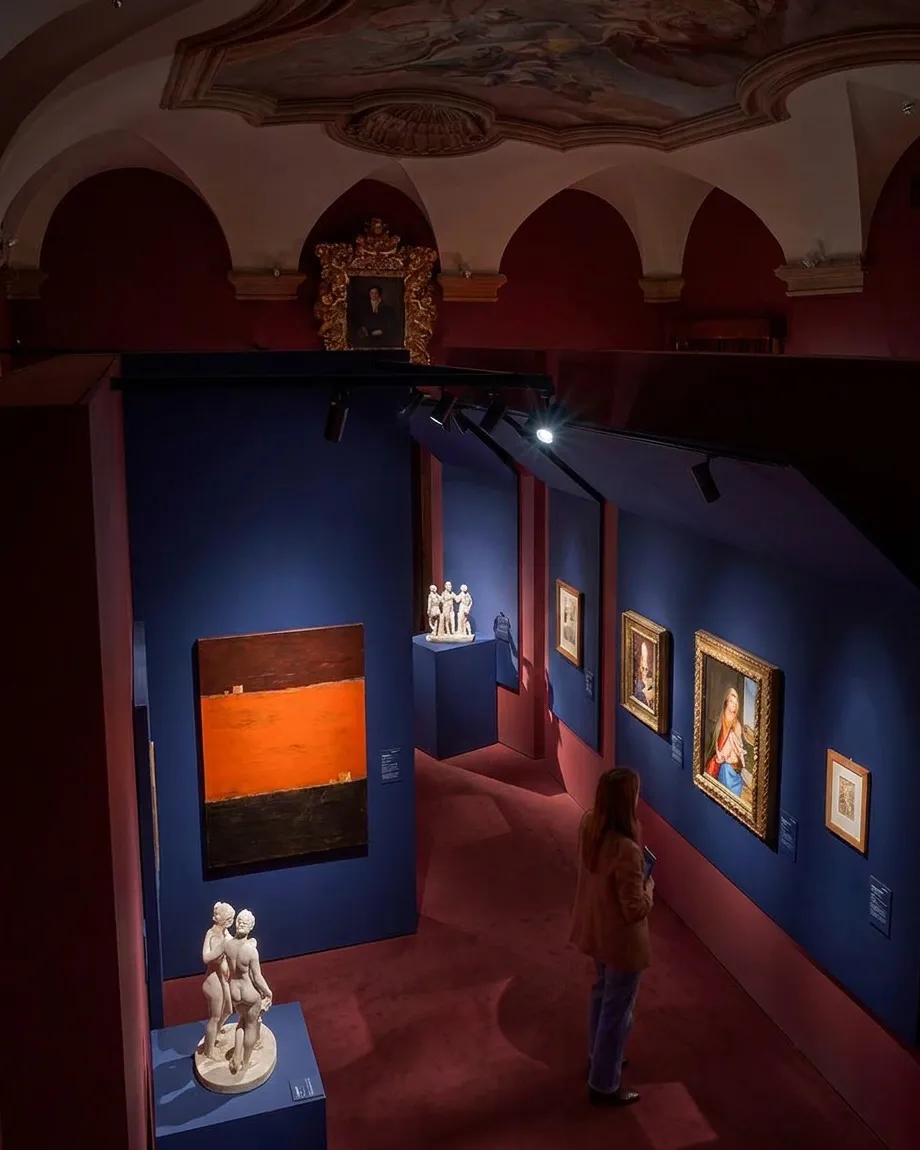
Context study / Spinoza's Lens
Spinoza's Lens in Museum Exhibition | Maurizio Valch
I. The Threshold of Substance
Before the imposing verticality of Spinoza's Lens, two gazes converge in the space where color ceases to be pigment and becomes an ontological weight. Damaris Cudworth Masham—the English philosopher who in the 17th century raised her voice to defend the warmth of affections and education against the cold logical architectures of her contemporaries—feels the immense orange band return an almost blood-like pulse, a demand for relational warmth that rescues the soul from its isolation. Beside her, Wang Bi—the young 3rd-century sage who transformed Chinese thought by revealing that non-being (wu) is the silent root that sustains and permeates all forms of the world—remains motionless. While Damaris's body leans toward the canvas, searching for the trace of a reflective embrace in the vibration of the oil, Wang Bi holds his breath before the minuscule blocks resting on the chromatic faults: he sees them as ephemeral condensations, small clots of matter that barely interrupt the flow of the originating void. Approaching the great divide where the burning orange grazes the lower black abyss, they attempt to define the exact end of light. But certainty breaks: the eye hesitates, the breath shortens, and the word is suspended... the border is not a line, it is a tremor, a spasm of matter that dissolves the contour and forces their bodies to step back before the immensity of the endless.
II. Notes from the Wounded Stratum
Sometimes I hold the palette knife like one holds a surgical instrument or a double-edged weapon. In the dim light of my studio, in front of this surface one hundred and sixty centimeters high, I doubted my own hand; I wondered if the canvas needed my will or if it was only asking me to step aside. I remember the exact moment I decided to wound the painting with a fine incision, a groove that would expose the vulnerability of the superimposed color. There is a latent secret in this trinity of strata, a physical memory that my rational mind is unable to recall but that my fingers recognize as they glide along the acrylic crust. I did not paint a theory of substance; I painted the effort of light to sustain itself between the scorched earth above and the sepulchral silence below, knowing that the painting will always know something about me that I myself prefer to ignore.
III. The Horizon's Scar
The dispute between the two philosophers now unfolds without words, in the pure tension of their postures. Damaris points with her fingertip—without actually touching the canvas—to the transition between the burning orange and the upper brown: to her, that dividing line is not a concept, but a real scar, a painful reminder of how human consciousness must tear itself apart to gain its autonomy. Wang Bi barely smiles, gently shaking his head; he warns her that to conceptualize that wound, to name it and pretend to understand where the sky ends and the fire begins, is the first step to diminishing the work. In trying to fix their eyes on the point where the incandescence sinks into absolute black, the gaze of both splinters... the heart rate alters... the matter becomes liquid before their eyes... and the density of the black seems to suck the warmth from the orange in a cold blink that freezes their hands. They understand, in that refraction of the limit, that the border is an unfathomable depth that refuses to be mapped.
IV. Being Without Conflict
When I look at the lower stratum of Spinoza's Lens, that territory of physical and dense darkness, I understand the trap of psychological time in which I so often fall: that absurd human habit of postponing existence, of waiting for the canvas of life to be completed tomorrow. I have discovered that in this black there is no void of death, but a fullness prior to language. There is an intensity in my painting that does not need conflict, light, or the spectator's gaze to be real. It is a mineral calm, a pure affirmation of being before thought intervenes to fragment it into subject and object. I only wanted the matter to rest in itself, free from the tyranny of our explanations.
V. The Remaining Question
Before the work of Maurizio Valch, the two intellects decide to take a step back, relinquishing the need to possess the painting with their intellect. There is no possible conclusion about Spinoza's substance, nor any formulas that exhaust the vibration of the oil and acrylic. As they walk away through the room, Damaris and Wang Bi do not carry away a certainty, but a physical question that resonates in their chests like the echo of an alien heartbeat. Is the limit a barrier that isolates us, or the only place where an encounter with the invisible is truly possible? The question remains floating in the museum air, waiting for the viewer, with their own body, to dare to hold the gaze of the lens.
- Original artwork
- Spinoza's Lens
- Actual dimensions
- 31.5 × 47.2 in / 80 × 120 cm
- Presentation
- Digital contextual visualization
Context references
abstract painting exhibition in classical museum · contemporary art alongside classical works · Maurizio Valch INCARNATE series · visiting art gallery orange and black painting · museum exhibition design painting · large format paintings from European galleries
About this visualization
This visualization places the artwork within an architectural context to help collectors and viewers imagine its presence in a real space. It is an interpretive reference, not an exact reproduction: the original work remains the sole authority for scale, color, surface and material presence.