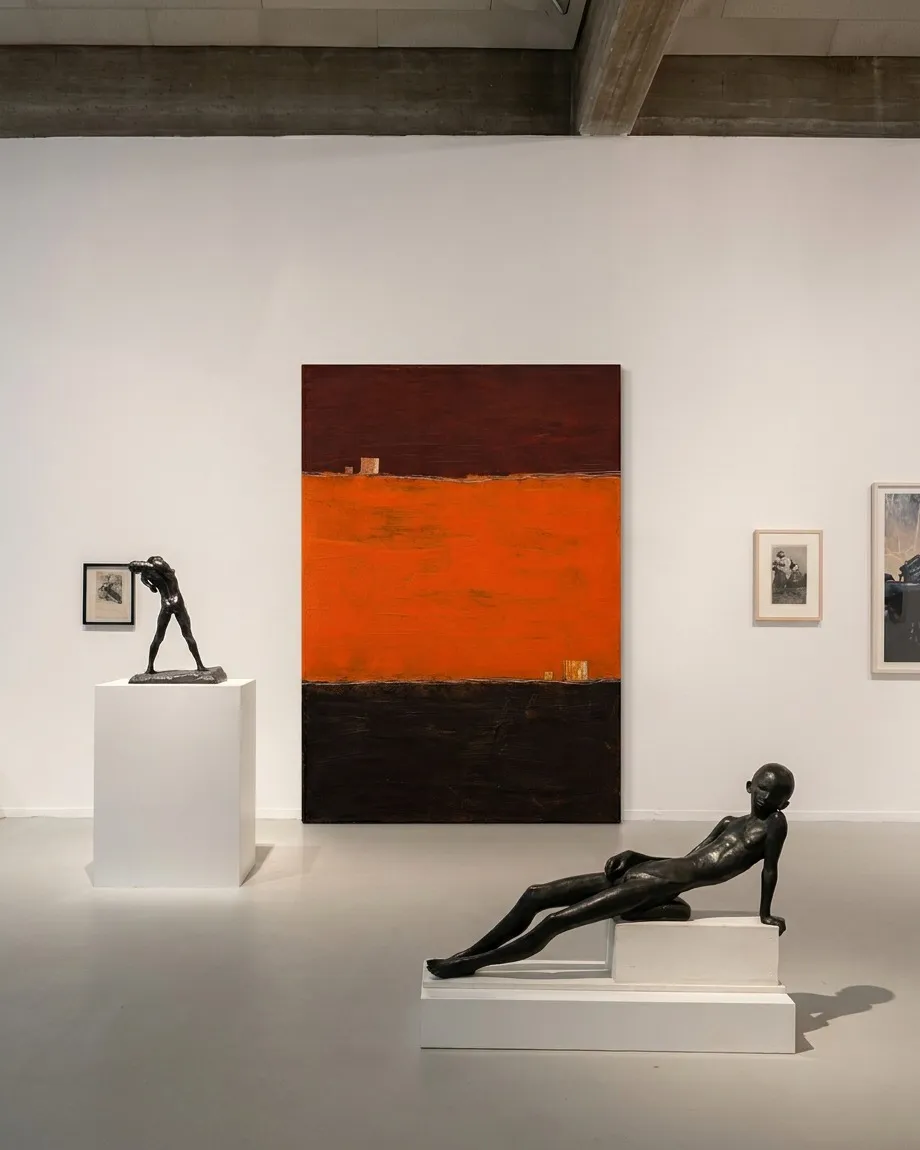
Context study / Spinoza's Lens
Spinoza's Lens - Artwork by Maurizio Valch | INCARNATE Series
I. The Cleft in the Refraction
Before Spinoza's Lens, space is suspended. We are not standing before a landscape, but before the x-ray of an absolute limit where three strata of matter claim their own gravity: an upper band of a rust-colored sky, thick as old blood; a central abyss of a burning orange that vibrates with the urgency of an internal combustion; and a ground of black earth, tilled with the weight of primordial coal. On the unstable borders of these chromatic masses, marked by fine incisions in the paint, rest minuscule, barely perceptible blocks that act as watchmen of the invisible.
To interrogate this threshold, two silent observers approach the canvas. On one side stands Linji Yixuan, the relentless master of Chan Buddhism who used sudden shouts and physical blows to demolish the scaffolding of the intellect and reveal the pure immediacy of being. On the other, Nicholas of Cusa, the Renaissance theologian and mathematician who coined the coincidentia oppositorum to demonstrate that infinite truth is only embraced in the abyss where conceptual reason surrenders. Both fix their gaze on the canvas, inhabited by the same silent question: what kind of being pulses in that orange band, in that suspended fire that stubbornly refuses to turn into light or shadow?
II. First Incision: The Maker's Body
I was not looking for an idea when I faced this canvas; I was looking for the weight of matter on wet fabric. I remember the creak of the palette knife forcing its way through the dense acrylic, the physical resistance of the accumulated layers that demanded to be wounded to reveal what they hid beneath. Those horizontal lines were not drawn to divide, but to scrape the canvas to its fiber, like someone polishing a glass seeking an impossible transparency. When those small monolithic blocks appeared at the edges of the orange vibration, I did not plan them. They emerged almost involuntarily, like silent witnesses of a memory that does not belong to me, archaeological remains of an ancient order resting there to keep the fire of the center from overflowing onto the black earth.
III. The Collapse of Categories
Linji contemplates the orange band and clenches his fists. For him, that chromatic vibration is not a representation of the spirit, but a silent shout that needs no translation. Seeing the dense, textured orange, Linji does not look for a meaning; he recognizes the instantaneous flash of lightning cutting through the night, but he distrusts the small blocks of matter resting in the incisions. "Why build scaffolding in the void?", he seems to ask with his gaze, intuiting that those monoliths are the ego's last attempt to cling to a safe border.
Nicholas of Cusa, on the other hand, leans toward the fine separation lines. For the theologian, those physical incisions are the incarnation of docta ignorantia: the exact point where the straight line and the curve merge in the infinite. To him, those tiny blocks are the minimum that contains the maximum, the mathematical hinge where the absolute silence of the lower black coincides with the burning wound of the center. However, the rough materiality of Valch's paint disarms them both: color is not a concept that can be bypassed with a shout, nor a paradox that sacred geometry can resolve; it is a physical presence that imposes its own silence.
IV. The Transmutation of Air
In an imperceptible instant, the intellectual discussion dissolves. The three-meter-high canvas stops being an object of analysis to become a force that alters the breathing of whoever contemplates it. The central orange is not light that illuminates, but a thermal density that strikes the chest, forcing the body to remember its own mineral fragility. Understanding this work no longer involves deciphering Spinoza's lens, but assuming the failure of any explanation. The layers of oil and acrylic, with their scrapings and accumulated transparencies, act as a filter that cleanses the viewer's gaze: to inhabit the painting, one must stop questioning it and accept the exposure of its broken horizon, allowing one's own consciousness to stratify into rust, fire, and ash.
V. Second Incision: Silence in the Studio
I know that when the studio light goes out, the painting continues to exist in a dimension I no longer control. Philosophers may look for the limit of reason or the absolute void in it, but to me, the painting is simply a living body that has found its own balance in silence. In the end, I sense that painting is an act of absolute surrender, an open door to love that is only crossed when one dares to strip bare before matter. Those small blocks that remain still on the border of the orange do not need to be explained; they are there to remind me that, even in the midst of the wound and the confrontation of shadows, there is a humble and moving resistance that sustains all our mystery.
- Original artwork
- Spinoza's Lens
- Actual dimensions
- 31.5 × 47.2 in / 80 × 120 cm
- Presentation
- Digital contextual visualization
Context references
large-format contemporary abstract painting · orange black and brown abstract painting · abstract art by Maurizio Valch · contemporary art exhibition with sculptures · minimalist designer living room painting · original artwork from art collection
About this visualization
This visualization places the artwork within an architectural context to help collectors and viewers imagine its presence in a real space. It is an interpretive reference, not an exact reproduction: the original work remains the sole authority for scale, color, surface and material presence.