Context study / Spinoza's Lens
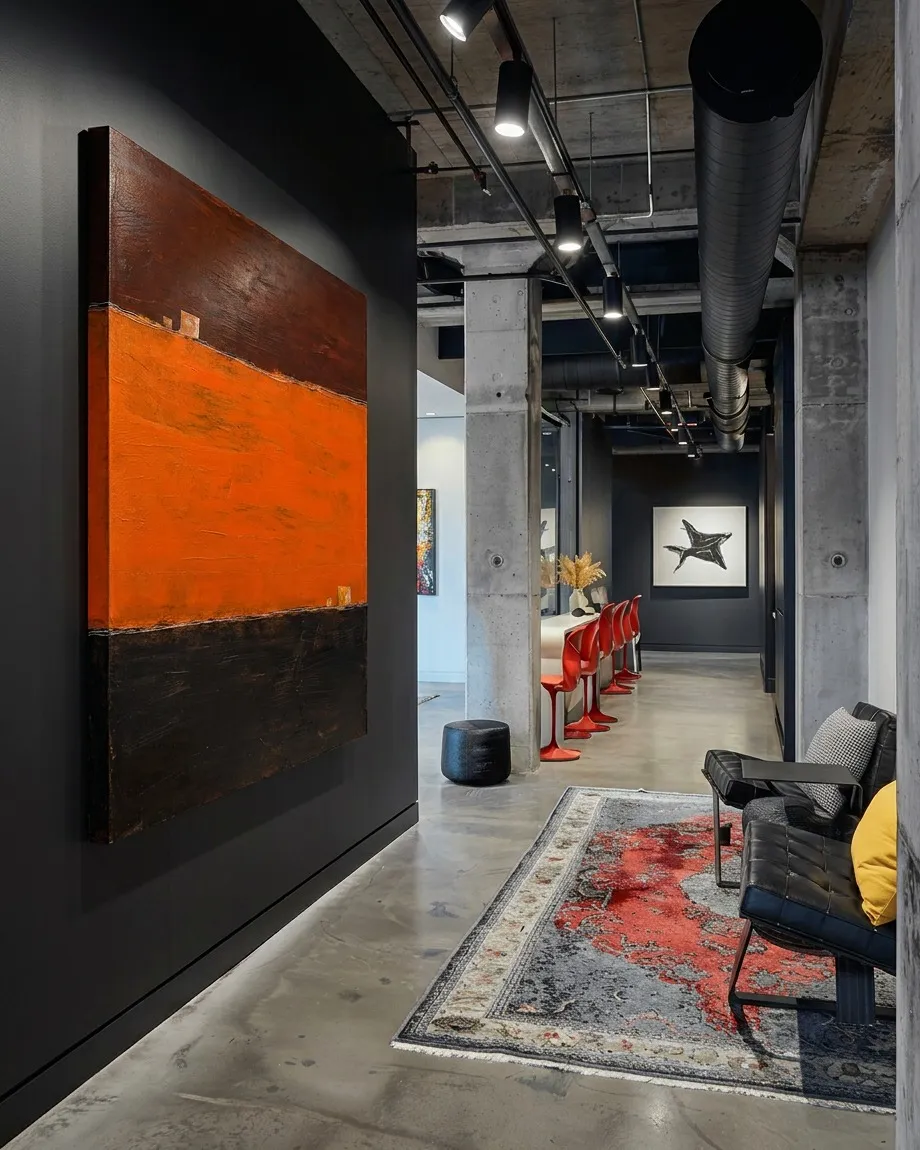
Spinoza's Lens Painting by Maurizio Valch in Industrial Interior
Fragment I: The Vibration of Duration (Voice of Thought)
Henri Bergson and Ajahn Mun are two men who, having inhabited the opposite ends of waking life and silence, stand today before a wall of fire and shadow to understand what happens when time decides to stand still and incarnate into matter. Facing the central band of Spinoza's Lens, a burning orange pulsing with the heat of a live ember, Bergson stretches out his fingers without quite touching the canvas. He senses that this color is not a static state, but an accumulation of instants, a continuous flow of duration pushing the upper sienna upward and pressing down on the lower black. "It is not color," the philosopher whispers, "it is the pulse of memory refusing to be divided into seconds." Ajahn Mun, accustomed to the dense immobility of nighttime jungles, observes the same band and feels a vibration in the center of his chest. For the monk, that orange is the residue of a desire that still insists on burning, a resistance of matter struggling not to dissolve into the emptiness surrounding it. As the gaze of both descends toward the dark border, the secret law of this space manifests itself: the density of the pigment increases as the light retreats, compressing elapsed time into an almost unbearable physical weight. Is it light that creates time, or is it time that, upon cooling, becomes this crust of paint?
Fragment II: The Creator's First Testimony (Voice of Maurizio Valch)
I look at this finished canvas and feel a strange distance, as if it belonged to the memory of another. There are marks down here, near the black crust, indentations made with the palette knife that I don't remember tracing; details that emerged from pure physical accident while my dog slept next to the easel and I was only looking for the exact consistency of the matter. I detest solemn explanations and the discourses of those who seek cheap enlightenment in art; for me, painting is a craft of dirty hands, a conscious fiction to open a door to love through what is real and tangible. However, touching the rough relief of the burnt sienna, a disquiet overtakes me: the time on my watch does not coincide with the time that has remained trapped in this canvas. Wounding the canvas with metal was an instantaneous act, but the wound now seems to have been there forever. What part of pain dissolves when it ceases to have a proper name and simply becomes texture?
Fragment III: The Lens of Perception (Voice of the Encounter)
The attention of the two thinkers now shifts toward the minuscule quadrangular blocks resting on the paint's fault lines. They look like small monoliths abandoned on the edge of a chromatic cliff.
—Look at them closely —says Bergson, whose breathing has synchronized with the rhythm of the painting—. They are not mere obstacles. They are lenses that concentrate duration. The flow of the orange pauses in them so that the mind can contemplate its own passing. They are memory becoming solid so as not to lose itself in the abyss.
—Or perhaps —replies Ajahn Mun in a voice that barely stirs the air of the room— they are the points where the mind runs aground. We cling to those small shapes, to those names and concepts, for fear of letting ourselves fall into the great black band below. We believe those blocks save us, but they only delay our liberation. Feel the tension in your throat: the body resists the immensity of the void pulsing underneath.
The secret law acts once again beneath their feet: as their eyes fall from the small lenses toward the absolute black, the air seems to grow denser, forcing them to space out each breath, as if the dark pigment exerted a physical gravity on their lungs.
Fragment IV: The Creator's Second Intervention (Voice of Maurizio Valch)
It amuses and at the same time overwhelms me to see how philosophers try to weave their conceptual webs over what I only consider a piece of stretched linen. They speak of absolutes, of lenses, and of liberations, but I know those small quadrangular shapes on the dividing lines were born from the technical necessity of balancing the visual weight of the composition, from a purely physical impulse to bring order to the chaos of the palette knife. Even so, I must admit my own defeat before the painting: there is an area, right in the lower third, where the black becomes so dense and absolute that it feels completely foreign to me. I don't know what is in there. I know I painted it, I know I dragged the oil with force, but when I look at it now, that shadow does not belong to me. It is a secret I accept, an indecipherable zone of silence that resists my own will. Can a block of paint just a few centimeters wide hold the weight of an entire uncertainty?
Fragment V: The Residue of Silence (Voice of Dissolution)
Before the immobility of Spinoza's Lens, the words of Bergson and Ajahn Mun eventually wear out, losing their conceptual edge. The vibration of the orange seems to have cooled completely upon touching the black abyss of the lower third, where the secret law runs its definitive course: there, time no longer flows, it has become pure inert, silent mass. At this point of maximum density, the philosopher of action and the master of detachment find an unforeseen complicity. There is no longer any need to argue whether matter is memory or emptiness. They remain together on the threshold, knowing that there is a narrow slit in the canvas —a millimeter of raw canvas barely peeking out behind the lower crust— that neither of them has managed to name, a wild residue that refuses to be thought. Is it necessary to cross the threshold to understand that silence always has the last word?
- Original artwork
- Spinoza's Lens
- Actual dimensions
- 31.5 × 47.2 in / 80 × 120 cm
- Presentation
- Digital contextual visualization
Context references
art for modern lofts and industrial spaces · dark wall decor with orange abstract art · large textured luxury paintings · contemporary interior design with original art · textured oil paintings by Maurizio Valch · black and orange contrast artworks
About this visualization
This visualization places the artwork within an architectural context to help collectors and viewers imagine its presence in a real space. It is an interpretive reference, not an exact reproduction: the original work remains the sole authority for scale, color, surface and material presence.