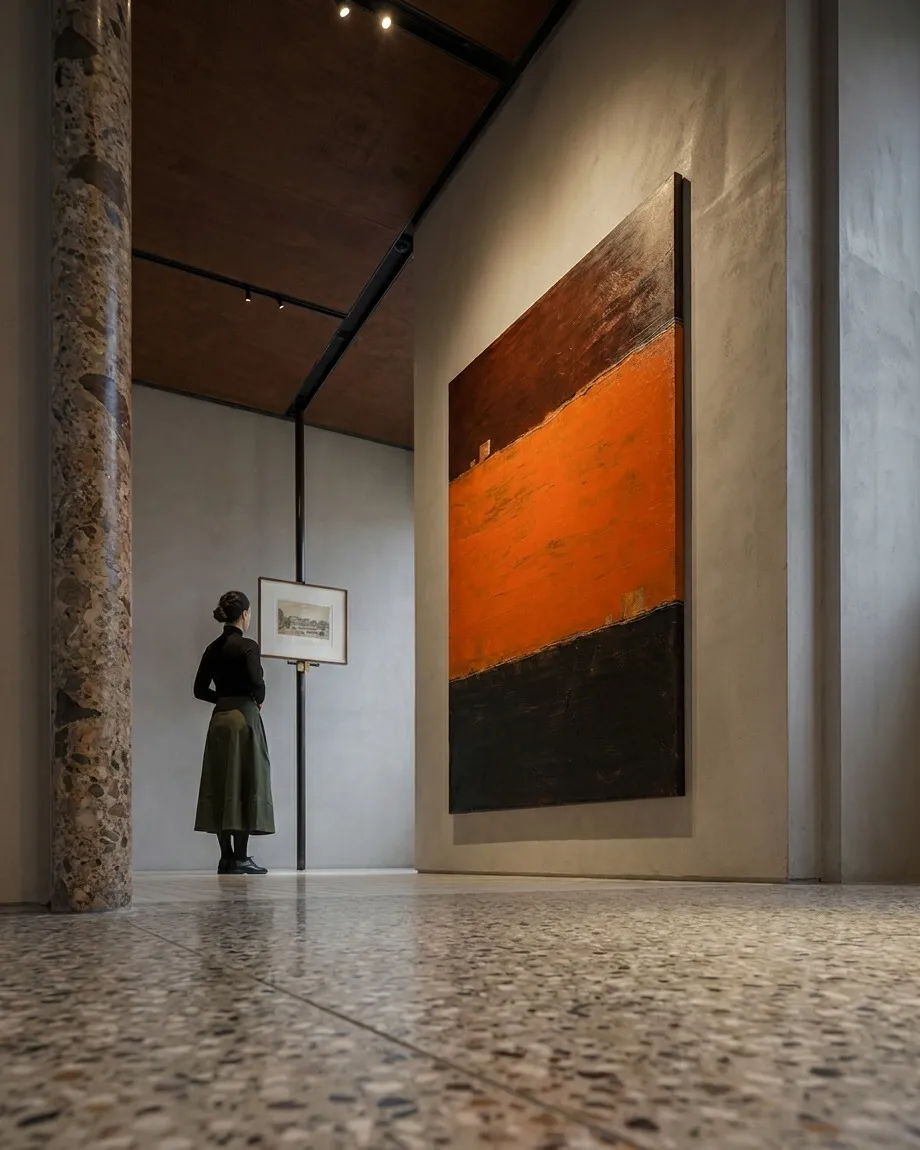
Context study / Spinoza's Lens
Spinoza's Lens (120 x 160 cm) - Abstraction by Maurizio Valch
Fragment I: The Lens and the Mire
Why polish glass to mathematical exhaustion if the universe, in the end, reveals itself as this three-story wound? In front of the surface of «Spinoza's Lens», Emil Cioran stops with slumped shoulders and a grimace of infinite weariness; he, who understood lucidity as a gangrene of the soul, sees in this wounded horizon the proof that all attempts to think are merely postponing disaster. He contemplates the upper band of the painting, that thick, blackish cherry red hovering over the center like a leaden eyelid. What did Baruch Spinoza intend to see through his perfect crystals? A geometric God, a cold harmony? Cioran smiles half-heartedly. The only real thing behind the glass is this great orange belly, a stagnant fire that does not warm but consumes the viewer's air. Attempting to rationalize this mass of acrylic and oil is like trying to measure a dying man's fever with a wooden ruler. The thought of purity suffocates here, crushed between a sky of pitch and an earth that resembles damp coal.
Fragment II: The Scar of the Studio
I did not want to paint a landscape. When I locked myself in with this 120 by 160 centimeter canvas, I was only looking for a boundary to hold my own weight. I remember the dry, almost obscene sound of the palette knife tearing the still-tender skin of the orange acrylic. I wanted to sink the metal until it touched the wood of the stretcher, but instead I found a darker memory, a resistance of oil and dust pulsing underneath. In tracing that horizontal incision across the canvas, I was not drawing a vanishing line; I was opening a mouth. As the orange color dilated my pupils until I lost my sense of distance, I wondered if I was constructing a portal to escape this room or if, on the contrary, I had just raised the walls of my own cell—a cell painted with the light of the most sterile sunset in the world.
Fragment III: The Plaster Temples
Just above the abyss of the incision, where the orange clashes with the darkness, rest tiny cubic blocks. They look like dust motes that have gained consciousness and gravity. Diogenes of Sinope, that vagrant who searched for a man with an unlit lantern and who here prefers to scratch the physical crust of the canvas to remind us that the mire always reclaims its inheritance, comes so close to the fabric that he almost touches it with the tip of his nose. He scoffs with a click of his tongue. "Look at them, Emil," he says to Cioran, "there you have your grand metaphysical systems. Those little plaster boxes that barely cast a shadow are Spinoza's lenses, melted and petrified by the heat of raw matter. We build tiny temples on the edge of the precipice just to convince ourselves that the void has an owner." Diogenes passes the pad of his rough finger near the physical furrow of the paint, despising the optical illusion of color and seeking the crust, the real roughness that proves that painting, before it is an idea, is wounded earth.
Fragment IV: The Rust I Did Not Prevent
I listen to them talk and realize they have seen an intention in my monoliths that I never had. They believe those small blocks are monuments to resistance, but to me they are merely the residue of weariness. Seeing the painting now, hanging under this cold light, I discover something that disturbs me: the instability of the lower horizon. There is a strange and almost erotic vibration of rust seeping from the black band into the orange. It is a silent invasion. I thought I had controlled the boundary with the incision, had decreed where the fire ended and where the night began, but the matter is mocking my hands. The painting keeps making itself, rusting in the shadow, and that confession of my own futility is the most honest thing I have ever painted.
Fragment V: The Residue of Silence
In the end, Diogenes's lantern is extinguished and Cioran's insomnia is left speechless. Theories crumble before the specific weight of Maurizio Valch's work. What remains in the spectator's stomach is not a concept, but a physical heaviness, an echo of the orange color pulsing behind the eyes even when the eyelids are closed. The painting is no longer explained; it is endured. In that intermediate space where reason surrenders, the canvas of the INCARNATE series becomes an exposed body: an extension of pigmented flesh that does not seek to be understood, but simply borne in all its beautiful and terrible muteness.
- Original artwork
- Spinoza's Lens
- Actual dimensions
- 31.5 × 47.2 in / 80 × 120 cm
- Presentation
- Digital contextual visualization
Context references
120 x 160 cm contemporary art paintings · solo abstract painting exhibition · architectural abstraction and interior design · orange and black color field paintings · Maurizio Valch original artworks · buy abstract paintings for collectors
About this visualization
This visualization places the artwork within an architectural context to help collectors and viewers imagine its presence in a real space. It is an interpretive reference, not an exact reproduction: the original work remains the sole authority for scale, color, surface and material presence.