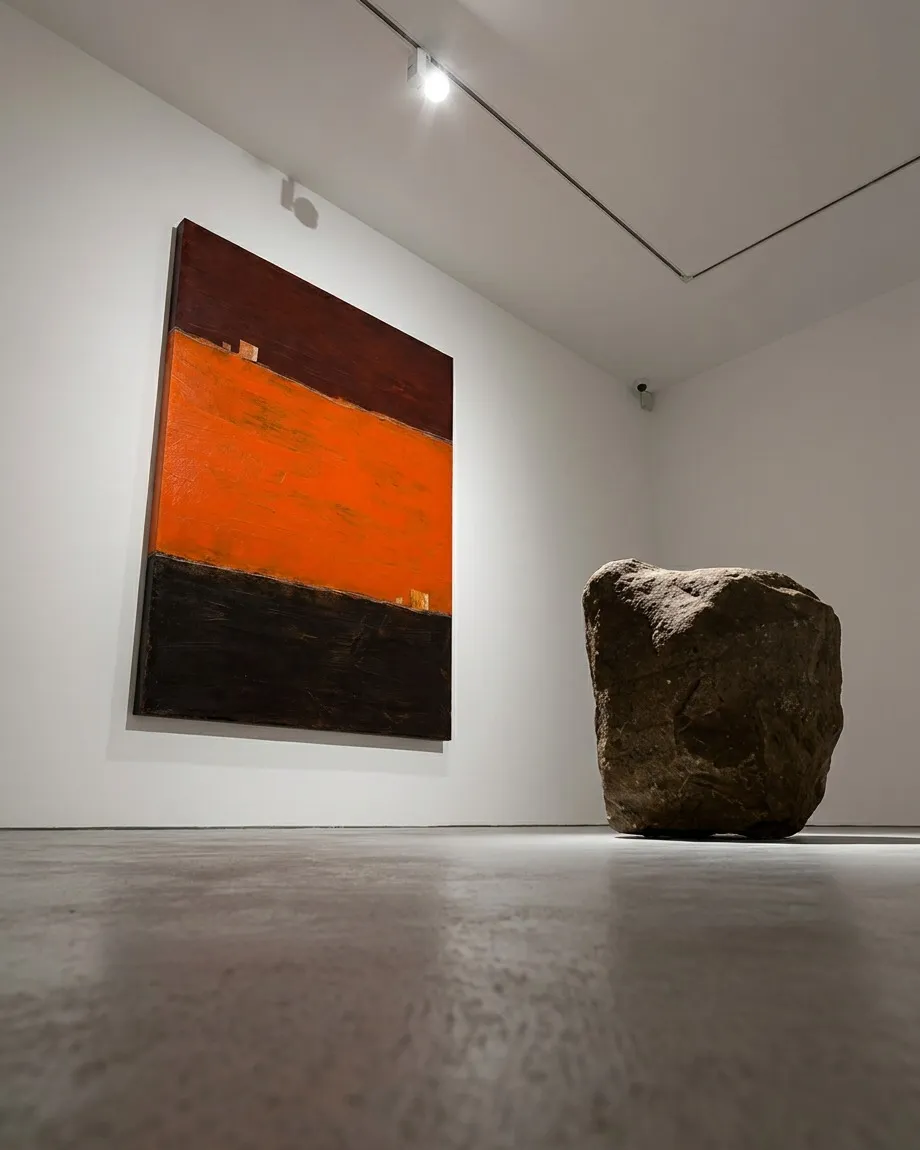
Context study / Spinoza's Lens
Spinoza's Lens by Maurizio Valch - Abstract Painting and Installation
Fragment I
At the threshold where color ceases to be surface to become a half-closed eyelid, two visions cross before the vibration of matter. Before the immensity of Spinoza's Lens, Sadr al-Din al-Qunawi contemplates the central orange band not as a pigment, but as a veil of existential light, an intermediate point where the invisible condenses to make itself visible before returning to the unknowable unity. For the Sufi mystic, that horizontal fire is the descent of grace sustaining the two dark worlds flanking it. However, Kshemaraja shakes his head slightly; for the Kashmiri philosopher, that burning orange is spanda, the primordial cosmic vibration that contracts and withdraws with contained violence between two absolute nothings. While Al-Qunawi perceives a sacred order descending silently, Kshemaraja feels the physical and electrical heartbeat of the canvas, a muscular pulse pressing and petrifying in the dividing lines, condensing all its energy into those tiny monumental blocks that barely manage to stand upright.
Fragment II
Sometimes I stop before the stretcher and doubt my own decisions, especially the title. Spinoza’s Lens. Why insist on the philosopher who polished optical glass until his lungs grew ill? I suppose that, just like him, my work consists of wearing down the surface to force an impossible transparency. When I sink the palette knife into the wet oil and acrylic, dragging the surface layers, I am not adding matter: I am wounding it, withdrawing it. Each scraping is an incision seeking to reveal the buried strata below, the ghosts of color that existed before the absolute orange. I feel an almost physical tension in the studio when I do this; I spend hours constructing a perfect balance, a horizontal peace of chromatic bands, only to jeopardize it with a violent slash of metal that can destroy everything in a second. Polishing the lens is not clearing the vision; it is opening a crack in the retina.
Fragment III
The gaze of both sages now descends to the subtle boundary where those small monoliths rest, barely suggested on the edge of the lower abyss. Kshemaraja smiles as he notices that these apparently solid forms are nothing but condensations of the same dynamic energy, moments of petrified consciousness that will, sooner or later, dissolve back into the burning flow of the orange. Al-Qunawi, on the other hand, observes those small structures with deep existential compassion: he wonders if those blocks are not ourselves, all of humanity suspended on a narrow ledge, balancing to avoid falling into the dark abyss waiting below or being consumed by the divine fire of the center. It is at this point that the abstract gaze of the philosophers clashes with the wonder of a child entering the room, who points to those two minimal blocks on the upper left and asks, with complete naturalness, if they are two empty houses in the middle of a desert of fire, or perhaps a pair of dice forgotten by a giant who grew tired of playing before the world was created.
Fragment IV
I look at the canvas from the opposite end of the studio and feel a profound strangeness. I have not painted a single human figure, yet those small monoliths of matter retain the weight of a departure, as if someone had been there just a moment ago and had just quietly withdrawn. In this space, where I am accompanied only by the slow breathing of my dogs and the creaking of the wooden floor, psychological time stops. The past I insist on repairing and the future in which I always postpone my peace vanish completely at the exact instant the palette knife presses the wet paint onto the canvas. In the end, I must admit to myself: this painting knows something about my own life that I am not yet able to formulate in words. It is not I who control the polishing of this lens; it is the lens observing me.
Fragment V
In front of the work, the space narrows and the spectator's body begins to register the real weight of the matter: a dry heat emanates from the orange band, striking the chest with the force of a desert at noon, while the heaviness of the dark ends seems to pull the shoulders down, anchoring us to the damp earth of the floor. The voices of the philosophers and the strokes of the painter merge into a single vibration that annuls the distance between thought and object. Everything seems to hold in an apparent immobility, a pact of forces holding its breath. Yet, behind the apparent stillness of the three bands, an insurmountable mystery remains in the scraped furrows dividing the color fields: what unfathomable depth beats behind the orange, in that thin line where the palette knife tore the canvas, revealing a dark background that no light seems able to reach?
- Original artwork
- Spinoza's Lens
- Actual dimensions
- 31.5 × 47.2 in / 80 × 120 cm
- Presentation
- Digital contextual visualization
Context references
contemporary minimalist art installation · dialogue between abstract painting and stone sculpture · textured oil and acrylic paintings · monumental three band abstraction · abstract art for design spaces · artistic decoration for museums and galleries
About this visualization
This visualization places the artwork within an architectural context to help collectors and viewers imagine its presence in a real space. It is an interpretive reference, not an exact reproduction: the original work remains the sole authority for scale, color, surface and material presence.