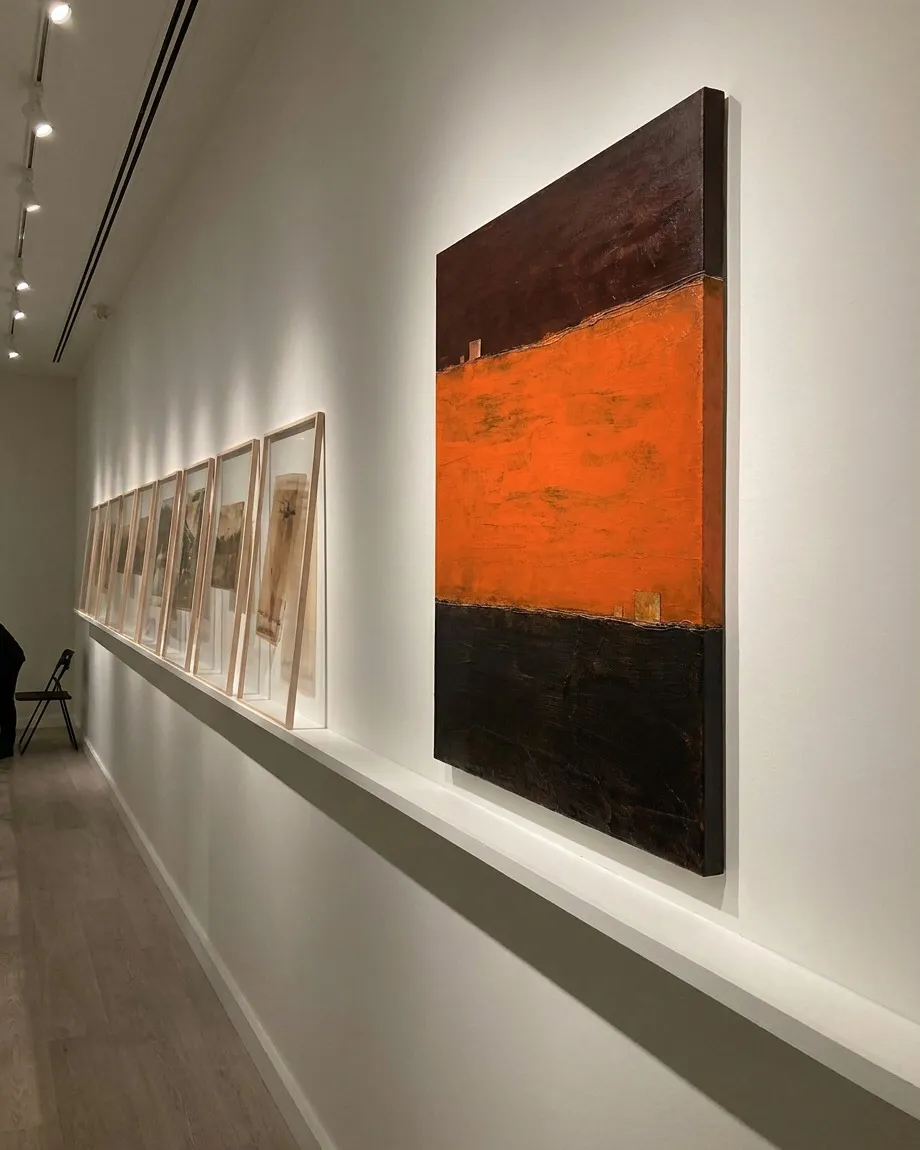
Context study / Spinoza's Lens
Spinoza's Lens - Maurizio Valch | Original Artwork INCARNATE Series
Fragment I: The Empty Lens (The Voice of Thought)
In front of the tripartite surface of Spinoza's Lens, the gaze pauses before it can categorize. There is no landscape here, but a silent collision of gravities. The Greek philosopher Arcesilaus—who refounded the Platonic Academy toward radical skepticism, teaching us to suspend judgment (epoché) before any appearance to find peace in the absence of certainties—would stand before this canvas, motionless, observing how the violent band of pure orange vibrates on the retina with an almost wounding intensity. Arcesilaus would doubt the very nature of that central fire: does that incandescence really exist in the matter, or is it merely a disturbance, an electrical agitation of our eye defending itself from the surrounding darkness? By suspending our need to define the painting, it ceases to be an analyzable object and becomes an embodied question. Before this boundary where the thick brown meets the absolute orange, we are struck by a primordial doubt: What can we recognize of a being before knowing who they are?
Fragment II: The Labyrinth of the Palette Knife (The Voice of Maurizio Valch - First Intervention)
When the palette knife touches the canvas, the silence of the studio is broken by a rough whisper, a rustle of dry earth and oil. Feeling the resistance of the material is, for me, the only way to return a body to the painting. By sliding the metal to open that horizontal trench, that furrow dividing the upper penumbra from the burning orange, I am not seeking to trace a clean border; I seek to wound the surface, to reveal the memory beating beneath the accumulated layers. The dense, sweet scent of oil paint floods the air as I drag away the excess pigment, revealing a tactile scar. In that physical instant of friction and subtraction, I understand that my task is no different from Spinoza's in his workshop: I am not painting to decorate a wall, but polishing a rough lens, wearing down the crust of the world, not to look outward, but to force the gaze to turn inward upon itself and see what remains hidden beneath my own strata of memory.
Fragment III: The Dream of the Monolith (The Voice of Contemplation)
Night descends upon the pictorial plane, and the lower mass—that near-black stratum worked by strokes of the palette knife—reveals its true nature. For the Taoist sage Chen Tuan—the legendary master who turned deep sleep into a form of inner alchemy, reminding us that stillness and inaction reveal the invisible currents of the universe—this dark band is neither a sterile void nor an absence of light, but the Wu, the fertile and silent abyss where the matrix of the cosmos reposes. On the edge of this tactile rift, Chen Tuan would contemplate the tiny golden monolithic blocks resting upon the furrow. They are neither temples nor geometric accidents; they are the closed eyes of someone dreaming the entire painting, points of latent light in the midst of the immensity. Here, a secret and beautiful tension arises: while the skepticism of Arcesilaus forbids us from asserting whether those small fragments of gold are real or mere optical illusions, the intuition of Chen Tuan smiles in the shadow, knowing that there is no need to assure anything to inhabit the painting and let oneself be cradled by its invisible breath.
Fragment IV: The Insurrection of Orange (The Voice of Maurizio Valch - Second Intervention)
There is a moment in the process when the painting stops obeying me. I had planned a rigorous structure, an order of strata where the orange light would be contained and subjected to the severity of dark tones. But as I applied that burning mass, the color rebelled. It began to expand with physical urgency, vibrating against the brown and the black like a living force claiming its own tactile space. I felt fear before my own work; the certainty of the original design cracked under the pressure of that indomitable energy. When I placed the small golden blocks on the fracture lines, I did not do it as a gesture of control, but as an act of surrender, an attempt to dialogue with a presence that no longer belonged to me. Looking at the finished canvas in the dim light of the studio, I shudder as I realize my own limitation, and I ask myself: What does this painting know that I, its author, do not yet know?
Fragment V: The Optics of Being (The Voice of the Return)
In the end, all theoretical speculations and the tensions of creation fade before the pure materiality of the work. We shed our discourses to recover a childlike gaze, naive and clean of suspicion. On the far right of the painting, upon the wound that separates the orange from the lower abyss, two tiny golden monoliths remain suspended in an impossible equilibrium. Are they about to plunge into the blackness, or have they just emerged from it, like the first sparks of a dawning creation? The painting does not answer. Spinoza polished his lenses so that the human eye could perceive the infinite unity of substance; Maurizio Valch hands us this canvas so that we may accept the mystery of its fractures. There are no conclusions to reach. Only the shared silence remains between the matter, the silent philosophers, and the spectator who, in front of the work, discovers themselves floating in an intimacy as unknown as it is real.
- Original artwork
- Spinoza's Lens
- Actual dimensions
- 31.5 × 47.2 in / 80 × 120 cm
- Presentation
- Digital contextual visualization
Context references
orange and black abstract painting · large format monumental abstract paintings · abstract art by Maurizio Valch · three color band painting · INCARNATE series artworks · contemporary art exhibition gallery · abstract painting with golden monoliths
About this visualization
This visualization places the artwork within an architectural context to help collectors and viewers imagine its presence in a real space. It is an interpretive reference, not an exact reproduction: the original work remains the sole authority for scale, color, surface and material presence.