Context study / Spinoza's Lens
Spinoza's Lens in Studio and Art Space | Maurizio Valch
I. The Substance that Disobeys Me
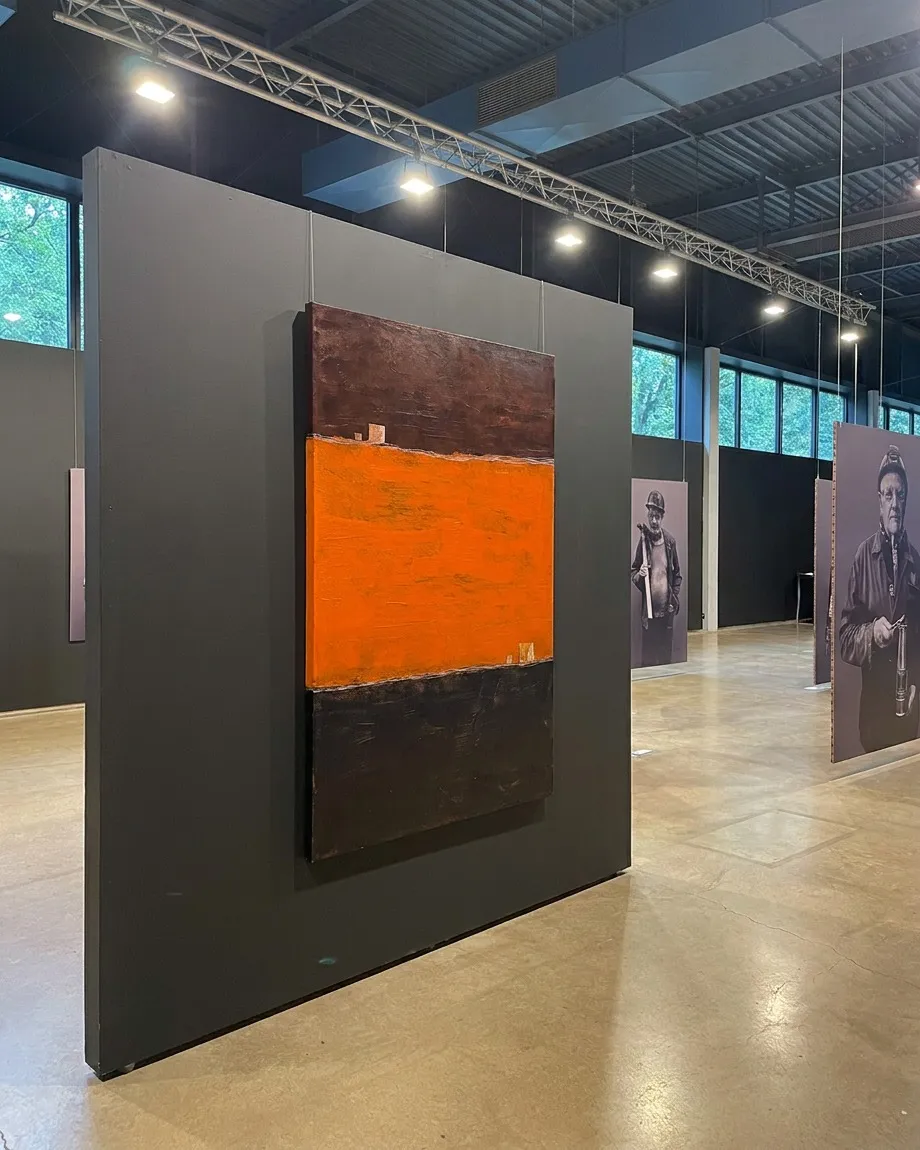
I do not know at what moment the acrylic ceased to be a docile matter on the stretcher to become a living resistance, a body demanding its own gravity. When painting Spinoza's Lens, I was not seeking to illustrate a theory; I was seeking to touch the limit of the visible. I remember the physical weight of the palette knife building up that burning, almost violent orange, pushing it against the absolute black that sleeps below and the dark umber pressing from above. I felt an almost sacred urgency, an impulse that did not come from reason, when making that fine incision just beneath the tiny golden monolith guarding the border of color. By wounding the canvas, I did not destroy the surface: I opened a vent. Sometimes I stand still in front of these dimensions of 120 x 160 cm and understand, with an intimate shudder, that this painting knows something about my own life that I myself have not yet managed to decipher. It is as if the oil and acrylic had sealed a pact behind my back, reminding me that the painter is only the witness to a mystery that surpasses him.
II. The Threshold of Appearance
Faced with the imposing canvas, two figures from distant eras contemplate the vibration of the material orange. The first to break the silence is Gorgias, the ancient Greek rhetorician and nihilist philosopher who dedicated his life to proving that reality is an incommunicable illusion and that words are only shadows of shadows. For him, this painting is the ultimate proof of his thesis: “Look closely at it,” he murmurs with a bitter smile, “this burning orange is not fire, nor heat, nor presence; it is only a beautiful optical lie, a trap for the tired eye desperately searching for a being where there is only emptiness.”
Beside him, with her gaze fixed on the dense grain of the paint, stands Clarissa Pinkola Estés, the Jungian analyst, writer, and guardian of ancient myths, celebrated for tracing the tracks of instinctive nature, trauma, and the creative force of the human soul. She does not deny the emptiness of which the philosopher speaks, but she sees in it a fertile territory. “You are wrong, Gorgias,” she replies in a calm, deep voice, “this is not a lie. It is a scab on the skin of the psyche. It is the stratum where everything we could not scream burns, barely contained by those small golden sentinels preventing the soul from collapsing into the dark night of the black that supports the painting.”
III. The Golden Scar
The discussion does not focus on technique, but on the wound. Gorgias points his index finger at the fine fault line dividing the orange light from the abyss below. “If there were a truth in this painting,” the Greek argues, “it would be inaccessible. Those geometric blocks you call sentinels guard nothing; they are accidents, human pretensions of imposing order on a chaotic and meaningless universe. The painter has polished this canvas as Spinoza polished his lenses, believing he would see God through the glass, without noticing that the glass only reflects our own blindness.”
Clarissa steps closer, her breath almost brushing the texture of the acrylic. “We do not search for God in the perfection of the lens, Gorgias, but in its fractures. Those incisions, those scrapings that Maurizio left with the palette knife, are the traces of the healing process. Trauma tears the fabric of our history, yes, but the golden scab born on the frontier of pain is what allows us to continue inhabiting the body. This painting does not need to be explained to heal the one who looks at it; it is enough that we recognize in its matter our own right to be wounded and, even so, continue to shine.”
IV. The Memory of the Strata
Sometimes I wonder if, just as Spinoza wore out his lungs breathing in the glass dust he polished to sharpen the gaze of others, I might be wearing out my own memory upon this three-centimeter-thick support. If we change the lens through which we look at our past, do the layers of what we were change too? The absolute black at the base of the work is not the absence of light; it is the accumulation of everything I have kept silent, the sediment of the years. The upper brown is the weight of the daily sky. And in between, that orange... its insolence astounds me. It is the color of desire that resists being buried. Applying the gold leaf onto the tiny blocks, I felt I was founding a miniature sanctuary, a safe boundary for the viewer to peer into their own abyss without falling in. It is a metaphysical suture on the canvas, a silent promise that matter, however fragmented, always seeks the unity of a single divine substance.
V. The Silence of the Matter
The dispute between the nihilist and the guardian of myths finally dissolves into the atmosphere of the exhibition room. There is no winner. Faced with Spinoza's Lens, Gorgias's words about the nonexistence of things become so dense that they end up acquiring body, and Clarissa's psychology strips itself of concepts to become pure tactile vibration. The painting ceases to be a surface hanging from a gray wall to transform into a threshold where being and nothingness embrace. The viewer leaving the room no longer carries the memory of a painting of three color strata; they carry within themselves a living territory, an orange vibration beating with the persistence of a heart that has decided, despite all wounds, to remain burning in the midst of the half-light.
- Original artwork
- Spinoza's Lens
- Actual dimensions
- 31.5 × 47.2 in / 80 × 120 cm
- Presentation
- Digital contextual visualization
Context references
display design for art exhibitions · 120 x 160 vertical painting on gray panel · side view of material abstract artwork · Maurizio Valch studio
About this visualization
This visualization places the artwork within an architectural context to help collectors and viewers imagine its presence in a real space. It is an interpretive reference, not an exact reproduction: the original work remains the sole authority for scale, color, surface and material presence.