Context study / Spinoza's Lens
Spinoza's Lens in Gallery Exhibition | Art by Maurizio Valch
Fragment 1: The Edge of the Glass
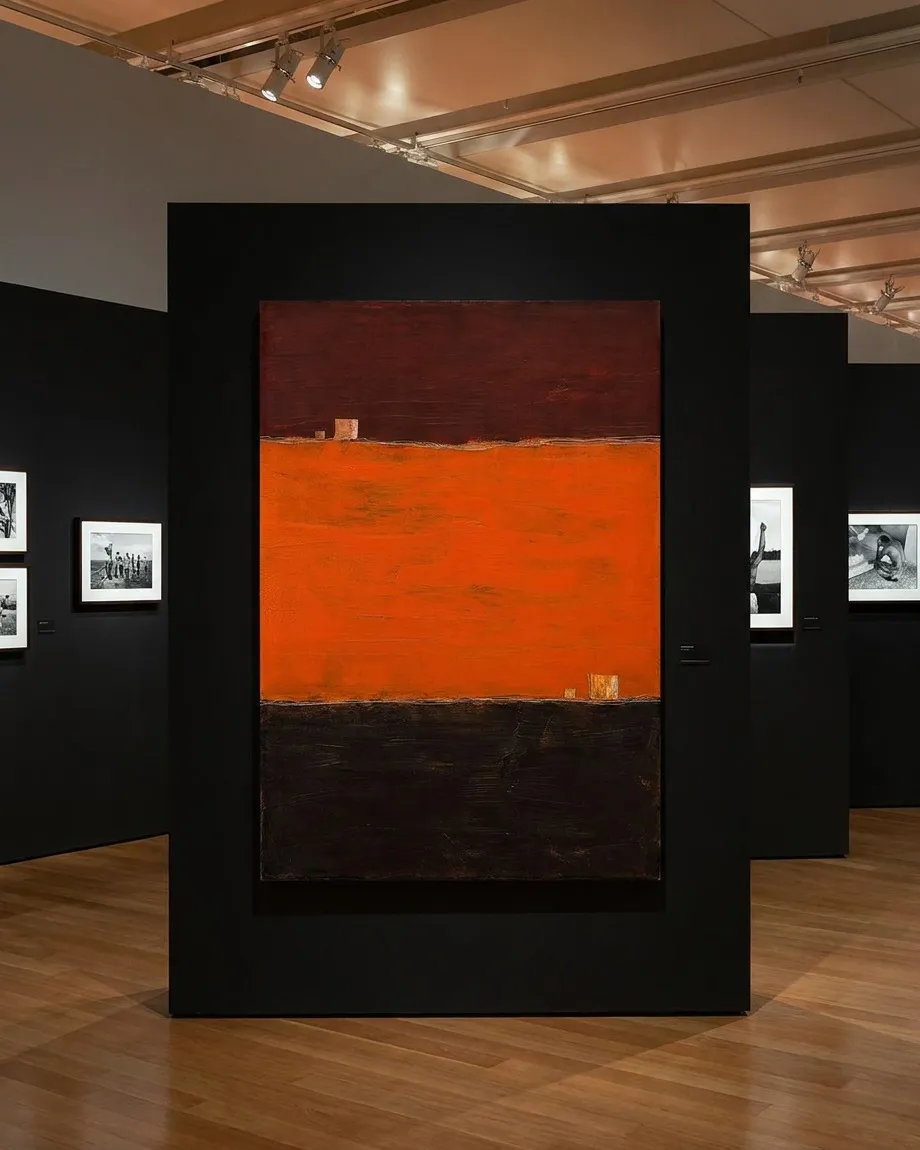
The vertical scale of Spinoza's Lens imposes itself before them like a tombstone of condensed light. On one side, Abraham ibn Ezra contemplates the chromatic trinity and senses the secret order of the cosmos: above, the dense burgundy of the supreme spheres, divine thought folded back into its own night; in the center, the tzimtzum, the creative contraction that bursts into an incandescent orange; below, the mineral black, the absolute concealment of matter. On the other side, Irvin D. Yalom perceives a very different geography, a topography of the human psyche where the burgundy is repressed consciousness, the orange the vital pulse of desire struggling not to be extinguished, and the bottom black the basic anxiety before nothingness, absolute isolation.
As they approach, the immense orange field begins to act physically on their bodies. The air seems to thin; they feel a sudden wave of heat on their skin and a slight acceleration in their chests, as if the vibration of the pigment were expanding the walls of the room. It is not a visual metaphor, but a real pressure, an urgency pushing the blood. It is then that their gazes, diverted by the thermal impact of the center, notice the small monolithic blocks with gilded edges resting on the fault lines. They are not ornaments, nor simple contrasts of scale. They are minimal existences, precarious consciousnesses trembling and barely holding on at the exact edge of an unfathomable abyss.
Fragment 2: The First Cut
I remember the weight of the palette knife in my right hand, the cold metal contrasting with the temperature of the wet acrylic I had just spread over the canvas. I had spent days building that plain of fire, achieving a saturation that vibrated with an almost unbearable beauty. And right there, at the point of maximum plenitude, I understood that the pure surface is a convenient lie. I plunged the palette knife with determination, dragging the material, feeling the resistance of the taut canvas under the pressure of my arm. It is a strange, almost violent contradiction: wounding beauty so that it acquires truth. As I removed that thread of wet paint, revealing the physical scar that divides the burgundy sky from the central fire, I felt I was scraping my own strata. It was not just pigment that was left exposed in that dark trench; it was my many past selves, the cracks of decisions not made, the echo of losses I believed buried. In the end, one never knows if they are painting a picture or simply opening the right windows for pain to breathe.
Fragment 3: The Dialogue of the Scars
“Look at this lower groove, Abraham,” says Yalom, leaning towards the incision that separates the burning orange from the absolute black. “It is the exact representation of fundamental isolation. The black below is not just a color; it is the silence of the grave, the constant reminder that we walk over the void. That wound in the paint is the boundary separating us from oblivion, the border that gives contour and urgency to our existence.”
Ibn Ezra shakes his head gently, his eyes fixed on the depth of the scraped relief, where the binder shines irregularly under the gallery's spotlights.
“You are wrong to fear that darkness, my friend. In our tradition we know that when understanding fails, when reason breaks before the abyss, it is precisely there that the Or Ganuz is revealed, the hidden light that the Creator reserved for the righteous. That scar is not a separation, but the only channel through which the divine can filter into our world of clay. Black is not emptiness; it is the excess of a presence our eyes do not yet know how to decipher.”
The silence that follows his words allows the physical murmur of the painting to settle between them. The matter down there is thick, carved with palette knife strokes that have left hardened ridges, grooves that seem ready to cut any finger that dares touch them.
Fragment 4: The Insufficiency of the Word
There comes a point when the conceptual scaffolding of both men simply splinters. Ibn Ezra's complex celestial mathematics, his astrological calculations and emanations of the spheres, suddenly reveal themselves as too rigid, unable to contain the organic quality of that black crust dominating the base of the canvas. Similarly, Yalom's clinical apparatus, his mapping of defense mechanisms and taxonomies of existential anxiety, crumbles before the raw vibration of the orange, which does not ask to be interpreted, but to be endured.
They look at each other and, for the first time, are silent. Like two small children stopping before the immensity of a marine horizon on a stormy day, they find themselves disarmed. Why do the golden blocks prefer to live on the scar and not in the center of the color? The question floats, suspended in its own naivety. They renounce words. Instead, they mentally extend their hands, tracing the physical roughness of the canvas, the fatigue of the material, the relief where paint accumulates and dries, reminding them that before thought there was earth, and before explanation there was always the body.
Fragment 5: What the Painting Knows of Me
Han pasado los años y hoy me vuelvo a encontrar frente a Spinoza's Lens. La miro y ya no me pertenece; ha adquirido esa autonomía silenciosa y algo altiva que tienen las cosas que han sobrevivido a sus creadores. Me doy cuenta de que la tela custodiaba un secreto que yo mismo ignoraba cuando la pintaba en la solledad del taller. Mientras me obsesionaba con las tensiones del color y la herida de las líneas, estaba depositando allí una fe ciega en la resistencia del alma. Ahora, en el invierno de mi vida, cuando mis días transcurren más despacio, cuidando a mis animales en el campo, observando cómo la luz de la tarde tiñe los pastos con el mismo tono naranja de la tela, entiendo la pintura de otra manera. Ya no veo en ella el conflicto de las fuerzas, sino la simplicidad de estar vivo. Esas pequeñas estructuras doradas que resisten sobre las grietas no son náufragos; somos nosotros, aferrados a la belleza de nuestros vínculos efímeros, cuidándonos mutuamente sobre la brecha del tiempo. El arte, después de todo, no era un ejercicio de la mente, sino una puerta lateral y silenciosa para aprender a amar la fragilidad del mundo.
- Original artwork
- Spinoza's Lens
- Actual dimensions
- 31.5 × 47.2 in / 80 × 120 cm
- Presentation
- Digital contextual visualization
Context references
large format painting in art gallery · vertical abstract painting presentation · contemporary art exhibition by Maurizio Valch · mounting ideas for minimalist paintings
About this visualization
This visualization places the artwork within an architectural context to help collectors and viewers imagine its presence in a real space. It is an interpretive reference, not an exact reproduction: the original work remains the sole authority for scale, color, surface and material presence.