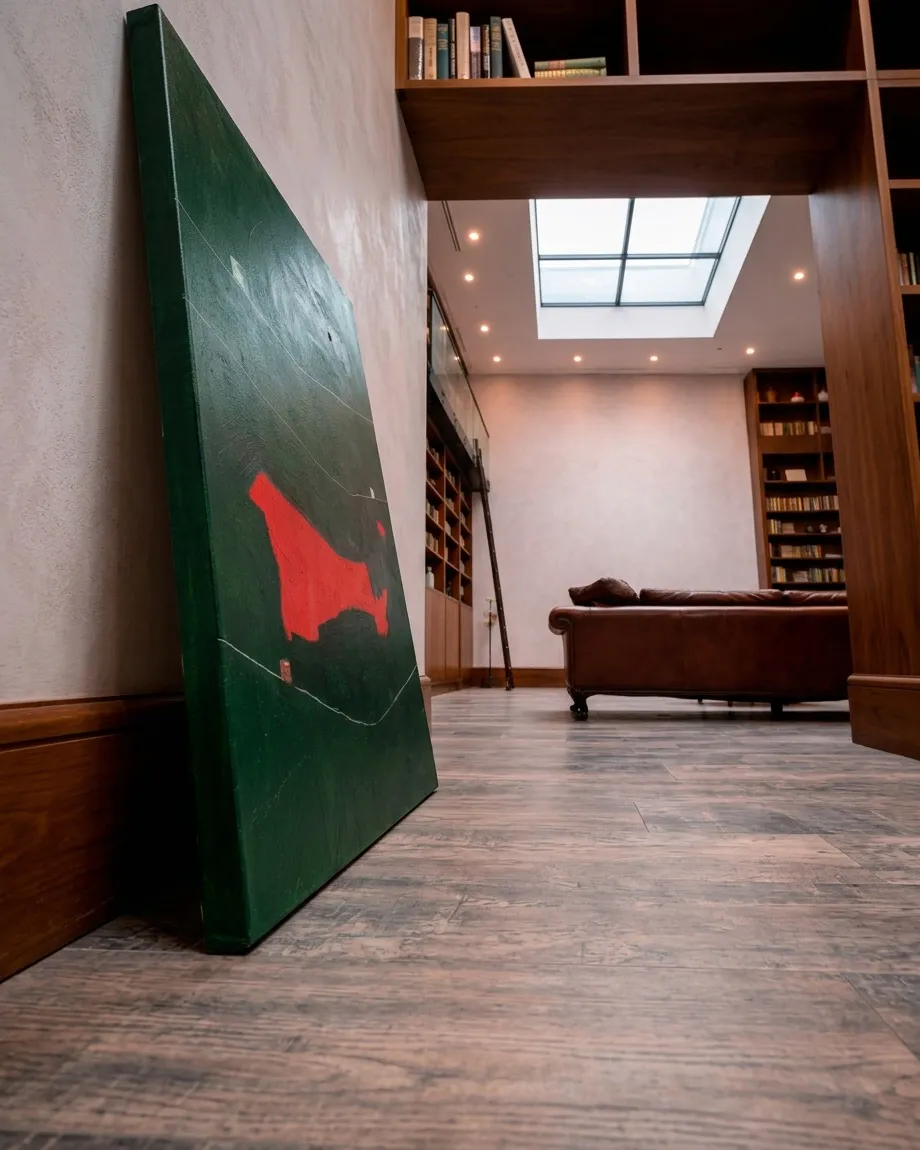
Context study / Sogno di un filo teso
Maurizio Valch - Sogno di un filo teso | Contemporary Art
The surface of "Sogno di un filo teso" presents itself to the observer not as a mere painted surface, but as a dense, vibrating territory where the forest green acts as a sounding board. This large chromatic field, far from being a passive background, behaves like an acoustic chamber that fosters absolute visual listening. Upon this dark, vegetal mass, three thin white lines cross the space from side to side; they have not been drawn with the addition of a brush, but torn from the canvas through a physical incision, a subtractive scraping that cleaves the matter to reveal the light of the support. These grooves function as tension cables or strings of a silent instrument subjected to extreme traction. The balance of the composition is sustained by the tension of these threads and the presence of tiny geometric blocks that rest precariously on them, forcing the eye into an exercise of concentrated attention, as if awaiting the imminent creak of a structure about to give way.
In the intimacy of the studio, the transition from acrylic to oil required me to work with the weight of the palette knife, searching for a physical resistance that the support could return to me. It was in this friction that, almost like a violent blow in the center of the plane, the large, irregular patch of carmine color emerged; I did not think of it as a color accent or a compositional device, but as a zone of thermal accumulation, a focus of matieric heat that alters the temperature of the entire painting. In applying this dense, burning mass over the cold green, I felt how the pigment accumulated an almost geological energy, a thick body that expands and interrupts the flatness of the canvas. Carving the white lines with a metal stylus through that vegetal density was an act of controlled tearing; each incision meant opening a rustic scar to release the light hidden beneath the layers of oil, converting the pictorial surface into a skin exposed and warm to the touch.
Contrasting the exact geometry of the lines that embody the dream of the tense thread, the central crimson mass introduces the law of gravity and collapse. This overflowing, asymmetrical patch represents the irruption of abandonment as a physical force: the moment when the material relinquishes the rigidity of the limit and yields to its own weight. The red block does not obey the orthogonality of the grooves, but spills organically over the green background, behaving like a sediment of loose earth that has slipped after a fracture. This voluntary collapse disarms any pretense of rigorous control over the space; the painting finds its true dimension when it assumes the fall, the irregularity of the edge, and the natural wear of the paint dripping and settling without asking permission from symmetry.
I conceive painting as an extension of my journeys on foot and by bicycle, long days where physical fatigue strips away the heaviness of thought and the insistence of the self. For me, true abandonment consists of this dispossession, in the decision to lower one's guard and allow the body to become receptive ground, clearing the gaze of decorative intentions. The small blocks of color I placed on the incised lines act like the stones of a cairn on a mountain path, tiny visual shelters where the gaze can pause before losing itself in the immensity of the green. In carving the lines that sustain these structures, I had to hold my breath and sharpen my listening to the material, measuring the tool's pressure against the fabric of the canvas so as not to rip it completely, stopping the blade at the exact limit where tension becomes pure resistance.
"Sogno di un filo teso" ultimately functions as a cartography of deviation and unstable balance. The work contrasts the utopia of the straight line—that tense thread that aspires to order the world—with the organic reality of the detour, where the cold of open space, the concentrated heat of the crimson beating like an open wound, and the abandonment of forms accepting their decline coexist. By renouncing decoration and illustrative representation, Valch's painting establishes itself as an active membrane that does not seek to explain anything to the viewer; on the contrary, it offers them a dry dock and a space of silence where, by suspending the urgency of seeking literary meanings, the body simply accommodates itself to the quiet and elemental vibration of matter.
- Original artwork
- Sogno di un filo teso
- Actual dimensions
- 31.5 × 47.2 in / 80 × 120 cm
- Presentation
- Digital contextual visualization
Context references
canvas painting by Maurizio Valch · abstract art inspired by territory · minimalist forest green and red paintings · original abstract painting with textures · contemporary art for collectors
About this visualization
This visualization places the artwork within an architectural context to help collectors and viewers imagine its presence in a real space. It is an interpretive reference, not an exact reproduction: the original work remains the sole authority for scale, color, surface and material presence.