Context study / Sogno di un filo teso
Sogno di un filo teso - STRATA Series | Maurizio Valch
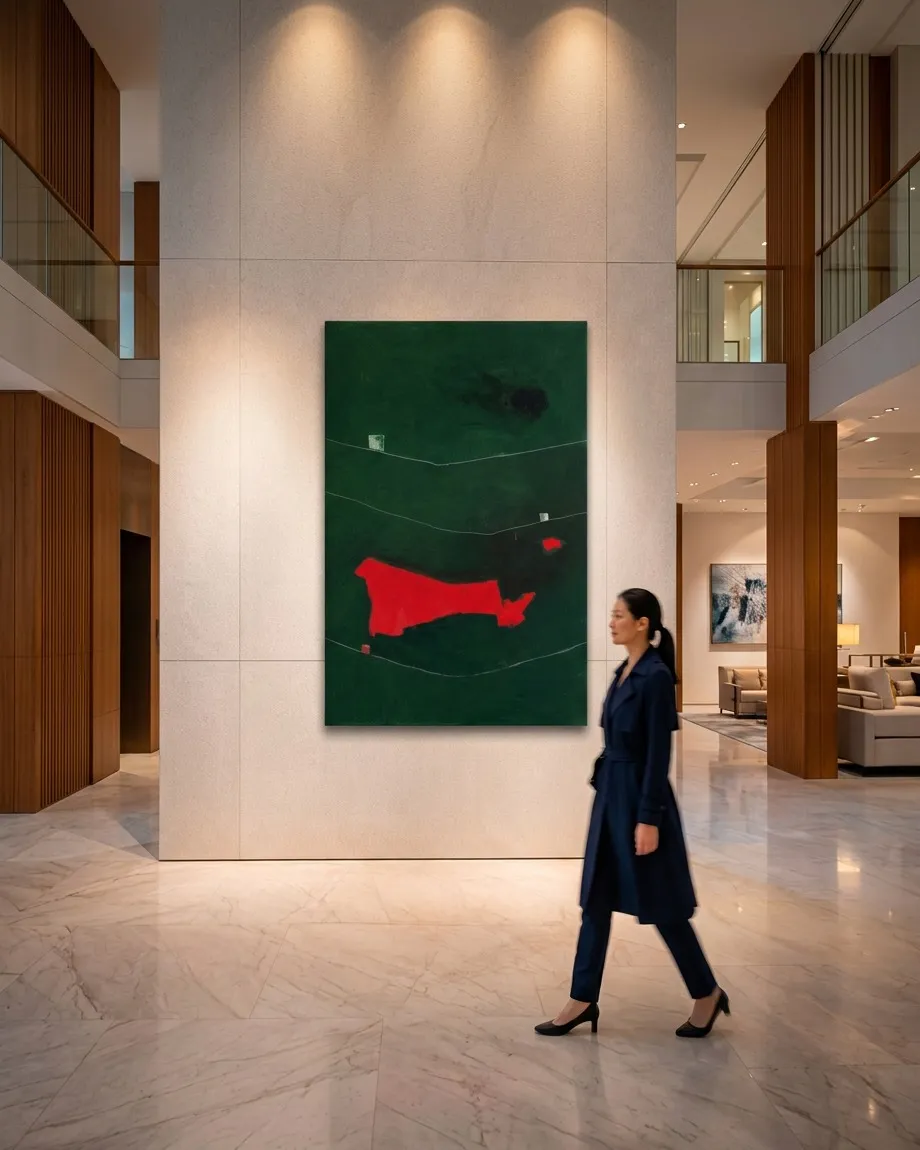
The immensity of this green plane does not claim a gaze; it demands a capitulation of the eye. In the monumental scale imposed by this concrete and marble lobby, the work stands not as a hanging object, but as a vertical threshold absorbing the passerby's haste. There are no symbols of faith here, no altars, no promises of written redemption; yet, when stopping before this emerald abyss, the body experiences that silent gravity that the ancients reserved for sacred spaces. It is matter itself, stripped of all narrative subservience, that assumes a liturgical function: a vast chromatic field that does not attempt to illustrate transcendence, but to physically produce it through its weight, its temperature, and its unfathomable depth.
When I traced those fine white lines crossing the upper half of the canvas, I was not thinking of a map or a celestial coordinate. I simply felt the urgency of introducing an interval of sanity in the midst of a mass of color that threatened to devour everything. Those lines are my silent prayers, incised marks scratching the surface to reveal that, beneath the apparent stillness of the paint, beats a support that resists. By holding my pulse steady against the density of the pigment, I understood that the sacred does not dwell in the representation of the divine, but in the extreme tension of not allowing the inner light to be completely buried by the darkness of the plane.
This suspension is broken by the irruption of the crimson mass in the lower section, a presence that behaves with the vibration of an offering or a cooled fire on the temple floor. In its dialogue with the work of Mark Rothko, Valch's canvas shares that capacity to convert color into an enveloping and sacred atmosphere, but distances itself from the floating mysticism of the American artist by anchoring the experience in a tactile and imperfect geology. The red here is not a diffuse celestial light; it is a material wound, a crust of thick oil claiming its right to physical existence. Transcendence in this painting is not sought by escaping the world toward an ideal plane, but by descending somatically toward the wound of the canvas, where the crack reveals that pain and beauty are made of the same clay.
Is that last downward-curved line the limit of our beliefs, or is it the loose end of an order that has decided to collapse so we can begin anew? I often wonder if my insistence on painting these suspended blocks and filaments is nothing more than an attempt to domesticate the vertigo produced by the silence of the studio. But the painting always knows more than the painter, and observing this canvas today, leaning against the immensity of this wall, I discover that the true sacred space is one that offers no comforting answers. The last line sustains nothing; it simply accompanies the fall, inviting us to accept the uncertainty of the abyss as the only condition where consciousness can awaken free from its own theories.
In the end, the contemplation of this work dismantles the tyranny of rational analysis that seeks to translate everything into a dictionary of psychological or mystical equivalences. Before the green-black void of the lower section, the viewer is returned to their own scale, stripped of guides and prepackaged discourses. The silence emanating from the painting is not the absence of sound, but the comprehension of our own mental noise, which falls silent when faced with a presence it cannot colonize. Without relying on dogmas or inherited iconographies, the painting becomes a tactile shore where the invisible is brushed by matter, reminding us that the deepest mystery does not wait at the end of a distant path, but in the courage to remain still before the immensity of the naked fact.
- Original artwork
- Sogno di un filo teso
- Actual dimensions
- 31.5 × 47.2 in / 80 × 120 cm
- Presentation
- Digital contextual visualization
Context references
green and crimson abstract painting · contemporary matieric painting · abstract art for modern lobby · STRATA series works Maurizio Valch · minimalist brutalist art
About this visualization
This visualization places the artwork within an architectural context to help collectors and viewers imagine its presence in a real space. It is an interpretive reference, not an exact reproduction: the original work remains the sole authority for scale, color, surface and material presence.