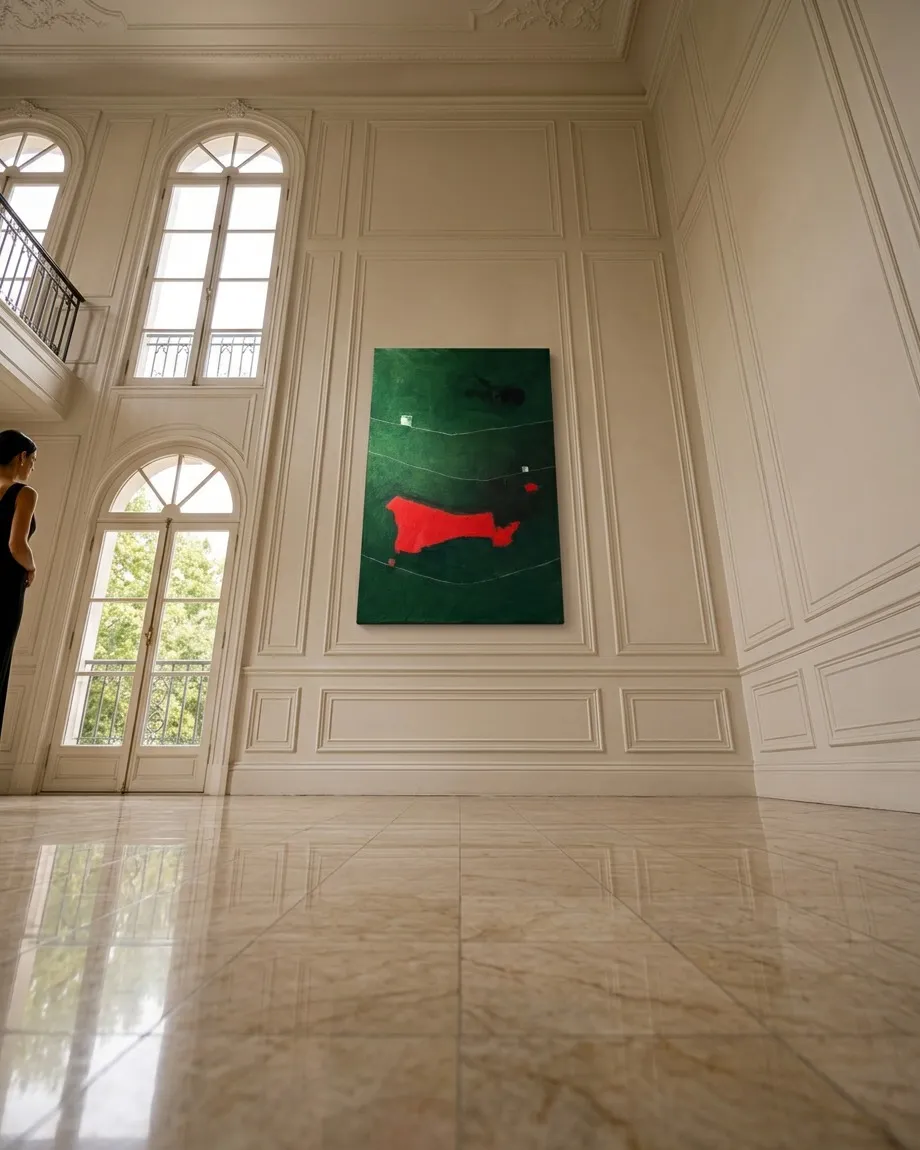
Context study / Sogno di un filo teso
Abstract Painting Sogno di un filo teso by Maurizio Valch
Movement 1: The Green Abyss and the Intuition of the Limit
Facing a canvas of 80 by 120 centimeters, the viewer's body is forced to step back to calibrate the distance. We are not in front of a window, but a geological depth suspended on the wall. The background of "Sogno di un filo teso" is a dense green, almost black in its upper strip, which does not evoke chlorophyll nature, but the viscosity of an abyssal ocean or an atmosphere charged with magnetism where light seems to have been trapped.
To navigate this plane, we need the company of Immanuel Kant, the thinker who taught us to question the limits of our own mind and to understand space not as an empty outside, but as the internal structure with which we order the chaos of the world. From a Kantian perspective, this green abyss is not a landscape; it is the representation of pure sensibility before reason intervenes. It is the a priori emptiness.
Silence, however, and absolute emptiness are intolerable to human consciousness. We need reference points, coordinates that allow us to inhabit immensity without losing our minds. That is where "il filo" (the thread) intervenes: that whitish, extremely light, and tense line that cuts through the density of the green. The line does not decorate the space; it founds it. By tracing that thread, the canvas ceases to be an unfathomable abyss and becomes a territory where up and down, fall and resistance, finally exist. It is thought's first attempt to delimit the unknowable.
Movement 2: The Red Anomaly and Infinite Partitions
At the exact center of this atmosphere sits a red mass, an island of burning temperature that breaks the monotony of the background. Next to it, small geometric blocks rest on the threads as if they were weights on an invisible balance. To decipher this physical distribution of forces, we summon Srinivasa Ramanujan, a man who did not deduce mathematics, but received them in dreams as visions of an infinite and sacred order that sustains the entire universe.
For the Indian mathematician, each of these elements on the line would represent not a dead geometric figure, but a "partition": the division of a totality into parts that, added together, restore a secret harmony. The red mass, off-center but stable, and the small fragments flanking it function as a visual equation where masses are miraculously balanced. The thin thread, far from breaking under the weight of this dense block, seems to be charged with an arithmetic tension, holding the weight through a relationship of distances that escapes the logic of ordinary physics.
When I faced that green abyss, I felt a vibration that demanded to be interrupted by a wound of heat. Holding my gaze on the canvas before applying the red was an exercise in pure mental gravity; I needed that mass to float without sinking, to have a real but unsustainable physical weight, a dense body that would test the entire surrounding space even before knowing how I was going to sustain it.
Movement 3: The Resistance of the "Filo Teso"
If we get close enough to the canvas, the illusion of perfect geometry vanishes. The "tense thread" that gives the title to Maurizio Valch's work is not a vector, cold, and mathematical line. It trembles. In its horizontal path, it curves slightly, yielding to the red mass and the small satellites that accompany it, registering in an almost biological way the effort of sustaining matter.
Here is where a naive but fundamental question arises: why doesn't the red sink into the green? If we were to remove that thin white line, our mind would immediately assume that the red block would fall into the void, absorbed by the density of the background. The thread, therefore, is not a mere pictorial stroke; it is a metaphysical scaffold. It shows us that the order of our reality is astonishingly fragile and that the distance between balance and collapse depends on extremely thin filaments.
Only much later, contemplating the finished work under another light, did I understand that those fine lines were not simple spatial divisions, but the involuntary record of a pulse I did not control. Those strokes that tremble under the weight of the red are silent formulas, a dream of mathematical balance that was traced through my hand as if the canvas itself needed to invent its own resistance so as not to collapse into the void.
In the end, as we step away from "Sogno di un filo teso", we are left with a disturbing suspicion. The painting confronts us with the suspicion that our own daily certainties—language, the laws of thought, the structures that sustain us—are nothing more than extremely fine threads suspended over an unfathomable background. And it forces us to ask ourselves, with a mixture of fear and wonder, what would happen if one of them broke tonight.
- Original artwork
- Sogno di un filo teso
- Actual dimensions
- 31.5 × 47.2 in / 80 × 120 cm
- Presentation
- Digital contextual visualization
Context references
Sogno di un filo teso artwork · abstract painting for high ceiling living rooms · Maurizio Valch paintings · green minimalist contemporary art · interior design with large format abstract art
About this visualization
This visualization places the artwork within an architectural context to help collectors and viewers imagine its presence in a real space. It is an interpretive reference, not an exact reproduction: the original work remains the sole authority for scale, color, surface and material presence.