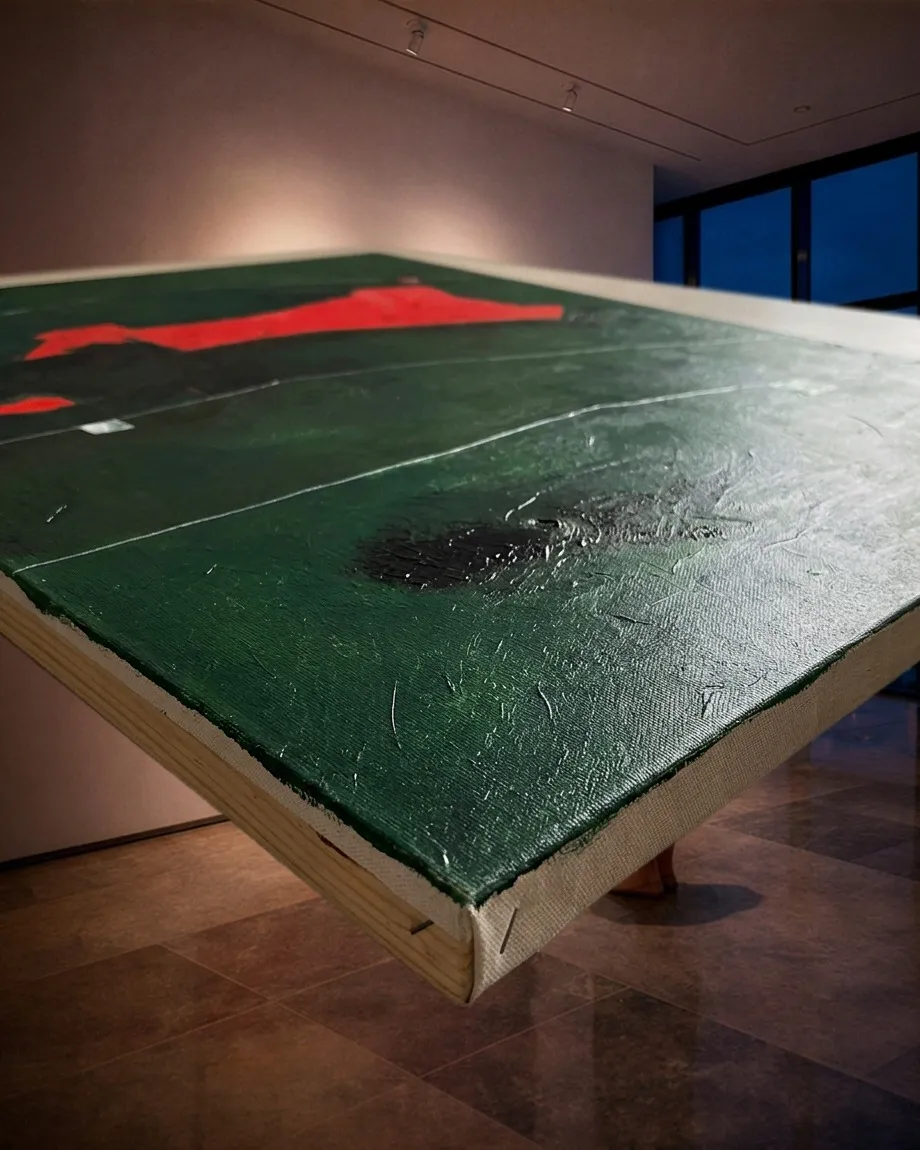
Context study / Sogno di un filo teso
Sogno di un filo teso - Maurizio Valch | Original Artwork
In the dense materiality of Sogno di un filo teso, an abyss of deep, geological green stretches across the surface, interrupted only by the organic vibration of a red mass that seems to emerge from a black shadow. This spatial arrangement immediately evokes the primordial gesture of cartography: the dream of a taut thread as the first human intervention aimed at measuring, partitioning, and structuring the chaos of wild nature. Like Paleolithic hunters or Neolithic builders tracing furrows to found a sacred or habitable space in the midst of the vastness, the work sits at the exact boundary where order attempts to domesticate matter. The three horizontal lines crossing this territory are not superficial additions, but real incisions dividing the pictorial plane, supporting a series of geometric blocks that float in a precarious, calculated stillness.
For me, the act of painting has never been a mere representation of forms, but a physical excavation into successive layers of a green that I accumulate like sediment and which actively resists being ordered. By dragging the tool over this wet, resistant topography, I do not seek to trace an ideal boundary, but to open an actual wound in the paint, leaving incised marks that split the surface and reveal the hidden tension of the canvas. That taut thread, that sharp edge (filo teso), functions as a navigational guide and, at the same time, as a physical scar marking the territory. Each incised mark is the record of a force, an instant of friction where the spatula cuts into the pigment to remind us that, even in the densest night of matter, there is the possibility of charting a course and sustaining the weight of the world on a thin line.
This confrontation between the rational line and overflowing matter opens a rift for debate between two visions of the psyche. On one hand, the thought of George Gurdjieff, the mystic who questioned the automatism and constant state of sleep of human beings, invites us to contemplate these incised marks as the wires of an invisible power grid that keeps us ordered but deeply asleep in our own mechanical nature. On the other hand, the psychology of Carl Gustav Jung, with his exploration of the collective unconscious and archetypes, pushes us to see in the large red patch an intrusion of the Shadow or a manifestation of the Self, a magma of libido bursting from the darkness, resisting domestication by the mental map of consciousness. The canvas thus becomes the stage for an internal rebellion, where the order of the thread and the force of the red impulse compete to inhabit the space.
In the scale of this dream, the small light and reddish blocks hanging from the lines are not mere chromatic accidents, but representations of primitive shelters, guard posts, or beads of a forgotten necklace dangling over the void. As part of my SITUS series, this work does not pretend to illustrate a psychological theory or resolve a philosophical dilemma; it is a purely physical question about what it means to occupy a place, resist on the margin, and hang suspended over the immensity of a green abyss. By suspending these minimal geometries on the thread of the incision, I present painting as an act of material resistance where human existence recognizes itself as fragile and exposed, yet firmly bound to a structure it has chosen to trace.
In the end, when theories dissolve into the silence of the room, the work returns us to its strict physical presence, to the edge of the stretcher where the folded canvas reveals its nature as an object. In this return to matter, the great paradox of painting is manifested: that thread which seems always on the verge of breaking is, in reality, the only element holding the entire structure together, preventing the green from devouring the red and the space from collapsing. Contemplating the work places us before that same unsustainable tension, suspended between the open wound of the incision and the depth of a void that the painting has no intention of resolving.
- Original artwork
- Sogno di un filo teso
- Actual dimensions
- 31.5 × 47.2 in / 80 × 120 cm
- Presentation
- Digital contextual visualization
Context references
Maurizio Valch Sogno di un filo teso · green and red abstract painting · abstract art with incisions · large format minimalist abstract paintings · contemporary geometric and material abstraction · dark green color field painting
About this visualization
This visualization places the artwork within an architectural context to help collectors and viewers imagine its presence in a real space. It is an interpretive reference, not an exact reproduction: the original work remains the sole authority for scale, color, surface and material presence.