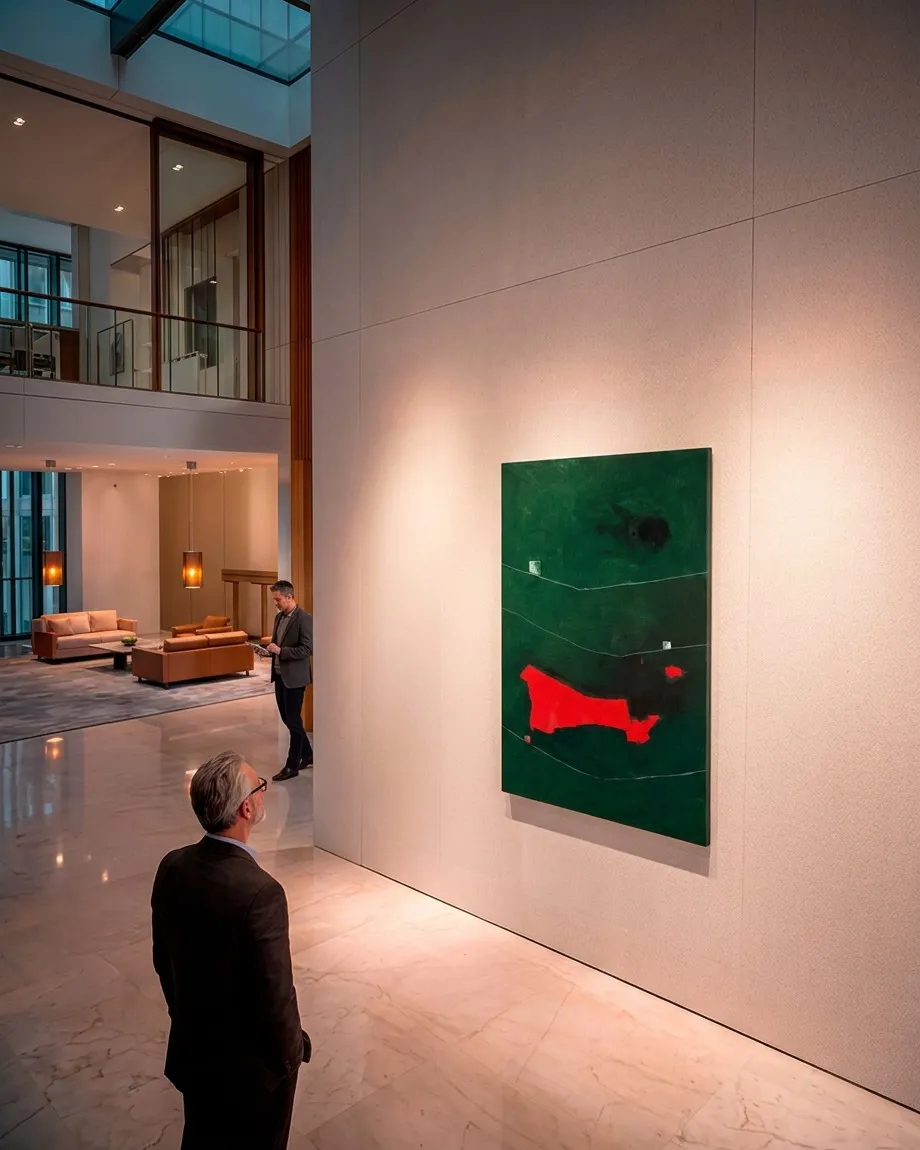
Context study / Sogno di un filo teso
Sogno di un filo teso - Maurizio Valch | Original Artwork
To enter the space of "Sogno di un filo teso" is to renounce the haste of the eye that seeks to classify. There is no landscape to recognize here, but an atmosphere to tune into; a green force field that seems to emit a low, magnetic hum. To navigate this work by Maurizio Valch, we must let ourselves be guided by its own structure: three thin white lines that, like the strings of an invisible instrument, sustain the tension of this entire visual universe.
First movement: The upper line (Weightlessness and detail)
In the upper part of the canvas, the olive green becomes dense, almost nocturnal. There floats a dark smudge, a cloud of concentrated pigment that generates a silent gravity in the upper right corner. Just beneath this suspended magnetism, the first white line crosses the painting. It is an extremely fine line that challenges the vastness of the background. On it, almost in the center, rests a tiny pale cube, a point of light balancing in the void.
Observing this delicate play of forces, summoning the mind of Italo Calvino becomes almost inevitable. He was an Italian writer obsessed with lightness, exact geometry, and invisible cities, whose gaze helps us decipher the tension of the thread in the painting as if it were a subtle structure suspended in the void. Calvino would approach the canvas looking for the hidden rule, trying to measure the exact distance between the small cube and the edges, convinced that this painting is the blueprint of an aerial utopia where things float to avoid being crushed by the weight of the world.
However, beside him, the sensibility of Franz Schubert interrupts this geometric fascination. He was an Austrian composer endowed with a unique sensitivity for creating melodies suspended between melancholy and abrupt interruption, teaching us to listen to the dense silences that inhabit the space between each note of color. For the musician, that small pale cube on the thread is not a spatial coordinate, but a solitary, suspended note: the beginning of a chord that fears breaking if the line gives way. While Calvino searches for the structure of the map, Schubert half-closes his eyes to hear the wind brushing against that taut filament.
> When I press the fine brush to trace that first white line, my pulse trembles not out of fear, but out of respect for the density of the green I have just built. It is an instant of pure uncertainty: dragging a sliver of light over a wet abyss, knowing that the oil has its own will and that, in the end, part of this trace will escape my control entirely, sinking or floating according to the secret laws of matter.
Second movement: The middle line (The abyss and the red vibration)
Descending toward the central part, the apparent calm of the green breaks dramatically. Here, the second white line delimits an abyss where an overwhelming visual event intrudes: a large mass of fiery red color. It is not a smooth surface; it is an irregular body, with frayed edges, vibrating with a temperature completely different from its surroundings. It seems to weigh a great deal and, at the same time, float like magma cooling in water. To its right, a smaller red patch seems to have detached from the main mass, while another tiny pale flash watches from above.
Faced with this thermal collision, a disarming, almost childlike question arises: Is this green background a dense forest seen from an airplane window in the middle of the night, or are we submerged in water so deep that light barely remembers how to exist? And that small red block on the right, will it eventually slip from the thread and fall into the void?
For Calvino, this red intrusion is an accident that breaks the order of his map; an unexpected continent that deforms the lines of tension with its unforeseen mass. Schubert, on the contrary, smiles at the disruption. For him, this red is a sudden fortissimo, a warm, dissonant chord that tears through the long, dull silence of the olive green. The vibration of the red is not an aggression, but proof that the canvas is alive, beating with the urgency of a pulse that resists being contained by the geometry of the thread.
Third movement: The lower line (The fall and the residue)
In the final band of the painting, gravity finally claims its right. The third white line no longer remains rigidly horizontal; it curves subtly downward, yielding to the weight of everything occurring above it. On its far left, barely supported on the fading thread, rests a minute red fragment, a thermal residue that seems to have dripped from the large central mass.
Where does the gravity of this painting fall? It does not fall toward solid ground, but toward a background that continues infinitely beyond the frame. Here, the green becomes denser, almost chewable, as if matter were accumulating at the bottom of the painting, waiting for the next movement.
> I listen to these two masters debating my work and smile in the silence of the studio. For me, that red is not a calculated musical note or a geographical coordinate; it is a pure intrusion, a foreign body beating stubbornly in the folds of my memory, resisting any rational explanation. I do not know if it supports the thread or if the thread is strangling it; I only know that I needed that thermal strike so that the green would not devour itself in absolute immobility.
As we step away from the painting, the tension remains unresolved. Maurizio Valch's threads remain taut, sustaining that impossible dialogue between the order of the line and the disorder of the burning patch. The viewer is left with the vibration of that red color suspended in the green, a dream that does not seek to be decoded, but contemplated in its fragile, beautiful, and unfinished resistance.
- Original artwork
- Sogno di un filo teso
- Actual dimensions
- 31.5 × 47.2 in / 80 × 120 cm
- Presentation
- Digital contextual visualization
Context references
abstract paintings for modern living rooms · material abstract painting · Maurizio Valch original art · decorating ideas with green and red art · large minimalist canvas
About this visualization
This visualization places the artwork within an architectural context to help collectors and viewers imagine its presence in a real space. It is an interpretive reference, not an exact reproduction: the original work remains the sole authority for scale, color, surface and material presence.