Context study / Sogno di un filo teso
Maurizio Valch - Sogno di un filo teso in Courtyard of Arches
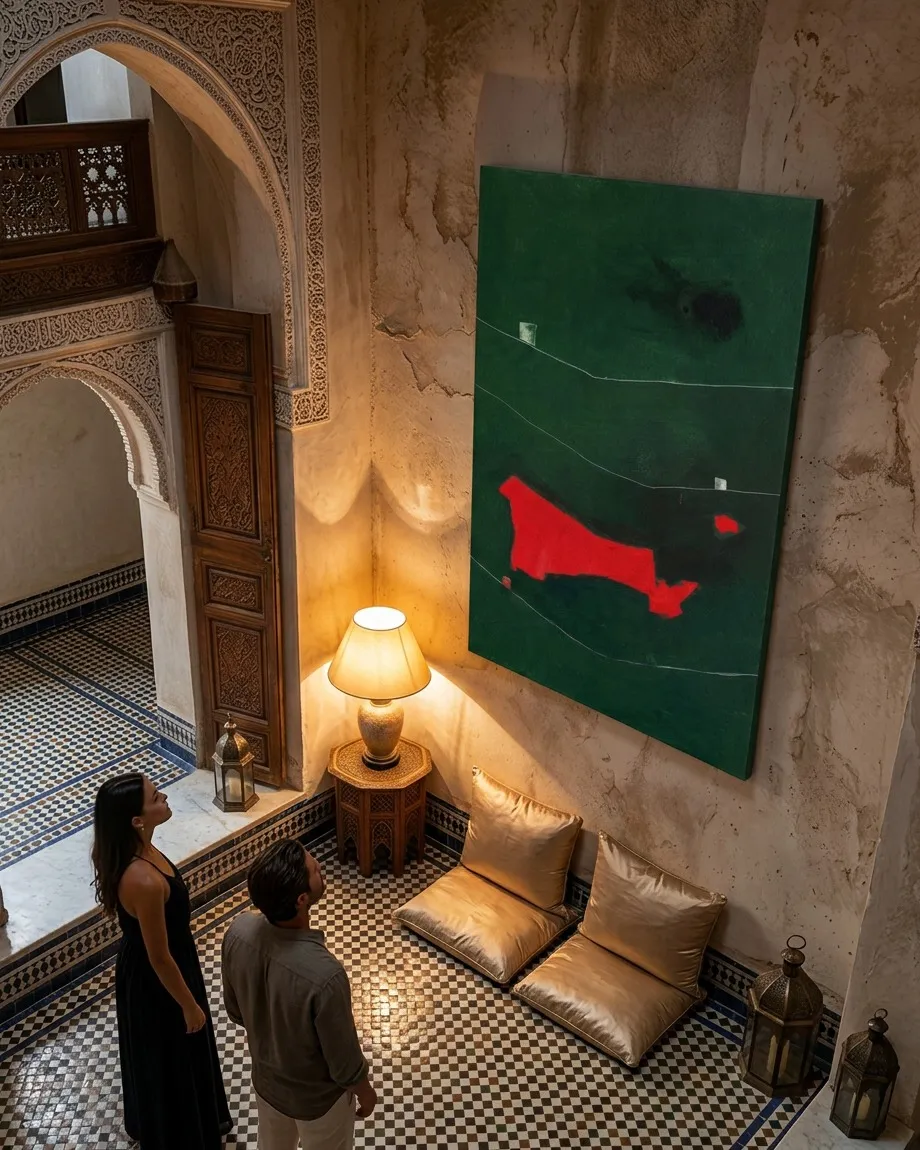
Under the warm, raking light of a courtyard of arches and tiles, Sogno di un filo teso behaves as a concentrated psychological presence rather than an illustrative representation. The immense green field does not describe a navigable geography; it absorbs the silence of the surrounding architecture, turning the space into an atmospheric resonance chamber. Here, emotion is not explained, decorated, or organized into a narrative sequence. It exists as a physical density, a dark and vegetal mass that weighs upon the gaze, anchored by the irregular intrusion of a red patch in the lower half. This monumental scale, revealed by the physical proximity of viewers in the room, demonstrates how a painting can sustain the gravity of an interior state without needing to translate it into anecdotes.
When I accumulated those layers of dense green on the canvas, I was not looking to illustrate a specific memory, nor did I intend for the color to function as a vessel for a concrete sadness or hope. The pigment became heavy under the spatula, offering a material resistance that demanded a stillness that my own mind did not possess at that moment. I remember the physical sensation of searching for a limit, the almost biological need to trace those fine white lines to sustain the balance of a surface that threatened to close in on itself entirely. Those lines are not the map of an external journey; they are the record of a pulse attempting to keep breathing in the face of the vastness of the void.
This renunciation of anecdotal explanation brings the work close to the sensibility of Mark Rothko, for whom color did not decorate a space but constituted a direct emotional event. However, while Rothko dissolves the limits of his chromatic fields into a mystical vibration, Maurizio Valch's painting retains a geological, inaccessible weight. The crimson mass does not float etherally; it imposes itself with the viscosity of a stratum that has risen to the surface under enormous internal pressure. The small light blocks orbiting near the white filaments do not function as symbols of salvation, but as points of tension that force the eye to measure the distance and effort sustaining the entire structure.
I look now at that red intrusion, suspended in the shadow of the weathered wall, and recognize the speed with which thought attempts to manufacture a theory to domesticate what unsettles us. Someone will want to see a wound there, a territory in conflict, or the memory of a personal shipwreck in distant lands. For me, the pictorial fact ended when that red patch refused to be modified further, claiming its own stubborn irregularity against the tyranny of the green order. It is a fact, not a metaphor for my biography. If I try to give it a psychological name, I only manage to bury the direct experience of the matter under a noise that belongs to my interpretations and not to the canvas.
In this particular presentation, contemplating the work from the scale of the viewer looking up at the large format, the final white line reveals its true somatic function. As it curves steeply toward the bottom edge, that thin incision records a force of gravity that we do not see but experience in our own muscles. The emotion condensed in Sogno di un filo teso remains active precisely because it offers no dramatic resolution or reconciliation of its opposing forces. It leaves us on the threshold, forcing us to sustain our gaze before the unfinished conflict between the stillness of the green and the fire of the red, where feeling ceases to be a story and becomes, simply, a place.
- Original artwork
- Sogno di un filo teso
- Actual dimensions
- 31.5 × 47.2 in / 80 × 120 cm
- Presentation
- Digital contextual visualization
Context references
paintings for rustic environments · abstract art in traditional decor · green and red living room painting · Maurizio Valch original artwork · decoration with tiles and paintings
About this visualization
This visualization places the artwork within an architectural context to help collectors and viewers imagine its presence in a real space. It is an interpretive reference, not an exact reproduction: the original work remains the sole authority for scale, color, surface and material presence.