Context study / Sogno di un filo teso
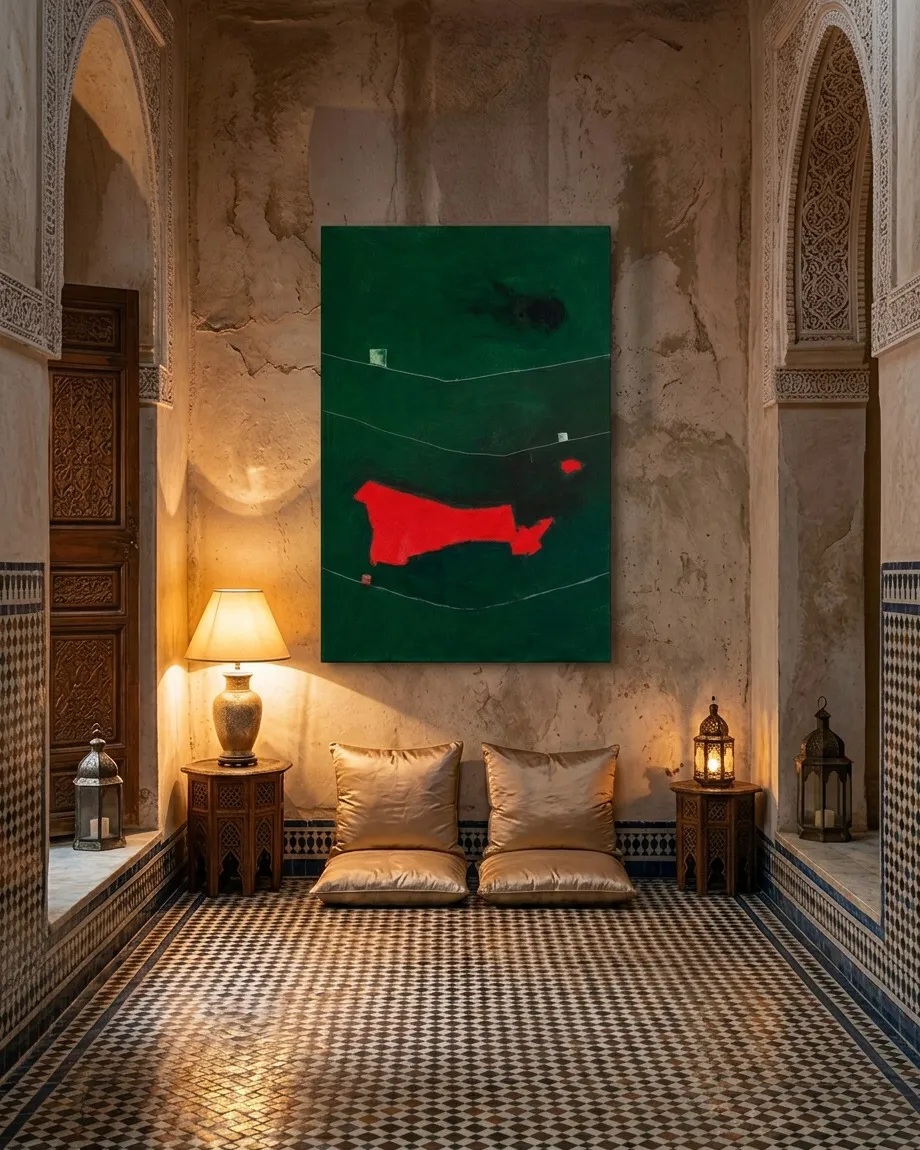
Sogno di un filo teso by Maurizio Valch in a traditional interior courtyard
An identity is not built on a list of dates, certificates, or geographical moves, but on the silent sediment that those displacements leave behind when the noise of anecdote is quieted. Installed in the warm twilight of this space with worn walls and geometric mosaic floors, Sogno di un filo teso behaves like the vertical cartography of an unwritten life. The immense green-black field is not an empty landscape, but the density of accumulated hours, of slow walks along ancient paths where apparently nothing happened. Here, biography does not need to declare its milestones—the five Caminos de Santiago, the long bicycle routes, or the changes of country—because it has translated into pure pictorial gravity, a physical presence that demands space and silence rather than a rational explanation.
I have spent years moving, abandoning houses, transitional rooms, and cities, always tempted to believe that my existence was a grand epic that required telling. However, when I confront the canvas, all those narratives collapse; the path ceases to be a line on the map and becomes a material resistance, a tension that I must sustain with my pulse. Tracing those thin white threads that cross the green space was not an attempt to illustrate an external journey, but to record the exact effort of maintaining balance when everything around seems to pull downward. It is in subtraction, in the decision not to paint the dog, the bicycle, or the room I left behind, where my truest trace remains: not as a story, but as the mark the tool leaves when cutting through the color.
The great red mass that breaks into the lower half of the composition operates as a thermal disturbance, a collision of dense fire against the contemplative sobriety of the background. This irregular block does not illustrate a specific conflict or a concrete psychological wound, and yet it carries the weight of those periods of emergency where the need to survive forces the reorganization of the entire territory. In this riad environment, under a lateral light that grazes the texture of the paint, the work reveals its condition as a three-dimensional body. The small light-colored tesseræ floating near the lines function as signaling buoys or support structures; they are discreet boundaries that, like the artist's daily responsibilities toward his animals, prevent the composition—and perhaps experience itself—from dissolving into an undecipherable abyss.
I remember the vertical pressure of those difficult periods in which the urgency of resolving the day left no room for theories or existential justifications. That red block, which seems to float or sink depending on the hour of the afternoon, comes from that state of raw experience, where the body simply acts and resists on the ground it has had to inhabit. It is easy for thought to build a convincing theory afterward about who I am and what my falls mean, but the canvas does not know how to lie: it only retains the viscosity of the oil, the speed of the scraping, and the coldness of the accumulated pigment. In the end, my painting is autobiographical because it contains the exact measure of my limits, the real wear of my hands in the studio, and that silence that only arrives when the mind understands its own noise.
In the bottom strip of the painting, the last white line curves pronouncedly, overcome by a gravitational force that we do not see but intuit as inevitable. Contemplated from the height of someone resting on the cushions of this architectural refuge, Sogno di un filo teso invites us to inhabit a territory free from the directives of the map. It does not propose a moral lesson, a hero’s triumphant return, or a comforting resolution for the viewer. By evading the trap of narration, Maurizio Valch's work keeps biography open, suggesting that a life is not a succession of conquered peaks, but a fragile thread stretched over a silent depth, waiting for the next shift in the wind to force us to seek a new direction.
- Original artwork
- Sogno di un filo teso
- Actual dimensions
- 31.5 × 47.2 in / 80 × 120 cm
- Presentation
- Digital contextual visualization
Context references
decorating with abstract art and mosaics · large paintings for textured rustic walls · interior design with floor cushions and arab lamps · integrating contemporary painting into traditional spaces
About this visualization
This visualization places the artwork within an architectural context to help collectors and viewers imagine its presence in a real space. It is an interpretive reference, not an exact reproduction: the original work remains the sole authority for scale, color, surface and material presence.